
Power from an underwater volcano: 8.7 seconds of net output 1,500 metres down – what the subsea geothermal test showed, and what a commercial plant still needs
260 °C water, a 16-metre well, 26,000 rpm, remote-controlled from Seattle. Why subsea geothermal energy is promising and hard, and the difference between a test and a power plant – with sources, without hype.
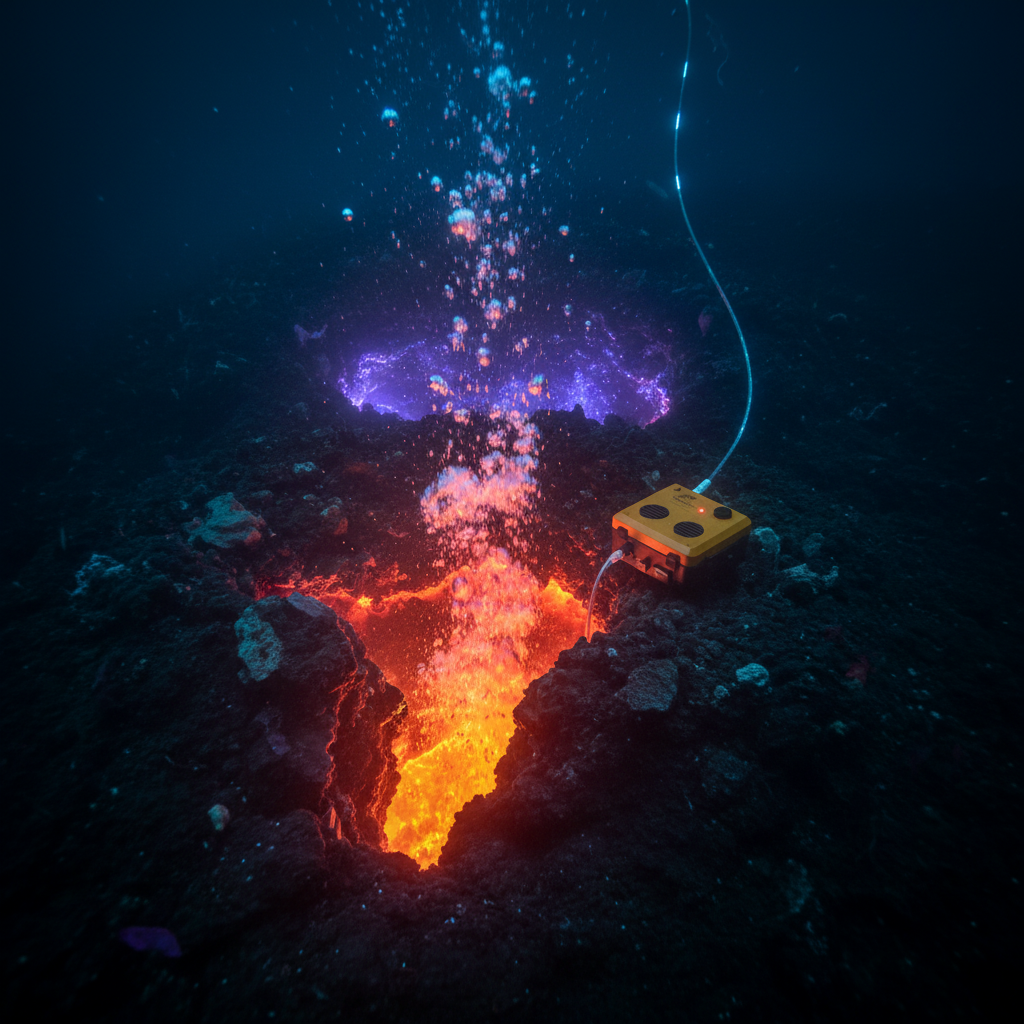
On 20 October a Seattle start-up, Endurance Energy, said it had drilled a geothermal well in the crater of an underwater volcano and, with a small plant placed on the seafloor, briefly produced more electricity than it consumed. The company calls it the first complete subsea geothermal test, from drilling to generation. This article summarises the numbers, explains how it works and shows what is still missing for a real power plant.
| Fact sheet | |
|---|---|
| Site | Axial Seamount, about 300 miles (480 km) off the Oregon coast |
| Depth | about 5,000 ft (1,500 m) below sea level |
| Well | 52 ft (16 m) below the seabed, lined with steel pipe |
| Water from the well | 260 °C (500 °F) |
| Source used | natural hydrothermal vent, about 281 °C |
| Net output | median about 2 kW, peak 16.5 kW |
| Net-positive time | 8.7 seconds |
| Test ended | 27 September; announced 20 October |
Sources: World Oil, 20 Oct, Interesting Engineering, 20 Oct.

What happened on the seafloor
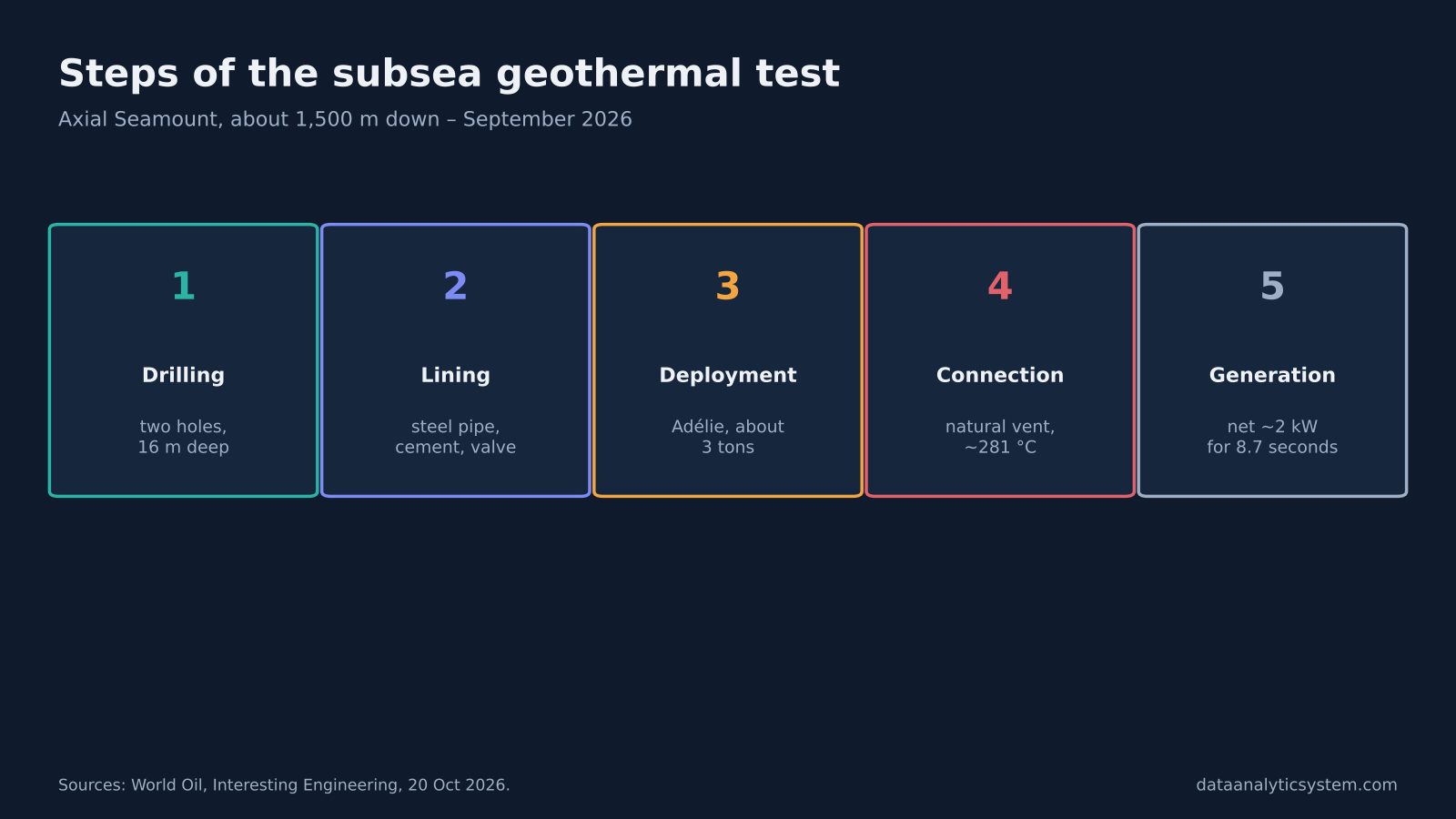
Based on Interesting Engineering and World Oil, the test went like this:
- A robotic drilling machine resting on the seabed drilled two closely spaced holes in the crater; both reached hot, mineral-rich water.
- The well was lined with steel pipe, cemented, and fitted with a valve.
- A test plant weighing about 3 tons, called Adélie, was lowered to the seafloor from a ship.
- Because the new well did not deliver enough flow, the team connected the plant to a nearby natural hydrothermal vent.
- The turbine reached about 26,000 rpm, and for 8.7 seconds the system produced more electricity than it used.
The equipment was started, stopped and monitored from Seattle, over the Regional Cabled Array, an undersea fibre-optic network owned by the US National Science Foundation (NSF).
Why subsea geothermal is interesting
A geothermal plant turns the Earth's internal heat into electricity: hot water or steam drives a turbine. On land this often means drilling kilometres deep. At underwater volcanoes, the hot layer lies close to the seabed – here a 16-metre well delivered 260 °C water.
According to the company, a commercial system could provide continuous, weather-independent power for coastal grids, industrial sites and data centres around the Pacific. That is the company's stated aim, not a measured result.
What did not go well – and why that is data too
The sources do not hide the problems:
- the first generation run was ended by the battery's overcurrent protection;
- during a restart attempt, a refrigerant pump cable failed;
- the company itself named mineral build-up and heat-transfer problems.
According to World Oil, the company says the three-week deployment produced data on drilling, well flow, heat transfer, mineral build-up and remote control. In a test like this, that is the main outcome: not the amount of electricity, but that the whole chain ran end to end once.
Test versus power plant: the orders of magnitude
A quick illustration, by this article's own calculation: 2 kW for 8.7 seconds is about 0.005 kWh of energy – roughly what a 10-watt LED bulb uses in half an hour. The company's planned commercial generator, Leopard, would be 2 MW, a thousand times the measured median output.
Next steps, according to World Oil:
| Step | What is known |
|---|---|
| Gentoo | upgraded Adélie, deployment planned this winter |
| Drilling | the current system can drill to 80 m |
| Leopard | 2 MW commercial generator, in development |
| Tonga | first commercial project, first power planned for 2027 |
5 things many people don't know
- The power did not come from the new well. The well delivered too little flow, so the plant was connected to a natural vent.
- The control room was 480 km away. The equipment was operated from Seattle over an undersea cable.
- The volcano is active. Axial Seamount is an active underwater volcano in the Pacific.
- The peak was eight times the median. Net peak output was 16.5 kW, against a median of about 2 kW.
- The company was founded in January 2025. Endurance Energy has existed for less than two years.
Summary
- Axial Seamount, about 1,500 m down: a 16 m well, 260 °C water.
- Net output: median about 2 kW, for 8.7 seconds.
- Problems: battery protection, a cable failure, mineral build-up, heat transfer.
- Plans: Gentoo this winter, the 2 MW Leopard, Tonga in 2027.
Related reading: Blog archive.
Educational content. Not investment advice. This article describes the company's statements and press sources; future plans are the company's aims, not verified results. Data Analytic Investments is not affiliated with Endurance Energy, the NSF or the portals cited; names are used for identification only. Images labelled "AI illustration" are not photographs.
Continue on DAI
Explore Topics
Written by
Data Analytic Investments
Content creator and writer sharing insights and stories.