
ECB decision, 29 October: deposit rate held at 2.50%, Lagarde to step down in February
A hike in September, a pause in October. What the ECB wrote about energy prices and inflation, and what Lagarde said about the decision and her own departure – with sources, without forecasts.

On 29 October the Governing Council of the European Central Bank (ECB) left all three key interest rates unchanged. Another piece of news overshadowed the decision: the same day Christine Lagarde said she will step down as ECB President on 7 February 2027. This article describes both events from the official texts and press reports. It offers no forecast of its own.
| Fact sheet | |
|---|---|
| Deposit facility rate | 2.50% (unchanged) |
| Main refinancing rate | 2.65% |
| Marginal lending rate | 2.90% |
| Previous move | 10 September 2026: +25 basis points |
| Inflation, September | 3.8% (August: 3.2%) |
| Energy inflation, September | 18.9% (August: 14.3%) |
| Lagarde's departure | 7 February 2027 |
Sources: ECB press release, 29 Oct, ECB monetary policy statement, Euronews, 29 Oct.

What the ECB decided
According to the press release, the deposit facility rate stays at 2.50%, the main refinancing rate at 2.65% and the marginal lending rate at 2.90%. The text says the ECB is not pre-committing to any particular rate path: decisions are data-dependent and taken meeting by meeting. These levels have applied since September. According to Euronews, this was the first pause after two hikes this year.
At the press conference Lagarde said the Governing Council had discussed a possible hike but unanimously decided to hold. The next meeting is in December, with new staff projections.
What the ECB wrote about prices
September figures from the monetary policy statement:
| Measure | August | September |
|---|---|---|
| Headline inflation | 3.2% | 3.8% |
| Energy | 14.3% | 18.9% |
| Excluding energy | 2.1% | 2.3% |
| Services | 3.0% | 3.2% |
| Food | 1.1% | 1.3% |
| Goods | 1.2% | 1.1% |
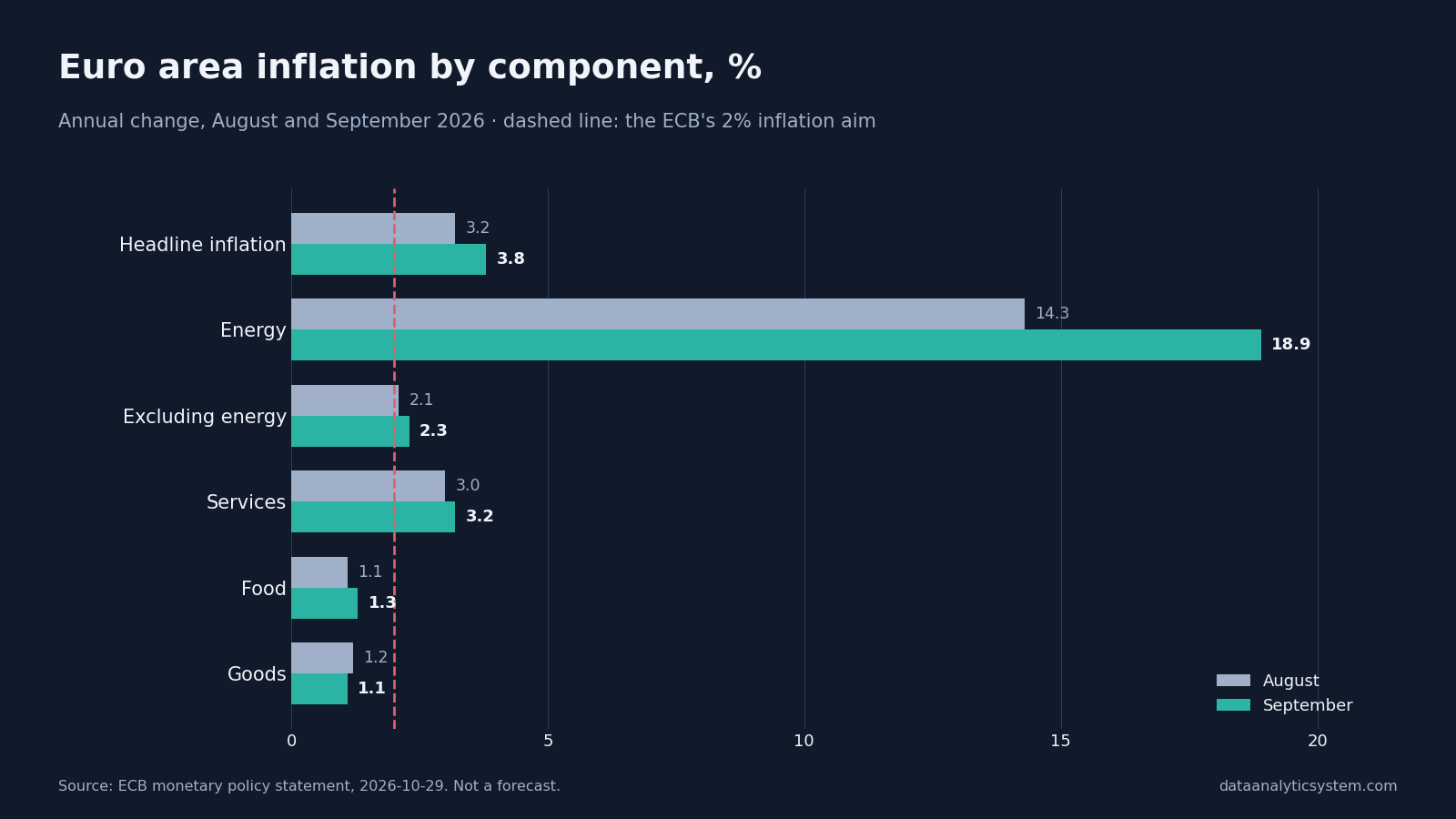
Against the ECB's 2% inflation aim, 3.8% is almost double. The table shows that most of the rise comes from energy: inflation excluding energy is 2.3%. The ECB's text says energy prices have continued to rise, an upside risk to inflation and a downside risk to growth. Underlying inflation measures have so far been broadly stable, and wages have not yet responded materially.
Wages and financing
- Compensation per employee rose 3.3% in the second quarter, after 3.6% in the first.
- The ECB wage tracker points to 2.5–2.8% for the rest of 2026.
- Unemployment was 6.4% in August.
- 10-year sovereign borrowing costs have risen by about 35 basis points since the cut-off for the September projections.
- Mortgage rates were 3.6% in August, against 3.5% in July.
Source: ECB monetary policy statement.
Lagarde's departure
According to Euronews, Lagarde leaves on 7 February 2027, about nine months before her eight-year term ends. At the press conference she said she would step down after the February monetary policy meeting and wants to be free to speak on matters beyond monetary policy. The Irish Times reports that some accounts link the early exit to France's presidential election in spring 2027; the ECB itself gave no reason.
On the succession, the sources opened for this article say:
- former Dutch central bank governor Klaas Knot and former Spanish governor Pablo Hernández de Cos are named as front-runners;
- Executive Board member Isabel Schnabel leaves a year early, in January, to join the IMF;
- the term of chief economist Philip Lane ends in May.
So three of the six Executive Board seats could change hands in the first half of 2027.
The French background
According to Euronews, France's 10-year borrowing cost rose above 5% the previous week for the first time since 2002, with a spread of about 155 basis points over German debt. ING estimated that the rise in borrowing costs since September did the work of a 25 basis point central bank hike in Germany and closer to 50 in France. The ECB press release notes that the Transmission Protection Instrument (TPI) remains available against disorderly market dynamics. According to Euronews, it has never been used.
5 things many people don't know
- There are three rates, not one. The ECB sets the deposit, main refinancing and marginal lending rates together; markets mostly watch the deposit rate.
- The balance sheet keeps shrinking. The ECB no longer reinvests principal from maturing securities, so APP and PEPP holdings decline gradually.
- 2.50% is the top of the neutral range. According to the Irish Times, this is the upper end of the range the ECB considers neutral.
- Market rates tighten too. ING says the bond-market move had an effect similar to a rate hike.
- The Governing Council decides for 21 countries. That is how many use the euro, according to Euronews. Hungary is not in the euro area; forint rates are set by the MNB.
Summary
- The ECB kept the deposit rate at 2.50% on 29 October, unanimously.
- September inflation was 3.8%; energy prices were up 18.9%.
- The ECB is not pre-committing to a rate path; the next meeting is in December.
- Lagarde leaves on 7 February 2027; the succession process has started.
Related reading: Fed decision, 28 October · MNB rate decision, October · Moody's: France Aa3 · Blog archive.
Data Analytic Investments is not affiliated with the European Central Bank or the portals cited; names are used for identification only.
Educational content. Not investment advice.
Continue on DAI
Explore Topics
Written by
Data Analytic Investments
Content creator and writer sharing insights and stories.