
Alphabet and Microsoft earnings: two companies, the same AI build-out, opposite free cash flow
Both companies published quarterly figures on 28 October, and on 29 October the stock market reacted in opposite directions. What capex is, what free cash flow is, and why the latter can be negative alongside strong revenue – with sources, without forecasts.

On 28 October both Alphabet and Microsoft published figures for the quarter ended 30 September. Both companies' cloud businesses grew fast, and both are spending record sums on data centres. Yet the market reacted in opposite directions: on 29 October, according to Yahoo Finance, Alphabet shares fell about 11% in morning trading while Microsoft's rose about 2%. This article puts the two reports side by side and explains the key terms. It offers no value judgement on either company.
| Fact sheet | Alphabet (Q3) | Microsoft (fiscal 2027 Q1) |
|---|---|---|
| Revenue | USD 127.6bn (+25%) | USD 92.3bn (+19%) |
| Cloud revenue | Google Cloud: 30.7bn (+103%) | Microsoft Cloud: 63.9bn (+30%) |
| Capex (property and equipment) | USD 51.4bn | USD 39.4bn |
| Operating cash flow | USD 42.3bn | USD 58.0bn |
| Free cash flow | −USD 9.1bn | about +USD 18.6bn (own calculation) |
Sources: Alphabet earnings release (SEC 8-K), Microsoft earnings release (SEC 8-K).

What capex and free cash flow mean
Capital expenditure (capex) is what a company spends on physical assets – here mainly data centres, servers and chips. Operating cash flow is the cash that actually comes in from day-to-day business. Free cash flow is the difference between the two. If capex exceeds operating cash flow, free cash flow is negative, and the gap has to be covered by borrowing, issuing shares or drawing on reserves.
Negative free cash flow does not mean a loss. Alphabet reported USD 26.2 billion of net income for the quarter, while its capex exceeded the cash coming in.
Alphabet's figures
According to the earnings release:
- revenue was USD 127.6 billion, against 102.3 billion a year earlier;
- Google Cloud revenue was 30.7 billion (15.2 billion a year earlier), with operating income of 11.1 billion (3.6 billion a year earlier);
- capex was 51.4 billion and operating cash flow 42.3 billion, giving free cash flow of −9.1 billion;
- earnings per share were USD 2.12, against 2.87 a year earlier – much of the gap comes from an USD 8.7 billion loss on the company's equity investments;
- headcount was 204,757.
According to CNBC, Alphabet keeps its 2026 capex range unchanged at USD 195–205 billion; the company said this amount will rise significantly in 2027. Yahoo Finance reports this was the second quarter in a row of negative free cash flow, and that the company issued USD 28.7 billion of bonds and raised 12.4 billion through at-the-market share sales.
Microsoft's figures
According to the earnings release:
- revenue was USD 92.3 billion (+19%), operating income 45.9 billion (+21%) and net income 36.6 billion (+32%);
- Microsoft Cloud revenue was 63.9 billion (+30%), and Azure grew 48%;
- commercial remaining performance obligations stood at USD 677 billion (+73%);
- additions to property and equipment were 39.4 billion, and operating cash flow 58.0 billion.
The free cash flow of 58.0 − 39.4 = USD 18.6 billion is an own calculation; Microsoft does not report this line. According to CNBC, capex including finance leases was 45.2 billion against analyst expectations of about 50.7 billion, and the company cut its full-year range to about 170 billion from about 175 billion. According to Newsquawk, the CFO said the shortfall came from some third-party capacity deliveries that were delayed.
What the comparison shows
| Question | Alphabet | Microsoft |
|---|---|---|
| Capex relative to operating cash flow | 51.4 / 42.3 ≈ 122% | 39.4 / 58.0 ≈ 68% |
| Cloud growth | +103% | Azure +48% |
| Funding in the quarter | bonds + share sales | operating cash |
Percentages are own calculations from the two earnings releases.
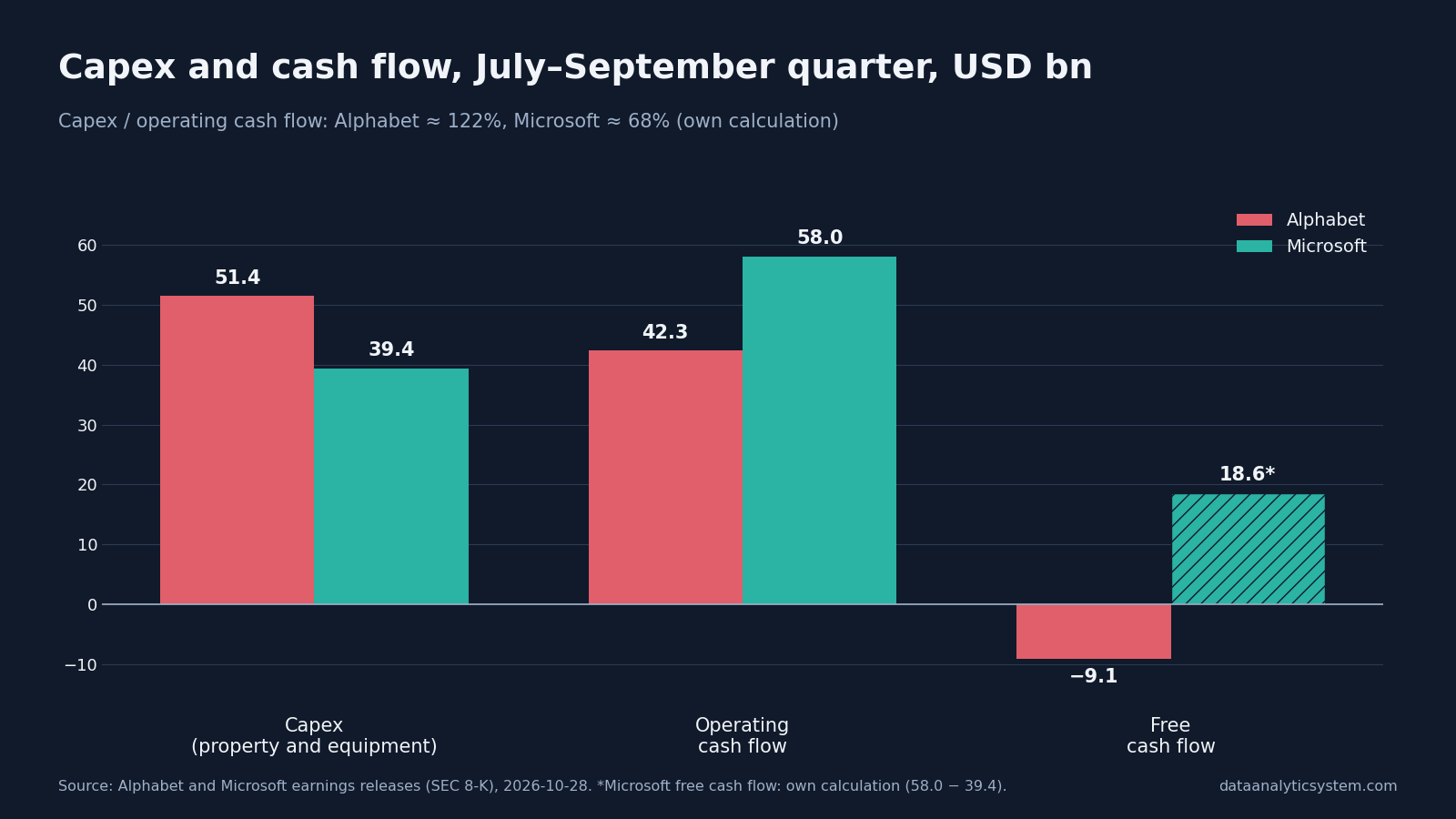
Yahoo Finance sums up the difference this way: Microsoft funds its AI build-out from operations, while Alphabet relies more on debt and share issuance. Neither company breaks out revenue or profit from AI infrastructure, so the return on the spending cannot be read from the reports.
5 things many people don't know
- The fiscal year is not the calendar year. Microsoft's year starts in July, so July–September is its first quarter of fiscal 2027.
- Leases can count as capex. Microsoft's release shows 39.4 billion of additions to property and equipment, while CNBC gives 45.2 billion including finance leases – which is why two numbers appear in the press.
- The investment loss is not operational. Alphabet's 8.7 billion loss came from its equity holdings, not from search or cloud.
- The contract backlog looks ahead. Microsoft's 677 billion of remaining obligations is signed but not yet recognised revenue.
- The share move differs by source. Yahoo reported about 11% in the morning; a CNBC headline mentions nearly 13% and about USD 500 billion of market value lost.
Summary
- Alphabet revenue grew 25% and Google Cloud 103%; free cash flow was −USD 9.1 billion.
- Microsoft revenue grew 19% and Azure 48%; free cash flow by own calculation was about +18.6 billion.
- Microsoft cut its 2026 capex range to about 170 billion, citing delivery delays.
- The return on AI spending is not measurable from the reports, because it is not disclosed separately.
Related reading: Fed decision and Big Tech earnings in one week · Anthropic S-1: what the prospectus shows · Blog archive.
Data Analytic Investments is not affiliated with Alphabet, Microsoft or the portals cited; names are used for identification only.
Educational content. Not investment advice.
Continue on DAI
Explore Topics
Written by
Data Analytic Investments
Content creator and writer sharing insights and stories.