Anthropic makes its IPO filing public: what an S-1 is, what the numbers show, and how a public benefit corporation and a multi-class share structure work
$16.3 billion in half-year revenue, an $80.7 billion net loss of which $72.4 billion is non-cash, a 22-bank syndicate, a price range left blank. What these lines in a prospectus mean – with sources, without assessing the stock.

On Monday 26 October 2026, the artificial intelligence developer Anthropic made public the S-1 registration statement it filed with the US Securities and Exchange Commission (SEC). The company plans to list on Nasdaq under the ticker ANT. According to TheStreet's market wrap, the news also moved the technology sector that day. This article explains what an S-1 is, what the document contains according to the press, and what its concepts mean. It does not assess the stock or forecast a price.
| Fact sheet | |
|---|---|
| Public filing | 26 October 2026 |
| Confidential draft | 1 June |
| Exchange, ticker | Nasdaq Global Select Market, ANT |
| Security | Class A common stock |
| Share count, price range | left blank |
| Lead banks | Goldman Sachs, Morgan Stanley (22-bank syndicate) |
| Revenue (Jan–Jun) | $16.3bn (a year earlier: $1.2bn) |
| Net loss (Jan–Jun) | $80.7bn, of which $72.4bn non-cash |
| Cash (30 Jun) | $112.4bn + $19.3bn short-term investments |
Sources: Northeast Times, 26 Oct, HNGN, 26 Oct — both citing the S-1.

What an S-1 is, and why it was confidential first
An S-1 is the registration statement a company must file with the SEC before listing on a US exchange. It contains the business model, financial statements, risk factors and ownership structure. US rules allow a company to submit a draft confidentially first; according to Futurum's June analysis, Anthropic did so in early June. After the public version comes the roadshow, where the company presents itself to investors, followed by pricing.
HNGN, citing unnamed sources, reports a roadshow starting on 9 November and a listing in the week of 16 November; the company has not confirmed this.
The numbers: revenue and loss
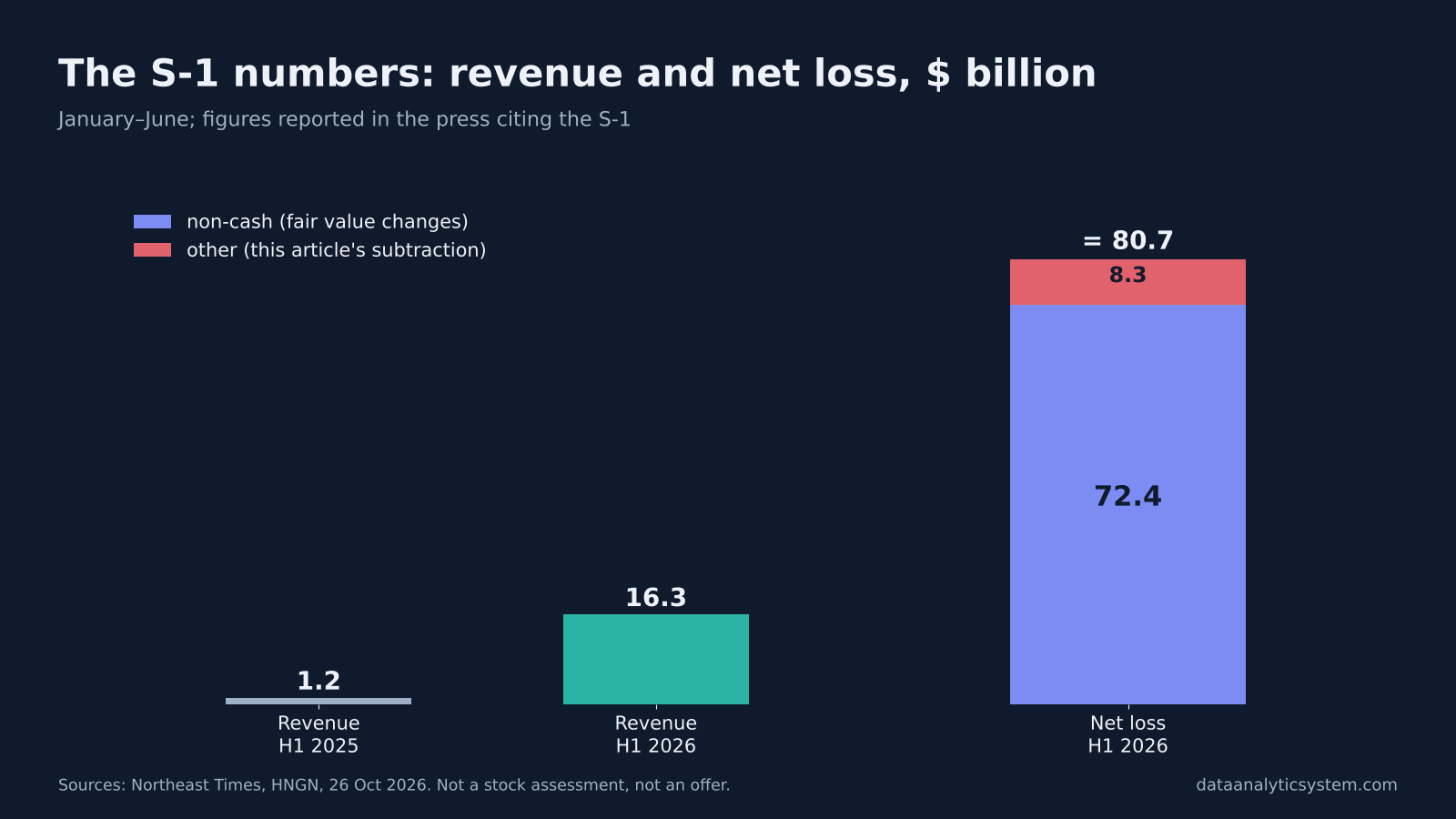
According to the Northeast Times, revenue for the half-year to 30 June was $16.3 billion, up from $1.2 billion a year earlier. By this article's division, that is roughly 13.6 times as much. About 80% of revenue ($13.1 billion) is consumption-based and $3.2 billion comes from subscriptions.
The net loss is $80.7 billion, but according to the source $72.4 billion of it comes from changes in the fair value of convertible notes and other instruments. That is a non-cash item: an accounting revaluation, not money paid out. By this article's subtraction, the remainder is about $8.3 billion. The operating loss is $693 million, while the company's "adjusted" operating income is a $1.6 billion profit – adjusted measures leave certain items out, so the two figures are not the same concept.
Who decides: the governance structure
Anthropic is a public benefit corporation under Delaware law. This is a company form whose directors must weigh a stated public benefit purpose alongside profit.
The sources describe two governance elements:
- Long-Term Benefit Trust. A body of five financially disinterested trustees that elects a majority of the board through a special class of stock (Northeast Times, HNGN).
- A Class F share. According to the Northeast Times, just before the offering a single such share will be issued to an entity owned by the seven co-founders, carrying 50.1% of the voting power on most matters.
The listed Class A stock carries one vote per share. According to the source, the prospectus's risk section itself states that the structure may effectively eliminate Class A holders' ability to influence important decisions. Under Nasdaq rules, such a company is a "controlled company".
Risk factors
According to the sources, the S-1's risk section mentions, among other things: a civil investigative demand from the Federal Trade Commission (FTC) received in October; litigation over a Defense Department designation; and that in the event of catastrophic model-related harm, no single insurer may have enough capacity to cover the liability. The company says its cash and revenue are sufficient for the next 12 months.
5 things many people don't know
- A blank price range is normal. In the first public S-1, the share count and price are often not filled in yet.
- Not only new shares are sold. According to the source, existing stockholders will sell too, alongside the company.
- Most of the loss is an accounting item. Of the $80.7 billion, $72.4 billion is non-cash.
- The valuation is only an estimate. Figures circulating in the press come from unnamed sources; the prospectus gives no price.
- A public-benefit fund is a shareholder. About 847 million non-voting shares, about 5% of fully diluted shares, are held by a subsidiary dedicated to the public benefit purpose.
Summary
- S-1 made public on 26 October; Nasdaq, ANT; price and share count still blank.
- Half-year revenue $16.3bn; net loss $80.7bn, of which $72.4bn non-cash.
- Governance: public benefit corporation, Long-Term Benefit Trust, founders' Class F share.
- Timing and valuation: press estimates only.
Related reading: Four earnings reports in one week · Blog archive.
Educational content. Not investment advice, not a stock or price assessment, and not an invitation to buy or subscribe for securities. This article describes figures reported in the press that cite the S-1. Data Analytic Investments is not affiliated with Anthropic or the banks and portals cited; names are used for identification only. Images labelled "AI illustration" are not photographs.
Continue on DAI
Explore Topics
Written by
Data Analytic Investments
Content creator and writer sharing insights and stories.