The Fed's 28 October rate decision: what markets expect, what a \"hawkish pause\" is, and why the number of dissents matters
A hike in September, two months of hotter-than-expected inflation, six days until the midterms. What a rate range, a futures-implied probability and a dissent mean – and what none of them can tell in advance. With sources, without forecasts.

The rate-setting body of the US Federal Reserve (Fed), the Federal Open Market Committee (FOMC), began a two-day meeting on Tuesday 27 October 2026. It announces its decision on Wednesday 28 October. According to AP's analysis on PBS and Yahoo Finance's live coverage, most of the market expects rates to stay where they are. This article explains the background and the concepts. It does not predict the decision.
| Fact sheet | |
|---|---|
| Meeting | 27–28 October 2026 |
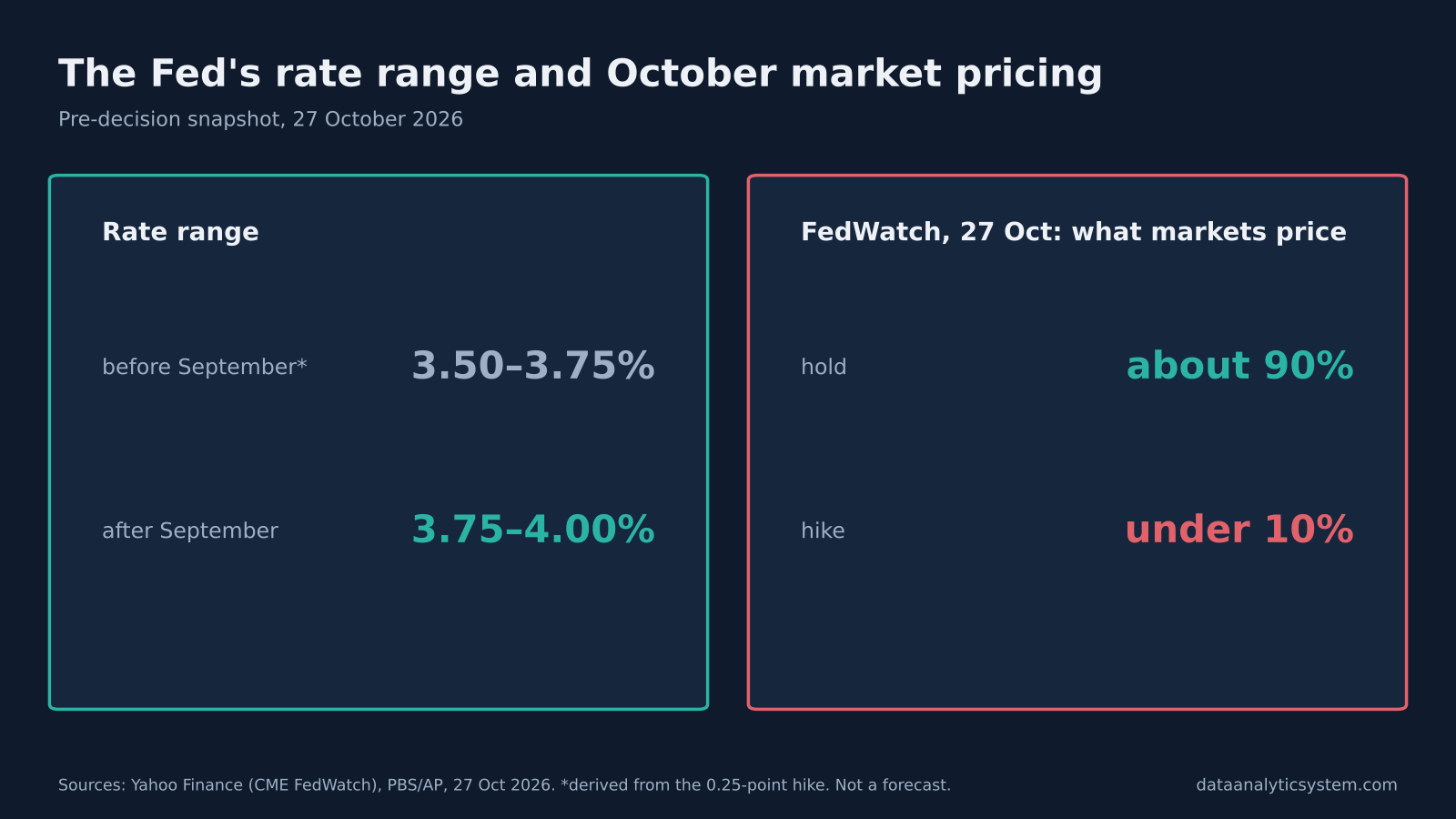
| Current range | 3.75–4.00% (raised 0.25 points in September) |
| Market pricing | about 90% hold, under 10% hike (CME FedWatch, 27 Oct) |
| Chair | Kevin Warsh, his fourth meeting as chair |
| Voters | 12 |
| Midterm elections | six days after the meeting |
| Central European time | the Fed usually announces at 2 p.m. US Eastern time, which is 7 p.m. in Budapest this week (this article's conversion) |
Sources: PBS/AP, 27 Oct, Yahoo Finance, 27 Oct.

Where the decision starts from
According to Yahoo Finance, the Fed raised its range by 0.25 percentage points in September, to 3.75–4.00%. According to AP, inflation has come in above expectations two months in a row, and the Fed's 2% goal has not been met in a single calendar quarter since late 2020. Households feel it: diesel hit a record $6.53 a gallon in late September, and the average 30-year mortgage rate reached a three-year high of 7.4% in October before easing to 7.32%.
Before September's inflation report, many analysts expected another hike in October. Since then, speeches by several Fed officials have suggested no move now, and futures pricing reflects that.
What a rate range is
The Fed does not fix a single rate but a range for the interest rate on overnight interbank loans (the federal funds rate). With a range of 3.75–4.00%, banks' overnight loans to each other typically trade within it. A 0.25-point move is called a "quarter point".
What "a 90% chance" means
CME FedWatch calculates probabilities from the prices of interest-rate futures. It is neither a survey nor a forecast: it shows what market participants are pricing at a given moment. If pricing changes, so does the number. According to Yahoo Finance, on 27 October the chance of a hold was about 90%.
What a "hawkish pause" is
According to Yahoo Finance, Alan Blinder, a former Fed vice chair, expects a "hawkish pause": rates stay put, but the central bank says it is ready to raise again. "Hawkish" describes a tighter, anti-inflation stance; "dovish" a looser one.
According to AP, that is why the statement and Kevin Warsh's press conference matter as much as the decision itself. Warsh has criticised forward guidance, the practice of a central bank indicating its future moves in advance. If he nevertheless repeats that inflation must return to 2% more quickly, markets may read it as a hint about the December meeting.
Dissents and independence
The September decision was unanimous. According to AP, two or three dissents among the 12 voters are possible now; it names Beth Hammack (Cleveland) and Lorie Logan (Dallas) as the most likely to favour a hike. The article also raises the question of Fed independence: Warsh was appointed by President Donald Trump this year, yet raised rates in September against the president's wishes; Trump has since sought to remove Governor Lisa Cook. Some analysts say the Fed wants to avoid a sharp move before the midterms.
5 things many people don't know
- Not all 19 policymakers vote. The FOMC has 12 voters; some regional presidents rotate each year.
- Dissenters are named. The statement lists who voted differently and why.
- "90%" is a market price, not a promise. FedWatch derives it from futures prices.
- Mortgage rates don't track the Fed rate one to one. The 30-year rate is 7.32%, well above the 3.75–4.00% range; it follows longer-term market rates.
- Inflation is a basket, not one price. Which prices drive the figure: US inflation at 3.7% and what the Fed decides.
Summary
- FOMC: 27–28 October; decision on Wednesday.
- Range: 3.75–4.00%; market pricing about 90% for a hold.
- Focus: the statement's tone, Warsh's words, the number of dissents.
- Backdrop: two months of hotter-than-expected inflation, the upcoming midterms.
Related reading: The Fed decision, 28 October · US inflation at 3.7%: what's in the basket · Blog archive.
Educational content. Not investment advice and not a rate or price forecast. This article was written before the decision, from public press sources. Data Analytic Investments is not affiliated with the Federal Reserve, CME Group or the portals cited. Images labelled "AI illustration" are not photographs.
Continue on DAI
Explore Topics
Written by
Data Analytic Investments
Content creator and writer sharing insights and stories.