
MNB rate decision, October 2026: Hungary's base rate held at 5.50% – what the statement says about inflation and risks
The base rate stays at 5.50%. What the interest rate corridor is, what Hungary's statistics office measured in September, why the central bank cites caution, and what comes next on the calendar – with sources, without forecasts.

On 20 October 2026 the Monetary Council of the Magyar Nemzeti Bank (MNB), Hungary's central bank, left the base rate unchanged at 5.50 percent. The decision was in line with expectations. This article summarises what the statement contains and what the data behind it show. It does not offer a rate forecast of its own.
| Fact sheet | |
|---|---|
| Base rate | 5.50% (unchanged) |
| Overnight (O/N) deposit rate | 4.50% |
| Overnight (O/N) collateralised lending rate | 6.50% |
| Last change | August, −0.25 percentage points, unanimous |
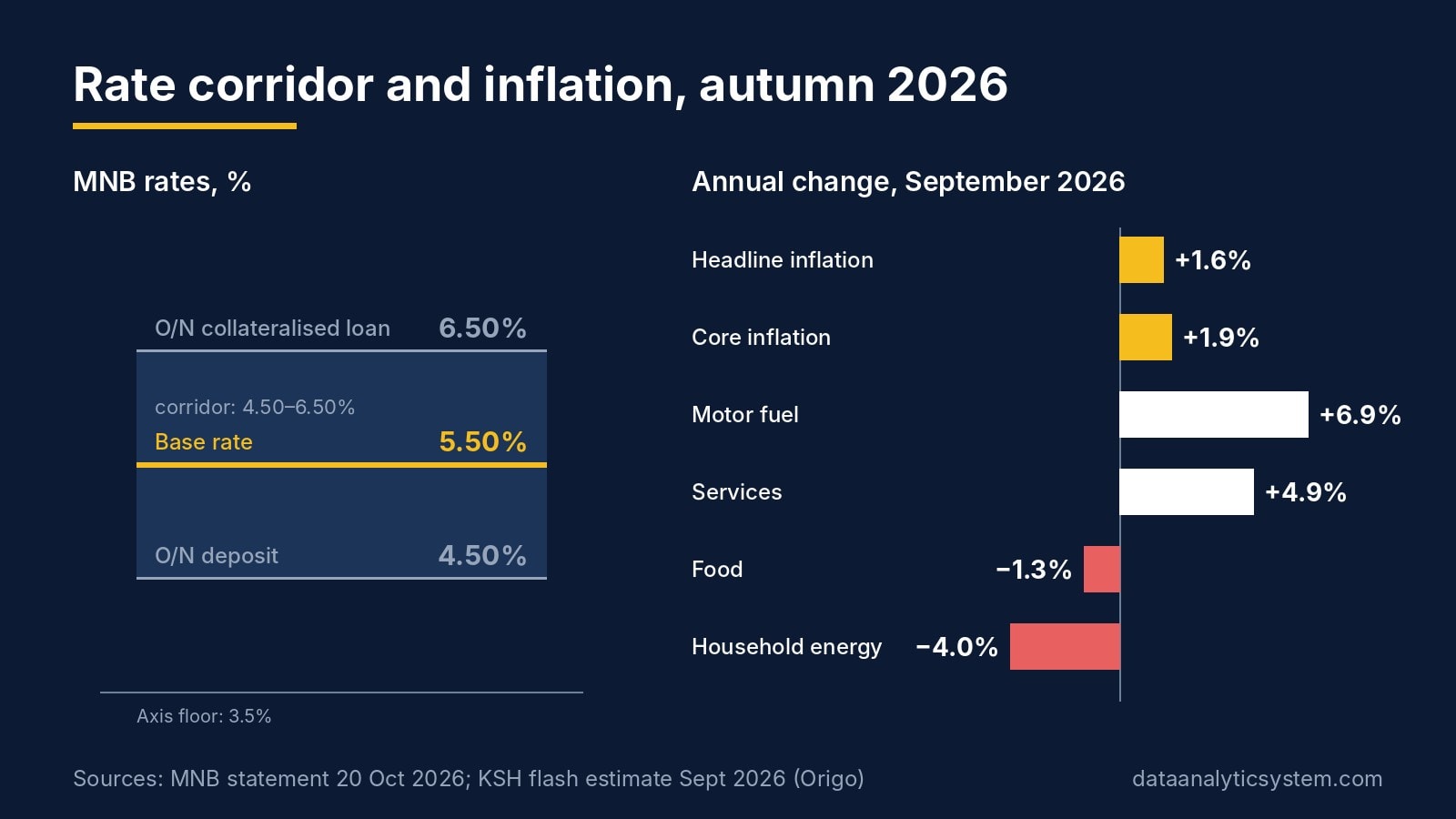
| Inflation, September 2026 | 1.6% |
| Core inflation, September 2026 | 1.9% |
| Abbreviated minutes | 4 November 2026, 14:00 CET |
Sources: MNB statement (Hungarian), Infostart, Tőzsdefórum.

What the base rate and the corridor are
The base rate is the central bank's policy rate. The MNB pays it on banks' balances held above their required reserves, and money-market rates follow it.
The interest rate corridor is bounded by two overnight (O/N) rates. At the lower edge, 4.50%, banks can park surplus money with the central bank for one day. At the upper edge, 6.50%, they can borrow for one day against collateral. According to the statement, the corridor sits one percentage point below and above the base rate, and it did not change either.
Inflation: 1.6% in September
According to the September data of the Hungarian Central Statistical Office (KSH), consumer prices in September 2026 were 1.6% higher than a year earlier. In August the figure was 1.3%. Month on month, prices rose 0.2%. One analyst, Gábor Regős (Gránit Asset Management), had expected 1.7%.
| Product group | Annual change (Sept 2026) |
|---|---|
| Food | −1.3% |
| Services | +4.9% |
| Household energy | −4.0% |
| Motor fuel | +6.9% |
Source: Origo, based on KSH data.
Motor fuel became 5.9% more expensive in a single month. The central bank's statement also names fuel prices as the main reason for the acceleration. Core inflation – a measure that excludes volatile items such as energy and unprocessed food – was 1.9%. The statement notes that its one-month rise matched the 2017–2020 average.
The central bank's projections
In its statement the MNB gives these figures:
- Average inflation in 2026: 1.8%.
- 2027: 3.1%, pushed up by fuel prices and a change in excise duty on tobacco products.
- At the end of the horizon: around the 2.5% target.
- New inflation target: 2.5% from 1 January 2028.
These are the central bank's own projections, not guaranteed values.
Why the MNB is cautious
The statement lists several reasons:
- Energy prices. Oil and gas prices are high because of geopolitical tensions.
- Long-term interest rates. In advanced economies they are historically high and have risen further. According to Tőzsdefórum's report, Governor Mihály Varga described them as close to a two-decade high.
- The major central banks. Based on market pricing, the statement says, the ECB, the Fed and the Bank of Japan may hike further after their September increases. The Fed next decides on 27–28 October, the ECB on 29 October.
- The region. The Romanian and Polish central banks also held rates in October.
- Domestic risks. The statement highlights the fiscal path and expectations around euro adoption.
On the economy: industrial output kept expanding in August, while retail sales growth slowed. This year's growth is held back by a fall in agricultural output caused by an exceptional drought.

What Mihály Varga said
The press conference was reported by Tőzsdefórum, in its own summary:
- Energy prices, international interest rates and inflation risks still justify caution.
- The forint's strengthening in the spring played a major role in favourable domestic inflation.
- Joining ERM-II and adopting the euro are two separate steps; there is no official government decision on euro adoption yet.
- The central bank expects inflation to rise somewhat over the coming months.
Real interest rate: a simple subtraction
The real interest rate is the difference between the interest rate and inflation. Subtracting September's 1.6% inflation from the 5.50% base rate gives roughly 3.9 percentage points. This is our own simplified calculation; the precise real rate is usually computed with expected inflation. According to the statement, a positive real rate helps keep inflation expectations anchored.
5 things many people don't know
- The inflation target is changing. From 1 January 2028 the MNB sets its inflation target at 2.5%. The decision was made in September.
- Core inflation is higher than headline inflation. In September it was 1.9%, against 1.6%. Core inflation leaves out, among other things, household energy, which became 4.0% cheaper over the year.
- Services are getting dearer, food cheaper. Year on year, services showed +4.9% and food −1.3%.
- Fuel rose almost 6% in one month. In September the monthly change was +5.9%.
- The details arrive in two weeks. The abbreviated minutes of the meeting are published on 4 November at 14:00. Two rate-setting meetings remain this year.
Summary
- The base rate is 5.50%, the corridor 4.50–6.50%.
- September inflation was 1.6%, core inflation 1.9%.
- The MNB expects average inflation of 1.8% in 2026 and 3.1% in 2027.
- The main reasons for caution: energy prices, high long-term rates, hiking major central banks.
- On the calendar: Fed 27–28 October, ECB 29 October, MNB minutes 4 November.
Related reading: What moves the gold price in autumn 2026 · Blog archive.
Educational content. Not investment advice. Data Analytic Investments is not affiliated with the Magyar Nemzeti Bank, the Hungarian Central Statistical Office, the European Central Bank, the Federal Reserve or the portals cited; names are used for identification only. Images labelled "AI illustration" are not photographs.
Continue on DAI
Explore Topics
Written by
Data Analytic Investments
Content creator and writer sharing insights and stories.