
Could Hungary's housing market speed up before Otthon Start ends? What Otthon Centrum says and what the third-quarter data show
Two directions at once: a property agency sees a short boost as possible, while the latest data show a slower market, bigger discounts and longer selling times. The difference between an expectation and a measured figure – with sources, without forecasts.

On 19 October it was announced that from 2027 Wekerle Plusz will replace Otthon Start, Hungary's fixed 3% home-loan scheme. Five days later, on 24 October, the agency Otthon Centrum (OC) told the national news agency MTI that the phase-out may prompt eligible buyers to bring their purchases forward, which could briefly lift the market. This article puts that expectation next to the latest measured data. It offers no forecast of its own.
| Fact sheet | |
|---|---|
| Otthon Start | fixed, at most 3%, new and used homes |
| Wekerle Plusz (from 2027) | fixed 3% new, fixed 5% used, ages 18–41 |
| Sales, Q3 2026 | about 26,754 (−22% year on year) |
| Sales, first 9 months of 2026 | 83,307 (−15%) |
| Average discount, Budapest | 4–5% (previously about 1%) |
| Demand index, September | 65 points (87 a year earlier) |
Sources: mfor.hu / Otthon Centrum, 24 Oct, BEOL / Duna House barometer, 17 Oct (both in Hungarian).

What Otthon Centrum said
According to the mfor.hu summary, OC's view comes down to four points:
- the end of Otthon Start may lead eligible buyers to bring purchases forward;
- in the short term a price rise cannot be ruled out, mainly for used flats;
- according to OC, the fixed 5% Wekerle Plusz rate for used homes is only 1–2 percentage points below market rates;
- the biggest tightening is that anyone owning a 50% share in a property no longer qualifies – which affects couples who co-own a home in equal halves.
OC adds that the announced renovation programme could narrow the price gap between well-kept and run-down homes, but that depends on the energy requirements and paperwork in the final decree.
What the measured data show
The Duna House barometer, reported by BEOL on 17 October, says this about the third quarter:
- about 26,754 residential properties were sold, 6% fewer than in Q2 and 22% fewer than a year earlier;
- part of the annual drop reflects the spike in August and September 2025, when Otthon Start was launched;
- the first nine months saw 83,307 transactions, down 15%;
- September had 9,385 sales, 16% more than August;
- the demand index stood at 65 points in September, against 87 a year earlier.
The national home price index slipped from 464 points in Q2 to 462. Prices are still about 6% higher than a year ago, but in Q2 the annual rise had been 19%.
Discounts and selling time
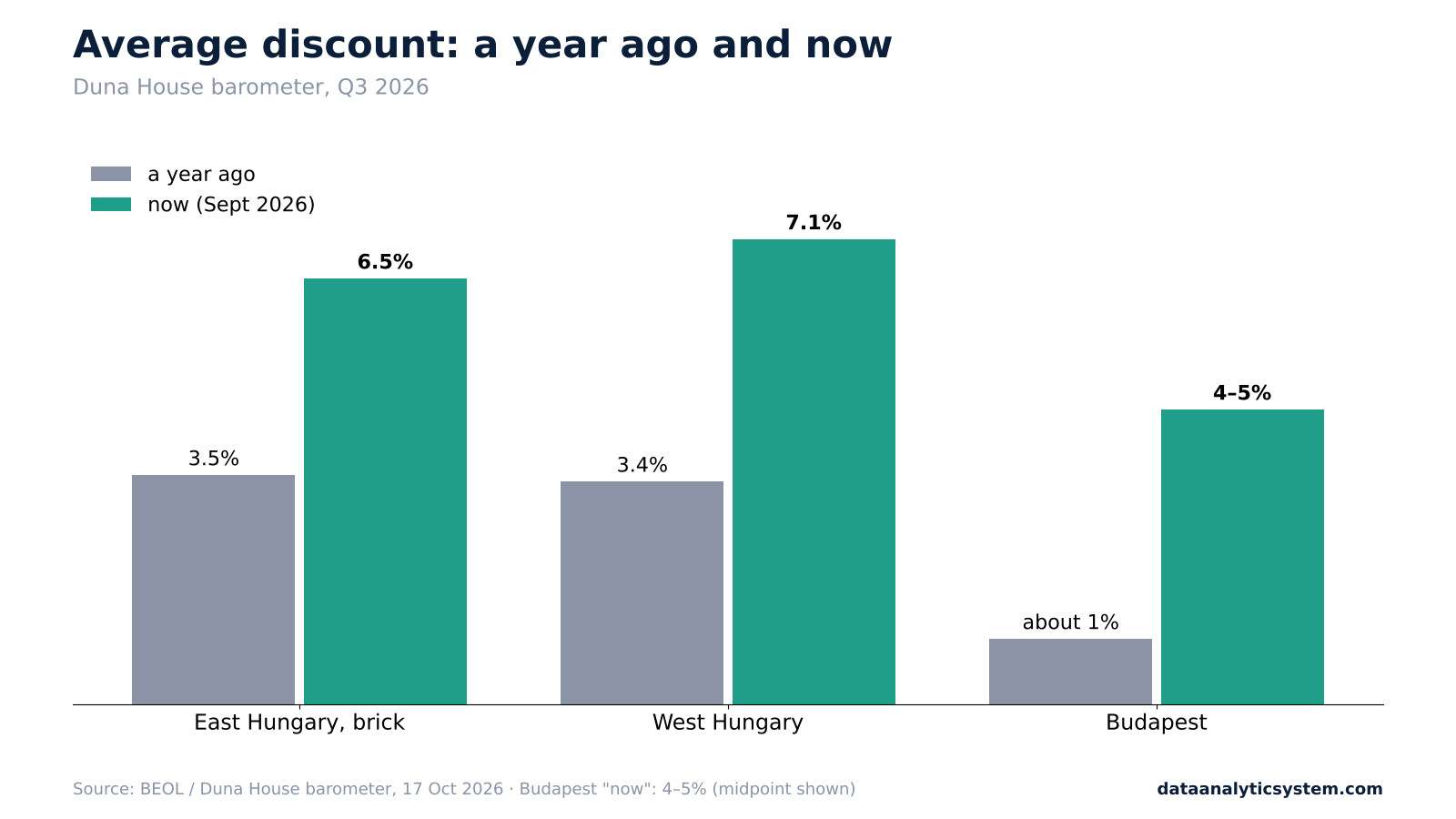
Buyers have gained bargaining power. According to Duna House data:
| Region | Average discount a year ago | Average discount now |
|---|---|---|
| Eastern Hungary, brick | 3.5% | 6.5% |
| Western Hungary | 3.4% | 7.1% |
| Budapest | about 1% | 4–5% |
Sales also take longer. A panel flat in Buda took an average of 101 days to sell in September, against 55 days a year earlier. For brick flats in Pest the figure rose from 80 to 96 days.
Who is buying now
- First-time buyers are the largest group, at 39% nationally and in Budapest.
- The share of investment buyers in Budapest fell from 31% to 18% within a year.
- In Budapest, 35% of homes sold had originally been bought as investments.
- The average Budapest mortgage fell from HUF 35.9 million to HUF 34.4 million.
How to read both directions at once
OC's expectation and the Duna House data do not contradict each other, because they measure different things. The data describe the past: what happened from July to September. The expectation is about the future: what might happen if eligible buyers decide before the deadline. Which effect is stronger will show in the coming months' data. The exact closing date of Otthon Start had not been announced at the time.
5 things many people don't know
- Last year's base distorts the picture. Part of the 22% annual fall comes from the exceptional turnover in August–September 2025, when Otthon Start launched.
- East and west moved in opposite directions. In Q3, brick-flat prices rose 3% in eastern Hungary and fell 4% in the west.
- Budapest brick flats are cheaper than a year ago. According to Duna House, their prices have dropped below the level of a year earlier.
- The half-share is the key. According to OC, the biggest tightening in Wekerle Plusz is excluding owners of a 50% property share.
- Loans cover a smaller part of the price. Nationally the average loan covered 47% of the property value, down from 50% in Q2.
Summary
- Otthon Centrum says the end of Otthon Start may bring earlier purchases and a short-term price rise.
- Duna House says 22% fewer homes sold in Q3, with bigger discounts and longer selling times.
- The two measure different things: one is an expectation, the other measured data.
- Still open: Otthon Start's closing date and the Wekerle Plusz decree.
Related reading: Wekerle Plusz: what we know about the Otthon Start successor · Otthon Start one year on · Blog archive.
Educational content. Not financial, investment or property-buying advice. Data Analytic Investments is not affiliated with Otthon Centrum, Duna House or the portals cited; names are used for identification only. Images labelled "AI illustration" are not photographs.
Continue on DAI
Explore Topics
Written by
Data Analytic Investments
Content creator and writer sharing insights and stories.