Euro area GDP, Q3 2026: up 0.4%, with employment flat, in Eurostat's flash estimate
Up 0.4% on the quarter in the euro area and 0.5% in the EU, employment at 0.0%. What Eurostat published on 13 November, how the member states compare, and what a flash estimate cannot tell you.
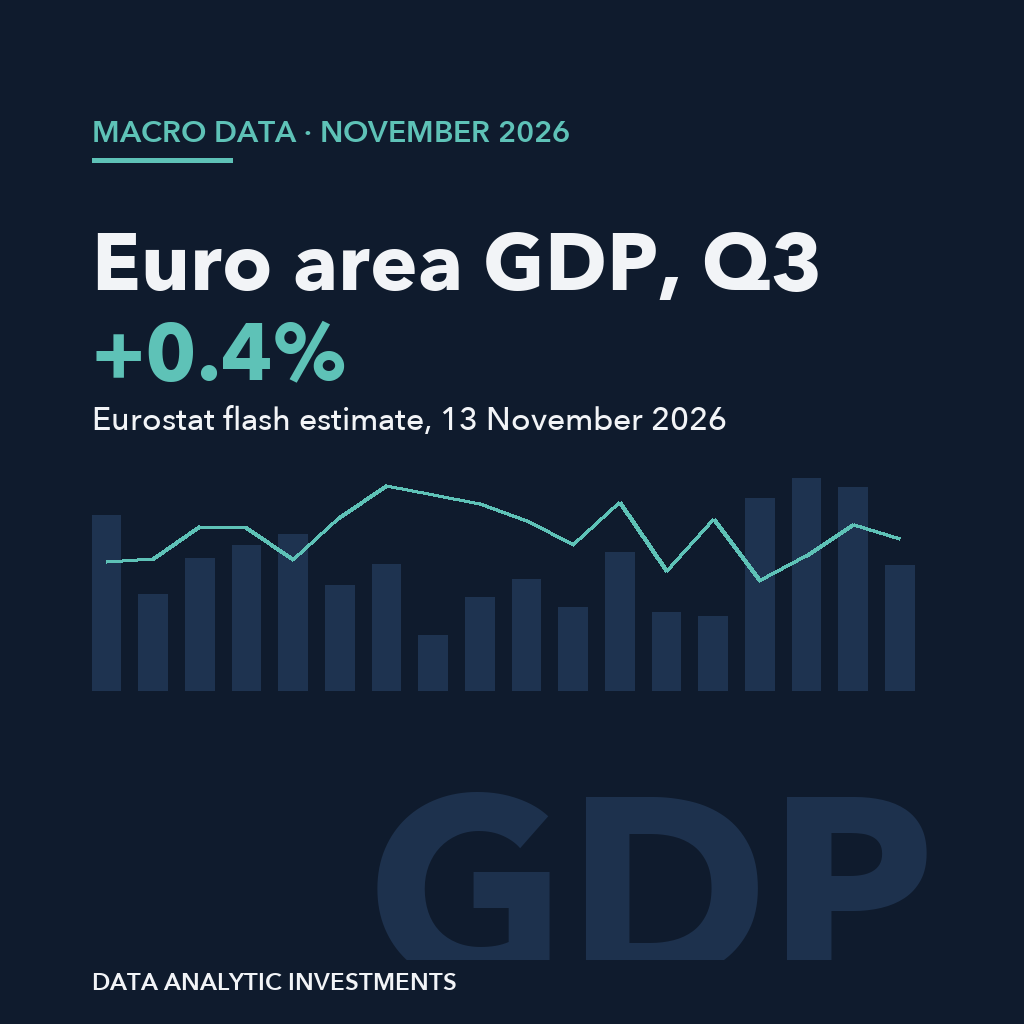
On 13 November 2026, Eurostat published its GDP and employment flash estimates for the third quarter. Seasonally adjusted GDP rose 0.4% in the euro area and 0.5% in the European Union compared with the previous quarter (Eurostat, 13 November 2026). In the second quarter, growth had been 0.6% and 0.7% respectively. The number of people in employment was unchanged in both areas.
This is the flash estimate published about 45 days after the end of the quarter. A preliminary GDP flash, based on data from 19 member states, came out on 30 October (Eurostat, 30 October 2026). The 13 November release draws on national data covering 97% of GDP and left the euro area and EU quarterly figures unrevised.
| Data sheet | |
|---|---|
| Publisher | Eurostat (Euro indicators) |
| Published | 13 November 2026 |
| Period | Q3 2026 |
| GDP, quarter on quarter, euro area | +0.4% (Q2: +0.6%) |
| GDP, quarter on quarter, EU | +0.5% (Q2: +0.7%) |
| GDP, year on year, euro area | +1.3% (Q2: +1.2%) |
| GDP, year on year, EU | +1.5% (Q2: +1.4%) |
| Employment, quarter on quarter, euro area and EU | 0.0% (Q2: +0.1%) |
| Employment, year on year, euro area and EU | +0.4% |
| Coverage | 97% of GDP; employment: 95% (euro area), 92% (EU) |
| Next revisions | 7 December 2026 and 19 January 2027 |
What the headline figures say
According to the Eurostat release, quarterly growth slowed while the annual rate edged up. The two are consistent. The annual figure compares with the same quarter a year earlier, so it still carries the stronger second quarter of 2026.
Euro area quarter-on-quarter growth over the last four quarters was 0.2%, 0.0%, 0.6% and 0.4%. For the EU, the sequence was 0.3%, 0.1%, 0.7% and 0.5%.
In 2026 the euro area has 21 members: Eurostat's country list now includes Bulgaria (EA21).
Employment: zero growth
The number of people in work was unchanged in the third quarter in both the euro area and the EU. In each of the three previous quarters, employment had grown 0.1% in both areas (0.2% in the EU at the end of 2025). Year on year, employment rose 0.4%, down from 0.5% in the euro area (Eurostat).
The flash estimate covers only the number of employed persons. Hours worked and the breakdown by industry come with the later regular estimates.
Member states: a wide spread
Eurostat's table also lists the national figures available so far (Eurostat):
| Country | Quarter on quarter | Year on year |
|---|---|---|
| Germany | +0.2% | +1.2% |
| France | -0.1% | -0.1% |
| Italy | 0.0% | +0.8% |
| Spain | +0.6% | +2.7% |
| Netherlands | +0.6% | +2.1% |
| Poland | +0.8% | +3.6% |
| Czechia | +0.5% | +1.6% |
| Austria | +0.2% | +0.6% |
| Slovakia | +0.1% | +0.5% |
| Romania | +2.1% | +0.3% |
| Lithuania | -1.0% | +2.3% |
| Ireland | +5.5% | +3.6% |
The Irish figure is an experimental estimate based mainly on output data, and Eurostat says it will be revised. Over the past year, Ireland's quarterly figure has ranged from -7.8% to +10.2%. Third-quarter data for Denmark, Greece, Croatia, Latvia, Luxembourg, Malta and Slovenia were not yet included.
Where Hungary sits
Hungary is not in the euro area but is part of the EU series. In Eurostat's table, Hungarian GDP grew 0.1% on the quarter and 1.5% on the year in the third quarter (Eurostat). The same table shows Hungarian quarterly growth of 0.6% in both the first and second quarters of 2026.
The Hungarian Central Statistical Office (KSH) published its own flash estimate on 30 October. Hungarian media reported that it was the sixth consecutive quarter of growth, and that the detailed breakdown is due on 1 December (444, 30 October 2026, in Hungarian).
The United States for comparison
The same release includes US GDP: up 0.8% on the quarter and 2.1% on the year in the third quarter, after 0.6% and 2.2% in the second (Eurostat). Eurostat shows the US figure as a plain quarterly change, not the annualised rate common in US reporting, so the numbers are comparable as printed.
What the data does not show
- It is a flash estimate, not a final figure. Eurostat's regular estimates on 7 December and 19 January may revise it.
- There is no breakdown. The flash does not say whether growth came from consumption, investment or trade.
- Not every member state is in. Seven countries' third-quarter data are missing, and the Irish figure is experimental.
- Volume is not income. Growth in chain-linked volumes measures the change in output, not household income or living standards.
- One quarter is not a trend. A slowdown or pick-up says nothing certain about the fourth quarter.
Summary
- Eurostat's flash estimate of 13 November puts Q3 2026 GDP growth at 0.4% in the euro area and 0.5% in the EU.
- Year on year, the euro area grew 1.3% and the EU 1.5%.
- Employment was unchanged on the quarter.
- In the same table, Hungarian GDP rose 0.1% on the quarter and 1.5% on the year.
Related reading: Euro area trade, September 2026, Blog archive.
Sources
- Eurostat: GDP and employment flash estimates for the third quarter of 2026 (13 November 2026): https://ec.europa.eu/eurostat/product?code=2-13112026-ap
- Eurostat: preliminary GDP flash estimate, Q3 2026 (30 October 2026): https://ec.europa.eu/eurostat/product?code=2-30102026-ap
- 444: KSH flash estimate for the third quarter (30 October 2026, Hungarian): https://444.hu/2026/10/30/betett-a-gazdasagnak-a-nyari-aszaly-kellemetlen-meglepetest-okozott-a-gdp
Data Analytic Investments is not affiliated with the institutions or portals cited; names are used for identification only.
Educational content. Not investment advice.
Continue on DAI
Explore Topics
Written by
Data Analytic Investments
Content creator and writer sharing insights and stories.