Zsolnay and eosin: the story of the Pécs factory and its dawn-coloured glaze
Founded in Pécs in 1853 to make stoneware, Zsolnay introduced eosin in 1893. Its pyrogranite lives on in Budapest buildings, and the factory site is now a cultural quarter.
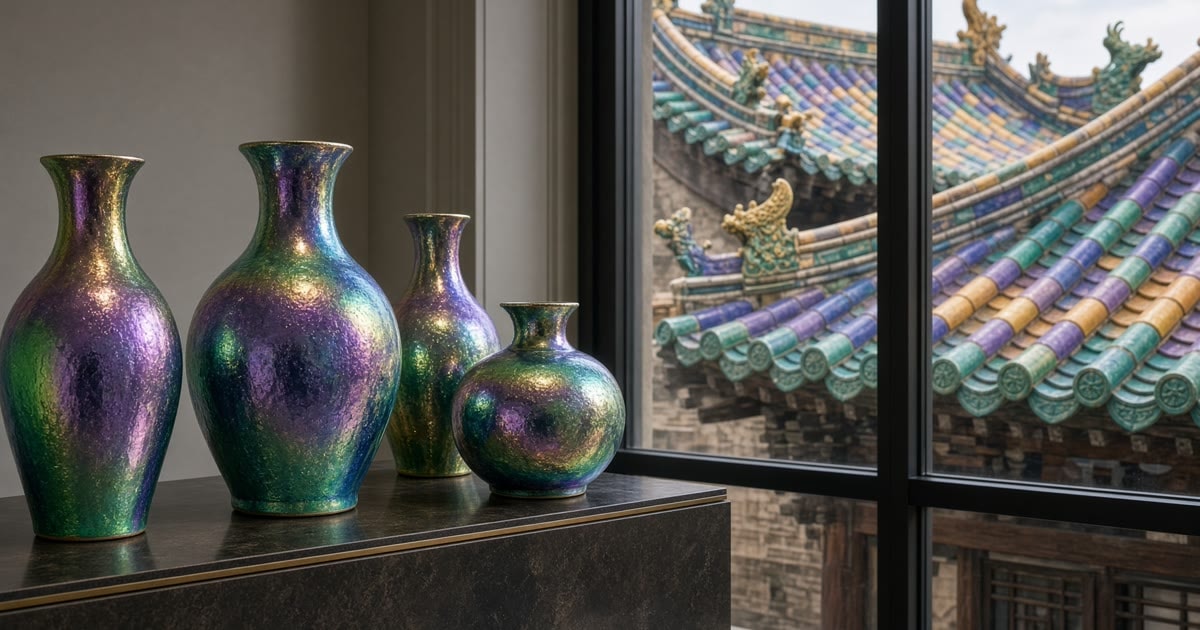
If you have ever seen a ceramic that shimmers green and violet and looks almost like metal, you have probably seen eosin. The Zsolnay factory in Pécs, southern Hungary, introduced the glaze in 1893 and still makes it today. This article follows the factory's history, from a family stoneware works through the world exhibitions to the Zsolnay Cultural Quarter opened in 2011. It also explains what makes eosin special, and where you can see Zsolnay ceramics in Budapest today.
Beginnings: Miklós and Vilmos Zsolnay
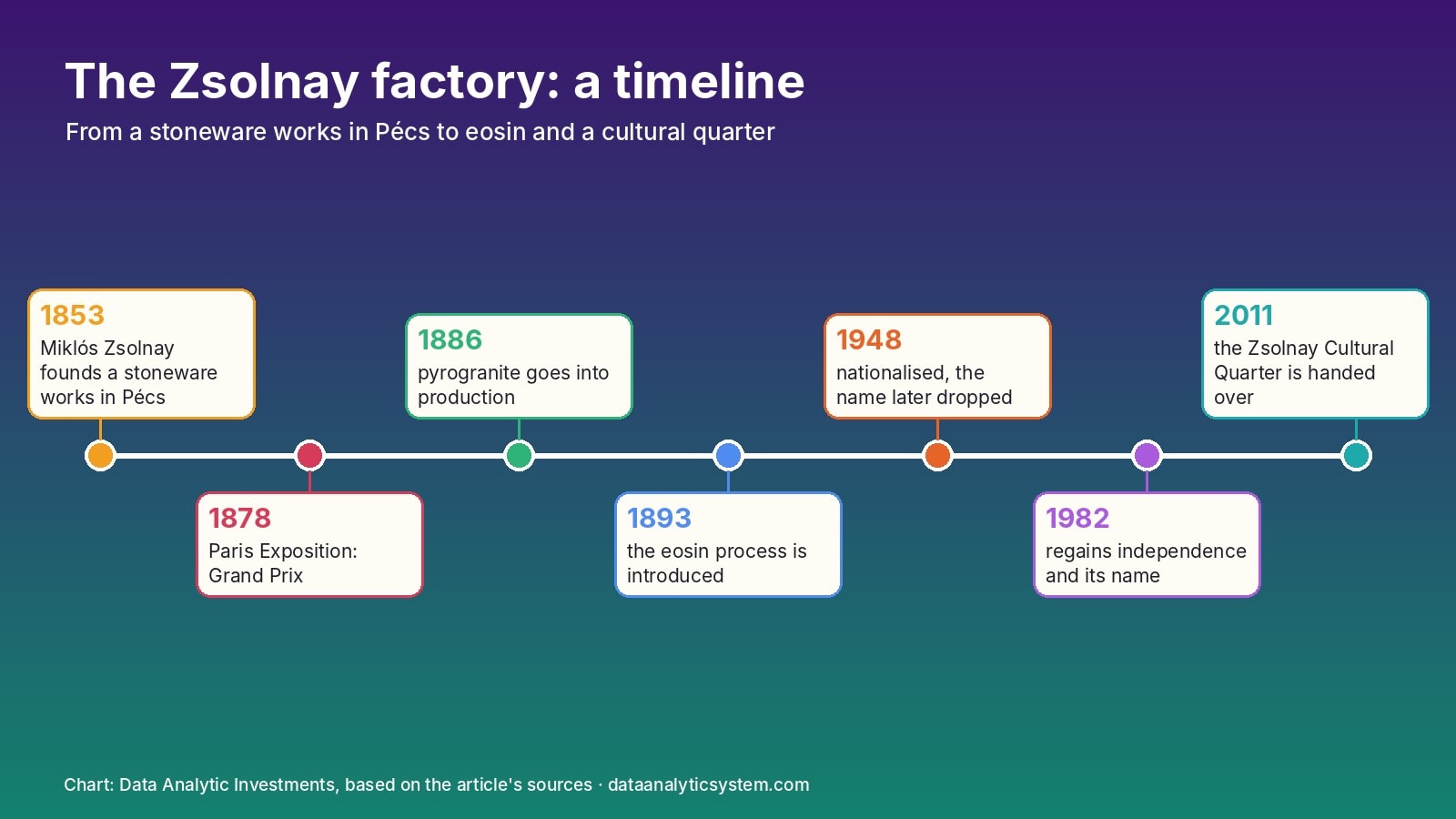
Miklós Zsolnay (1800–1880) founded the factory in Pécs in 1853 to produce stoneware and other ceramics [1]. Vilmos Zsolnay (1828–1900) joined the company in 1863 and later became its manager and director [1]. Vilmos's name became bound up with the factory's reputation. Pyrogranite and eosin both appeared during his time.
World exhibitions and growth
The company showed its products at the Vienna World's Fair in 1873 and the Paris Exposition in 1878, where it received a Grand Prix [1]. Pyrogranite went into production in 1886. The eosin process was introduced in 1893, followed by porcelain pieces made with it [1].
In 1900 Vilmos's son Miklós took over. By 1914 the company was the largest of its kind in Austria-Hungary [1].
What is eosin?
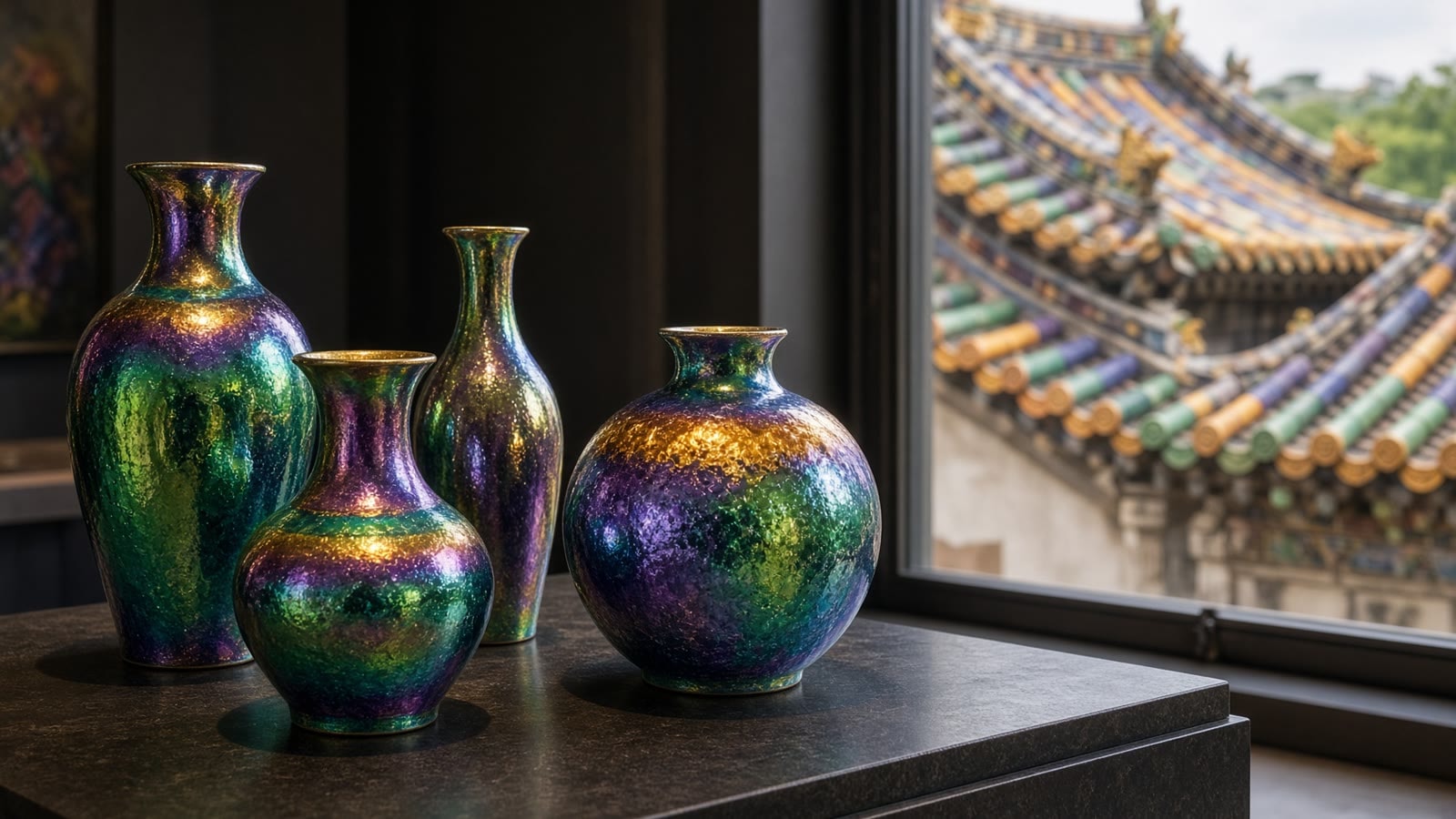
Eosin is an iridescent reduction glaze. Depending on the viewing angle and the light, its surface recalls silk, metal or glass. The manufactory has kept the production process secret to this day [2].
The name comes from Eos, the Greek goddess of dawn [2]. According to Zsolnay's own history, eosin was developed in the 1890s by Vilmos Zsolnay together with Lajos Petrik, director of the Budapest Industrial School, and Vince Wartha, a professor at the Budapest University of Technology [2].
Three things are worth knowing about the glaze:
- Every piece is unique. Zsolnay says each eosin object is one of a kind and cannot be repeated [2].
- It comes in several variants: hand-painted, etched and marbled eosin [2].
- It was also used to decorate buildings, not only ornaments [2].
Eosin and Art Nouveau
Eosin became a Zsolnay trademark and a favourite of Art Nouveau artists. Around 1900 it was combined with new forms and decoration. The factory's history highlights Sándor Abt, Lajos Mack, Géza Nikelszky and József Rippl-Rónai [2]. Eosin pieces are held today by the Metropolitan Museum of Art in New York and the Musée d'Orsay in Paris [2].
Pyrogranite: ceramics on buildings
Pyrogranite is a frost-resistant architectural ceramic, produced from 1886 [1]. According to Wikipedia it was used on these Budapest buildings, among others [1]:
| Building | Where |
|---|---|
| Matthias Church | District I, Buda Castle |
| Hungarian Parliament Building | District V, Kossuth Lajos tér |
| Museum of Applied Arts | District IX, Üllői út |
Next time you stand in front of one of them, look up at the roof and the façade ornaments.
The Zsolnay Fountain in Pécs
In Pécs you can see eosin in the open air. The Zsolnay Fountain on the southern side of Széchenyi Square was designed by Andor Pilch in 1912 and made at the Zsolnay factory from eosin-glazed ceramic [4]. It was moved to its present site in 1930, in front of the church of the Brothers Hospitallers. On each of its four sides is an ox-head water spout, echoing a drinking vessel from the Nagyszentmiklós Treasure. The fountain commemorates Vilmos Zsolnay [4].
How to recognise eosin
A few signs help when you see a piece described as eosin in a museum or an antique shop:
- The colour moves. Walk around it or turn it, and the surface flashes in different colours, because the iridescence depends on the viewing angle and the light [2].
- Metallic, yet ceramic. The surface recalls silk, metal or glass [2].
- No two are alike. If two "identical" pieces match perfectly, be wary: according to the factory, every eosin object is one of a kind [2].
The 20th century: war, nationalisation, a new start
During the Second World War the factory's Budapest plant was bombed. In 1948 the factory was nationalised, and the Zsolnay name was eventually dropped [1]. In 1982 the company regained its operational independence and its name. In 1991 it became a joint-stock company, and a few years later a private equity investor bought it. In 2012 the Swiss-Syrian businessman Bachar Najari bought it from the city of Pécs [1].
The Zsolnay Cultural Quarter
The Zsolnay Cultural Quarter was built on the old factory site as part of the Pécs 2010 European Capital of Culture programme. Construction began in 2009, and the handover of the buildings was completed in December 2011 [3].
According to the Hungarian weekly HVG, the project cost more than 11 billion forints. About 40,000 square metres of buildings were renovated on five hectares, and the paper described it as Central Europe's largest reconstruction of an industrial monument [3]. The quarter has four parts:
- Crafts quarter: the history of the Zsolnay family and its porcelain, with craft workshops.
- Creative quarter: cultural institutions and events.
- Children's and family quarter: interactive science and technology exhibitions.
- University quarter: higher education in the arts [3].
The planners expected 200,000 visitors a year [3].
5 things many people don't know
- Zsolnay started as a stoneware factory, not a porcelain factory [1].
- The name eosin refers to the Greek goddess of dawn [2].
- Eosin was a joint development. Vilmos Zsolnay worked on it with Lajos Petrik and Vince Wartha [2].
- After the Second World War the factory even lost its name for a while, getting it back only in 1982 [1].
- Eosin pieces are in the collections of the Met and the Musée d'Orsay [2].
Summary
Zsolnay's history is that of a family business that, by the end of the 19th century, had grown into the largest ceramics factory in Austria-Hungary. Its two inventions, pyrogranite and eosin, can still be seen today: one on Budapest rooftops, the other in museum cases and in the quarter in Pécs.
Sources
- Wikipedia – Zsolnay
- Zsolnay – The history of Eosin
- HVG – The full Zsolnay Quarter is handed over (5 December 2011, in Hungarian)
- Szallas.hu – Zsolnay Fountain, Pécs (in Hungarian)
Educational content. Data Analytic Investments is not affiliated with the Zsolnay Porcelain Manufactory; brand names are used for identification only. Images marked "AI illustration" are not photographs.
Continue on DAI
Explore Topics
Written by
Data Analytic Investments
Content creator and writer sharing insights and stories.