
Herend porcelain: its history from 1826 to today
From a small workshop near the Bakony hills to a world-famous manufactory: Vince Stingl, Mór Fischer, Queen Victoria's 1851 order and the legend of the Rothschild birds.
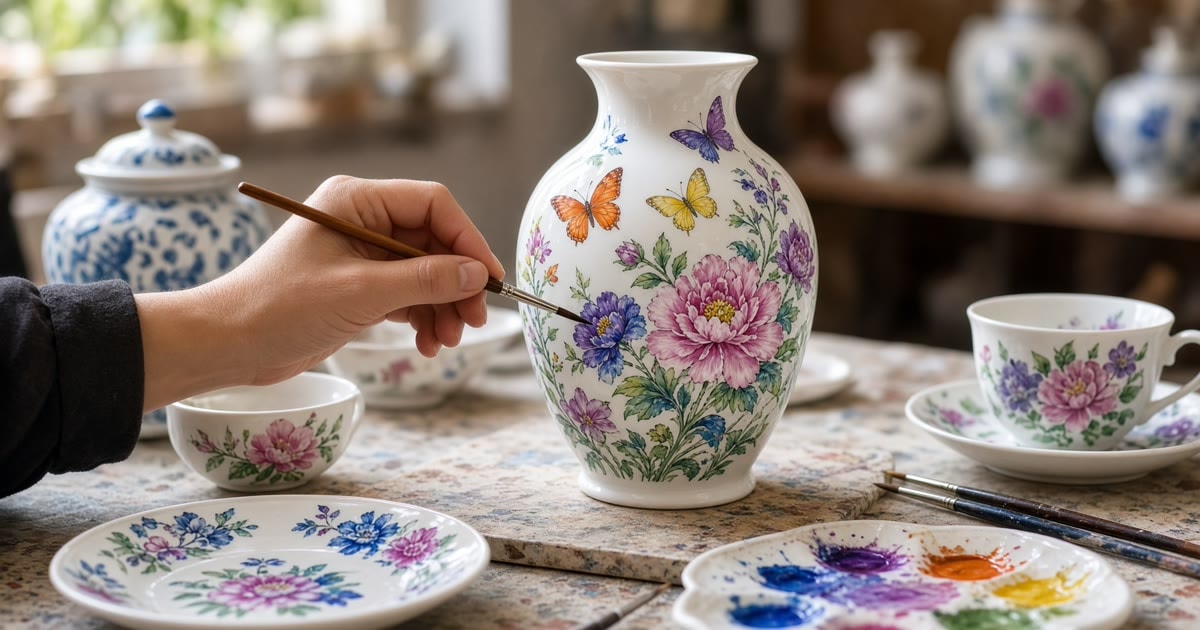
Herend is a small town where the Bakony hills meet the Balaton Uplands in western Hungary. Its name is nevertheless known in more than sixty countries, because it makes one of the world's best-known hand-painted porcelains. This article follows how a ceramics workshop founded in 1826 became a manufactory supplying royal courts. It looks at where the best-known patterns got their names, and at what happened to the factory in the 20th century.
Beginnings: Vince Stingl's workshop
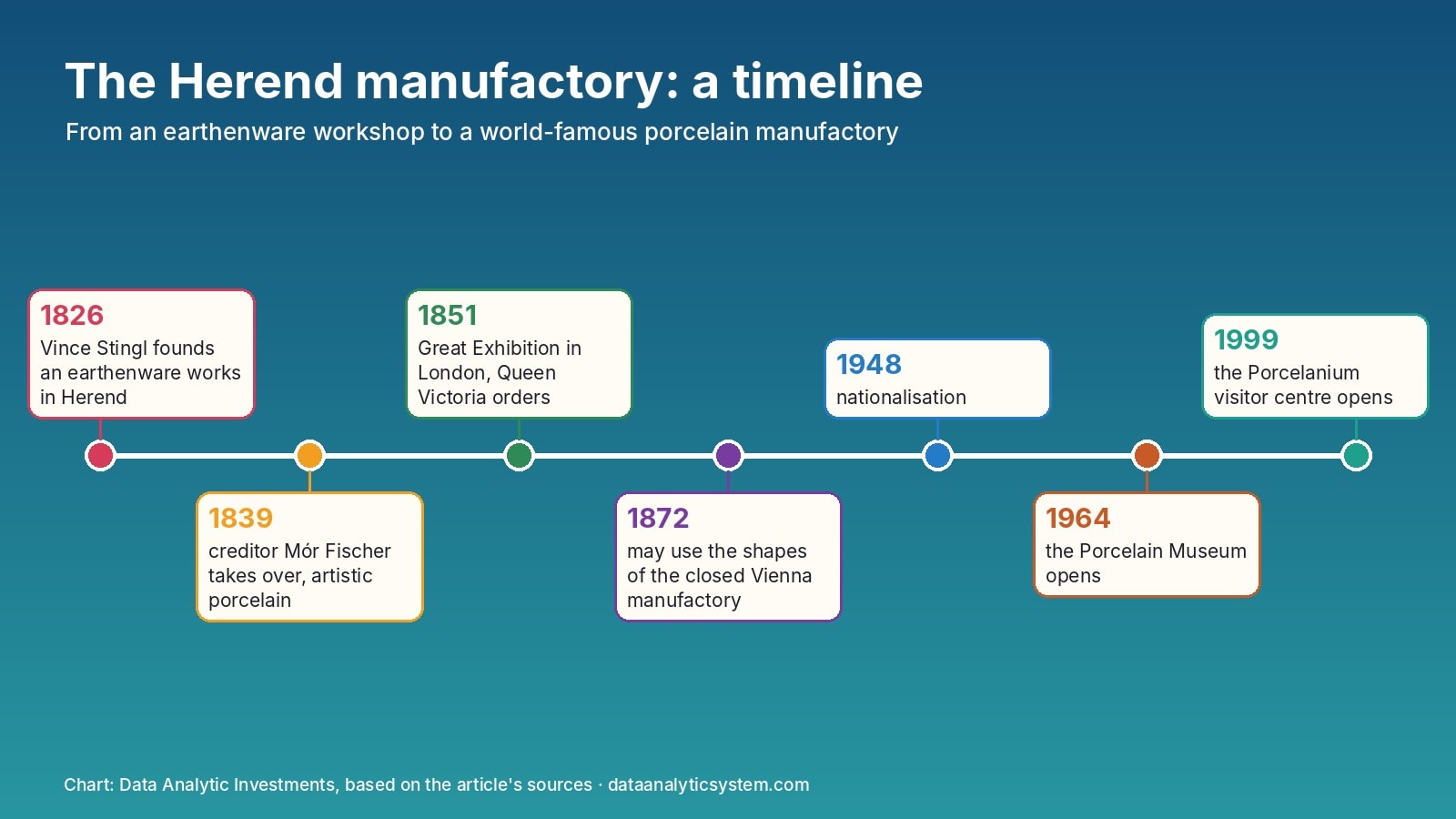
Vince Stingl founded the factory in Herend in 1826. At first it made earthenware, and Stingl experimented with porcelain on the side [1]. The business did not prosper: Stingl went bankrupt, and in 1839 his creditor, Mór Fischer, took control. That same year Fischer began producing artistic porcelain [1][2].
Under Fischer the profile changed quickly. By 1849 Herend's wares were being bought by the Hungarian aristocracy [1].
London, 1851: Queen Victoria's order
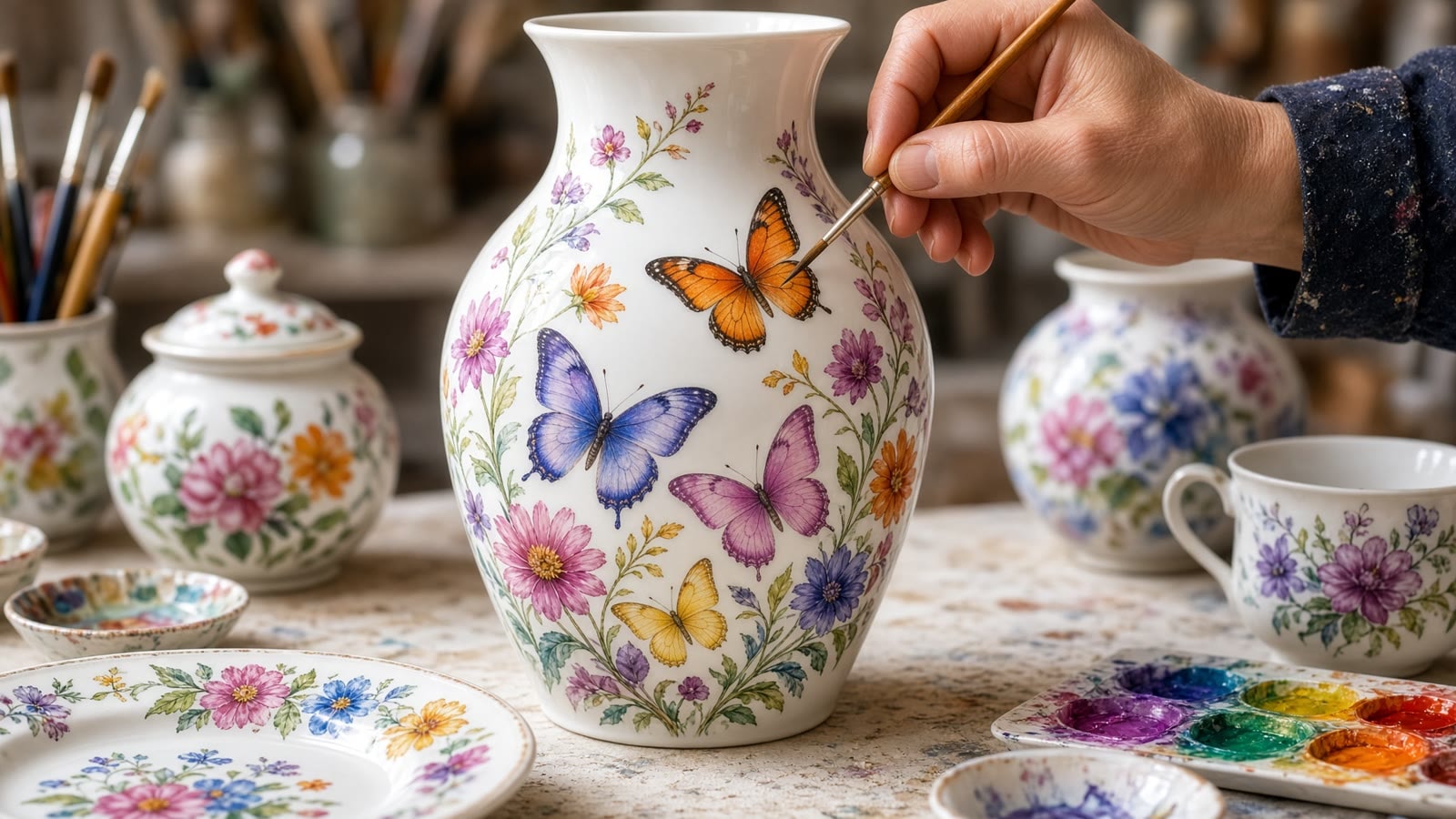
The turning point was the Great Exhibition in London in 1851. Herend showed a colourful butterfly-and-flower design that won a gold medal. Queen Victoria ordered a dinner set in it for Windsor Castle, and the pattern was named "Victoria" after her [1][3].
The connection lives on. A modified Victoria pattern with peony and butterfly motifs is in use at Kensington Palace. According to a hospitality guide on Herend, the crowned version of the porcelain butterfly sitting on the teapot lid is made exclusively for the Windsor family [3].
Pattern names: who were the customers?
Several Herend patterns are named after early customers. Wikipedia lists Victoria, Esterházy, Batthyány, Rothschild and Apponyi among them [1].
| Pattern | Named after |
|---|---|
| Victoria | Queen Victoria, order of 1851 [1][3] |
| Esterházy | the Esterházy family [1] |
| Batthyány | the Batthyány family [1] |
| Rothschild | the Rothschild banking family [1][2] |
| Apponyi | the Apponyi family [1] |
The legend of the Rothschild birds
The Rothschild banking family lent Mór Fischer money to expand the factory [2]. The Rothschild pattern comes with a legend. Baroness Rothschild is said to have lost her pearl necklace in her garden in Vienna. A gardener later found it hanging from a branch after noticing excited birds nearby. The pattern shows two birds with the necklace [2]. Note that this is a legend, not a documented event.
Court supplier and a title of nobility
Success brought official recognition. In 1865 Franz Joseph I granted Fischer a title of nobility [1]. The emperor also ordered Herend sets as gifts, and the factory received the title of imperial and royal court supplier [3]. In 1872 Mór Fischer Farkasházy, purveyor to the court, was allowed to use the shapes and patterns of the Vienna porcelain manufactory, which had closed [1].
According to Wikipedia, Herend won 24 grand prizes and gold medals at international exhibitions between 1851 and 1937 [1]. That figure is marked "citation needed", so treat it with care.
The 20th century: nationalisation and a new start
In 1948 the factory was nationalised. In 1964 the Porcelain Museum opened to visitors; in 2002 it was named Hungary's museum of the year [1].
After the fall of communism the company was privatised. Sources give different years: Wikipedia says 1993, Tea Time magazine says 1992. They agree that management and employees now hold the majority, about 75 percent [1][2].
How many patterns, how many shapes?
According to Kempinski's guide to Herend, the manufactory has designed more than 16,000 shapes and 4,000 patterns in nearly two hundred years. In theory these combine into 64 million different products [3].
Separating shape from pattern is the key to the Herend system. The same cup can be made with dozens of patterns, and the same pattern can appear on a plate, a vase or a figurine. Herend describes its porcelain as hand-painted and gilded, so no two pieces are ever exactly the same [1].
How to read a Herend piece
If you come across a Herend piece in an antique shop or a family cabinet, three questions help:
- Which pattern? The pattern name often refers to an early customer, such as Victoria or Rothschild [1].
- Which shape? The same pattern can appear on many shapes, so shape and pattern together define the piece [3].
- Hand-painted? Herend porcelain is hand-painted and gilded [1], so small differences between two "identical" pieces are natural.
Where you can see it today
- Herend: the Porcelanium visitor centre, opened in 1999. In its Mini Manufactory you can watch how porcelain is made and briefly try shaping clay or painting yourself. The Porcelain Museum's permanent exhibition covers the manufactory's history, alongside changing temporary shows [1][4].
- Budapest: a three-storey showroom on József nádor tér, and a shop on Andrássy út with large hand-painted figurines in its window. Visitors can paint a plate or make a porcelain rose [3].
- Abroad: brand stores in places such as Abu Dhabi, Athens and Zagreb [3]. Herend exports to more than 60 countries [1].
5 things many people don't know
- Herend did not start with porcelain. In 1826 Vince Stingl made earthenware and only experimented with porcelain [1].
- Mór Fischer became the owner as a creditor. He took over in 1839 after Stingl's bankruptcy [1][2].
- The Victoria pattern was a gold-medal design. Queen Victoria ordered it after the 1851 Great Exhibition [1].
- The birds of the Rothschild pattern hold a pearl necklace. The legend is about a lost necklace found thanks to birds [2].
- From 1872 Herend could use the shapes of the Vienna manufactory after it closed [1].
Summary
Herend's story is one of persistence. A creditor turned a bankrupt workshop into an artistic manufactory, and a London gold medal became a royal order. Despite the breaks of the 20th century, hand painting and the pattern heritage have survived.
Sources
- Wikipedia – Herend Porcelain Manufactory
- Tea Time Magazine – The History of Herend
- Kempinski Hotel Corvinus – Craftsmanship at the Herend Porcelain Manufactory (in Hungarian)
- Veszprém Info – Porcelanium Visitor Centre, Herend
Educational content. Data Analytic Investments is not affiliated with Herend Porcelain Manufactory; brand and pattern names are used for identification only. Images marked "AI illustration" are not photographs.
Continue on DAI
Explore Topics
Written by
Data Analytic Investments
Content creator and writer sharing insights and stories.