The Hungarian táncház method: where it comes from and how it works
From the first Budapest dance house in 1972 to UNESCO recognition in 2011: what the táncház method is, who started it, and how people learn in it.
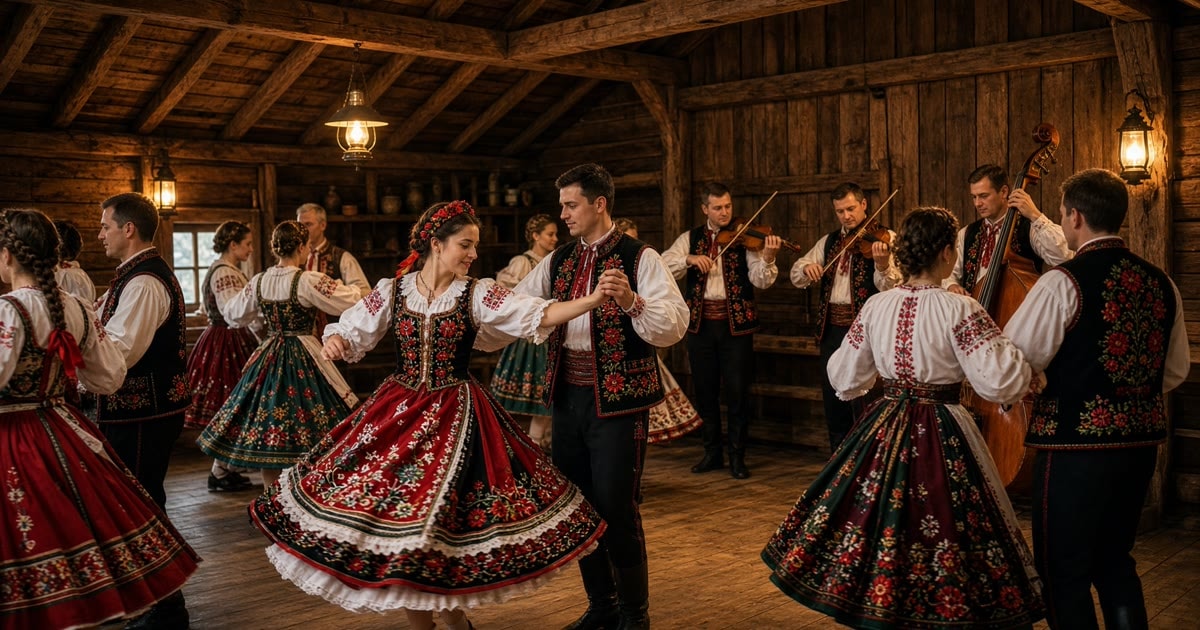
At first sight a táncház ("dance house") is simple: a live band plays and people dance. Behind it, though, is a learning method more than fifty years old. It carried village dance and music traditions into the everyday lives of thousands of young city people. In 2011 UNESCO selected it as a good practice for safeguarding intangible cultural heritage. This article explains where the dance house comes from, what happened in Budapest in 1972, and why UNESCO recognised the method rather than a particular dance.
What did "táncház" originally mean?
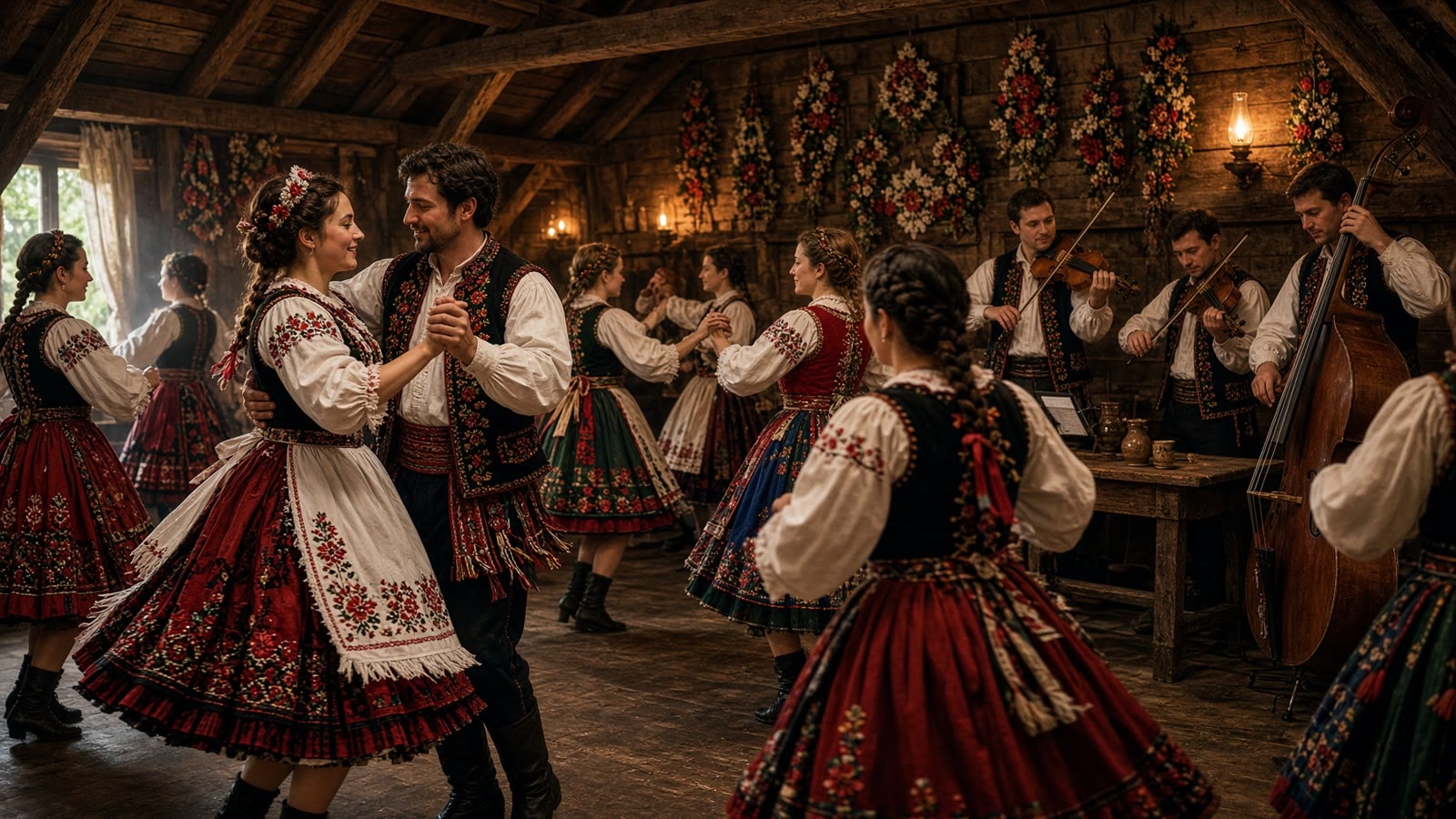
The word comes from village practice. In several parts of Transylvania young people gathered at a particular house to dance, and that house, or the occasion itself, was called the dance house. English-language Wikipedia traces the term to this Transylvanian tradition of holding dances in private homes [2].
One of the best-known places of that world is Szék (Sic in Romanian), in the Mezőség region. The village has three quarters, Felszeg, Csipkeszeg and Forrószeg, and each had its own dance house. The Csipkeszeg dance house is now a museum, and the rebuilt house in Forrószeg displays photographs by Péter Korniss [2]. Music from Szék also played a key role at the start of the Budapest movement.
6 May 1972: the first Budapest dance house
The first urban dance house was held on 6 May 1972 in Budapest, at the book club on Liszt Ferenc Square. Müpa Budapest summed up the beginnings for the movement's 40th anniversary: Béla Halmos played the fiddle, Ferenc Sebő the kontra (a three-string accompanying viola) and Péter Éri the double bass, and they played music from Szék. The dancers gathered around Sándor Timár, leader of the Bartók Dance Ensemble [3].
The 2013 obituary of Béla Halmos names Ferenc Novák, Ferenc Sebő, Béla Halmos and György Martin in connection with the beginnings. The same article says Halmos played a key role in getting the method onto the UNESCO list in November 2011 [4].
The idea behind it was simple. Folk dance on stage is choreography: a rehearsed production made for an audience. Village dancing is a community occasion in which everybody takes part. The dance house brought this second form to the city.
What makes it a method?
According to UNESCO, participants learn from more experienced members or tradition bearers by direct observation and imitation, accompanied by live music [1]. The essence is not a textbook but a situation:
- Live music. The band follows the dancers, and the dancers follow the band.
- Imitation. You watch better dancers and copy them. Teaching here is not dictating steps.
- Anyone can join. UNESCO stresses that anyone, regardless of age, competence or prior exposure, can become an active participant [1].
- Close to the source. Dances and tunes come from specific villages and specific informants. Folk dance and music resource centres give the public access to archival recordings [1].
UNESCO adds that today dance houses are complemented by events organised by age or content, workshops, camps, playhouses and handicraft clubs. Dancing goes together with singing, crafts and ethnographic presentations, and the method is used in art schools and at every level of education [1].
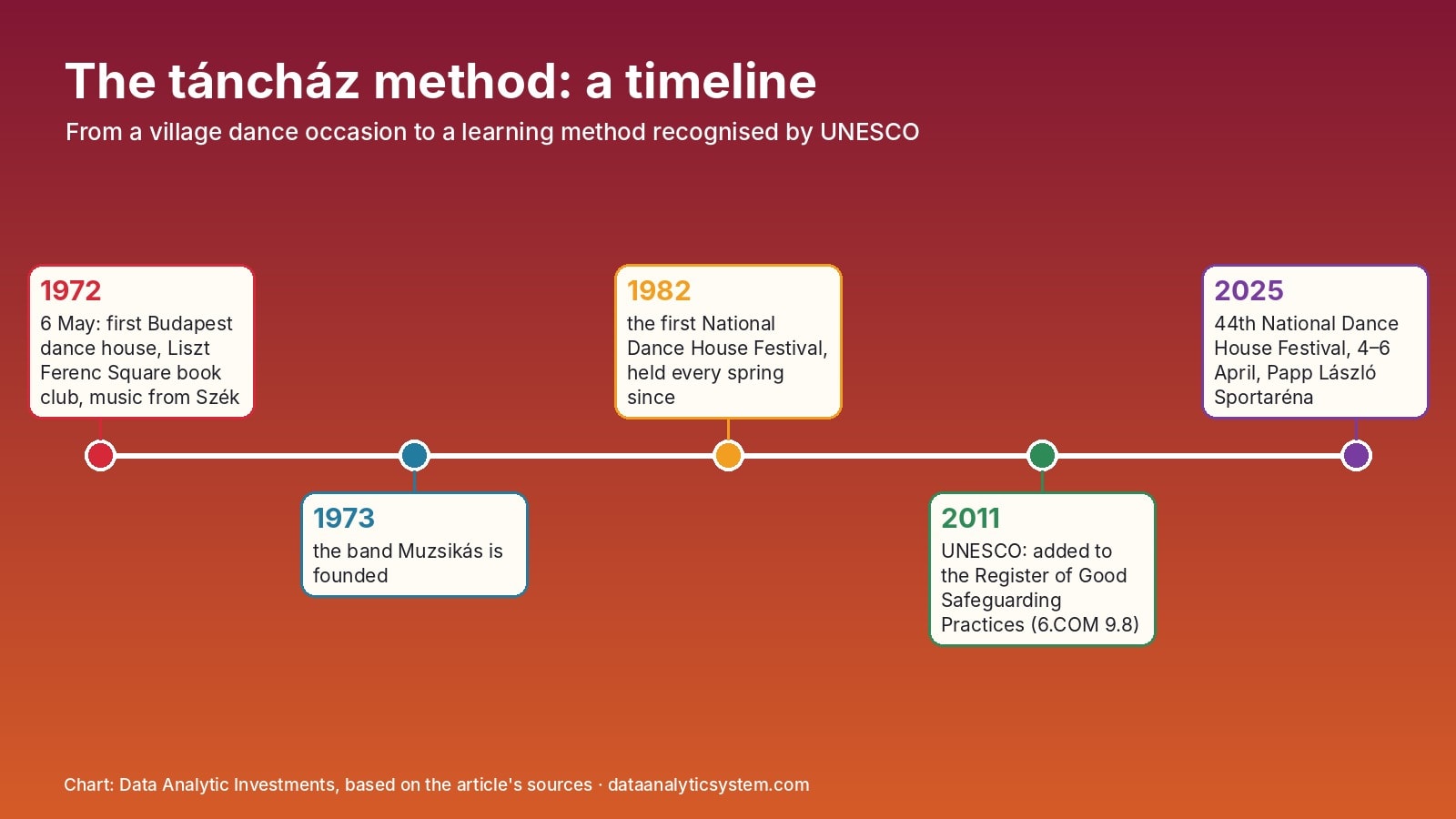
Milestones of the movement
| Year | Event |
|---|---|
| 1972 | 6 May: the first Budapest dance house, at the book club on Liszt Ferenc Square [3] |
| 1973 | the band Muzsikás is founded [5] |
| 1982 | the first National Dance House Festival, held every spring since [6] |
| 2011 | UNESCO adds the táncház method to the Register of Good Safeguarding Practices [1] |
| 2025 | 44th National Dance House Festival and Fair, 4–6 April, Papp László Budapest Sportaréna [7] |
The National Dance House Festival
The movement's largest yearly event is the National Dance House Festival and Fair (Országos Táncháztalálkozó és Kirakodóvásár). UNESCO itself describes it as the largest meeting of tradition bearers, mediators and enthusiasts [1].
According to a 2009 Infostart article, the festival has been held every spring since 1982. At the time it was part of the Budapest Spring Festival: the main venue was the Papp László Sportaréna, and the all-night Saturday dance house took place in the Petőfi Csarnok [6]. In 2025 the 44th festival, organised by the Táncház Association, ran from 4 to 6 April, again at the Sportaréna. For the first time it included international men's and youth legényes (solo men's dance) competitions [7].
The dance house around the world
The method did not stay in Hungary. English-language Wikipedia lists ensembles and camps in the United States (New Jersey, Washington, Los Angeles, New York, Cleveland, Michigan) that bring teachers and musicians from Hungary and Transylvania. London has a regular dance house [2].
The music travelled too. "Szerelem, szerelem", recorded by Muzsikás with Márta Sebestyén, features in the soundtrack of The English Patient (1996) [5].
Why did UNESCO recognise the method?
UNESCO keeps three lists for intangible cultural heritage. In 2011 the táncház was added to the Register of Good Safeguarding Practices (decision 6.COM 9.8). This register does not recognise an object or a custom. It recognises a way in which a community keeps its heritage alive, one that can serve as a model for other countries [1].
The distinction matters because several sources get it wrong. English-language Wikipedia, for example, mentions the list of elements in need of urgent safeguarding [2], while UNESCO's own page clearly names the Register of Good Safeguarding Practices [1].
5 things many people don't know
- UNESCO did not list Hungarian folk dance itself, but the táncház method: the way it is taught and passed on [1].
- The first Budapest dance house played music from Szék. Béla Halmos was on fiddle, Ferenc Sebő on kontra and Péter Éri on double bass [3].
- Béla Halmos trained as an architect. He graduated in 1970 and later earned a candidate's degree in musicology [4].
- In Szék every quarter had its own dance house. The one in Csipkeszeg is now a museum [2].
- The National Dance House Festival has been held every spring since 1982. The 2025 edition was the 44th [6][7].
How to get started
No prior knowledge is needed, because the dance house is built on learning on the spot. Comfortable shoes, patience and a few evenings will do. If you come from the music side, you can start with archival recordings, since one of the foundations of the method is that the source can be heard [1].
Sources
- UNESCO – Táncház method: a Hungarian model for the transmission of intangible cultural heritage (2011, 6.COM 9.8)
- Wikipedia – Táncház
- Müpa Budapest – Forty years of the táncház movement (15 May 2012)
- Infostart – Elhunyt Halmos Béla (19 July 2013, in Hungarian)
- Wikipedia – Muzsikás
- Infostart – National Dance House Festival (2009, in Hungarian)
- We Love Budapest – 44th National Dance House Festival and Fair 2025 (in Hungarian)
Educational content. Images marked "AI illustration" are not photographs.
Continue on DAI
Explore Topics
Written by
Data Analytic Investments
Content creator and writer sharing insights and stories.