Hungarian Christmas traditions from St Lucy's Day to Epiphany
Lucy wheat and Lucy's chair, carolling and nativity plays, regölés, szaloncukor, switching and house blessing: the customs of the Hungarian Christmas season day by day.
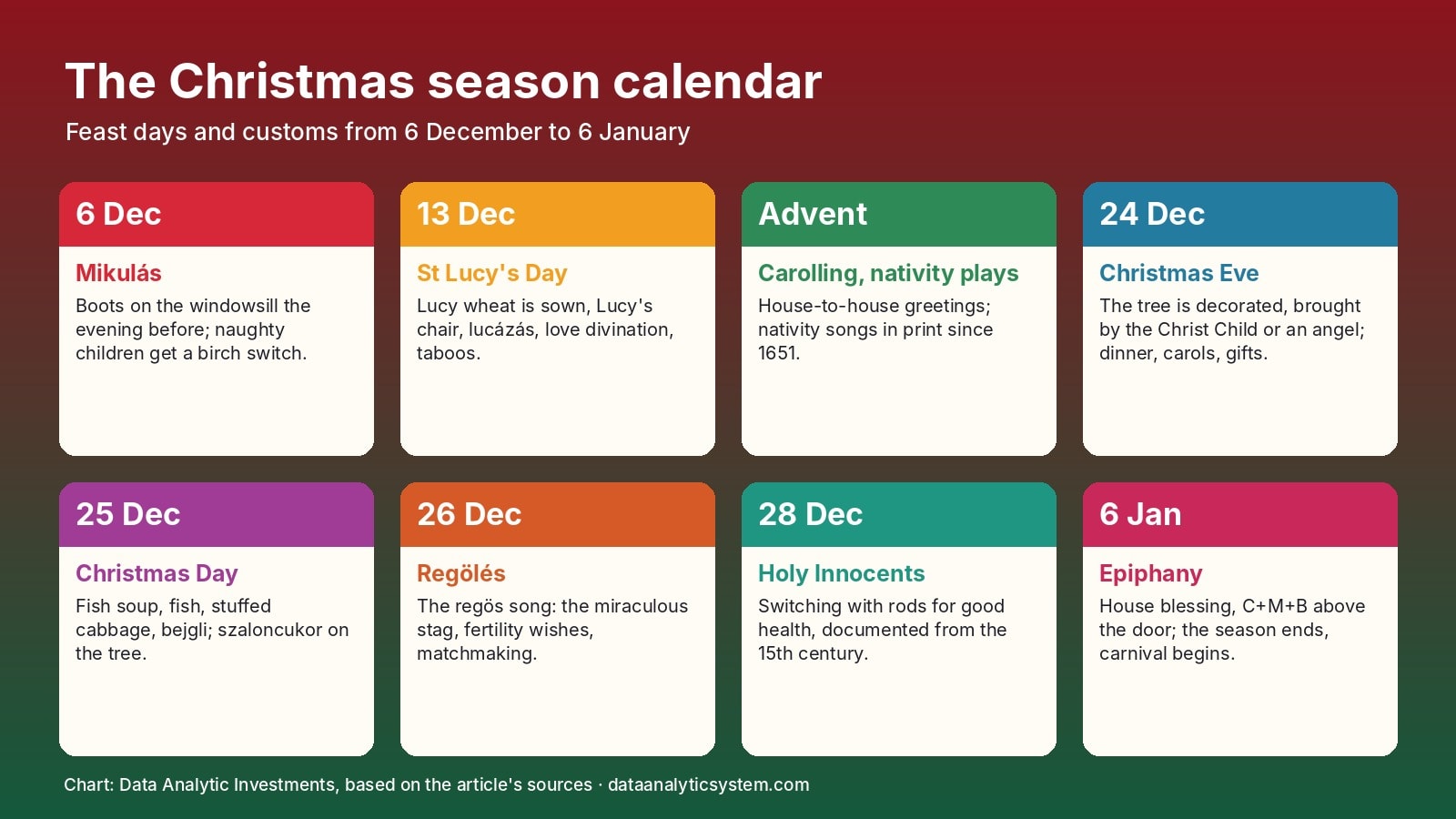
A Hungarian Christmas is not a single evening. In folk tradition it is a longer season that runs from mid-December to 6 January, and almost every day of it has a custom: a divination, a greeting, a play or a blessing. This article goes through the best-known customs of the season, from St Lucy's Day to Epiphany. It relies mainly on the Hungarian Ethnographic Lexicon (Magyar Néprajzi Lexikon) and flags where the sources are uncertain.
Prelude: Advent and Mikulás
Christmas is preceded by four weeks of waiting. Each week one more candle is lit on the Advent wreath [9]. On the evening of 5 December Mikulás (St Nicholas) arrives. Children put their boots on the windowsill and find sweets in them in the morning. Mikulás is often accompanied by a krampusz, and naughty children get a virgács, a bundle of birch twigs [9].
13 December: St Lucy's Day
Lucy's Day is one of the most superstition-laden days of the winter season. In Hungarian folk belief Lucy became a witch-like figure, and the day was surrounded by taboos and customs meant to ward off evil [2].
- Taboos. Baking, washing, lending and sewing were forbidden. Brooms were hidden so that witches could not fly on them [2].
- Lucy's chair. It was made from seven kinds of wood, one piece carved each day from Lucy's Day on. On Christmas Eve young men secretly carried it to midnight mass and stood on it to spot the witches, then fled, scattering poppy seeds or salt behind them. The chair was burnt before dawn [2].
- Lucázás. Boys went from house to house with straw or wood, recited verses and received gifts, to secure a good harvest. The custom was also called kotyolás or palázolás [2].
- Love divination. Girls wrote boys' names on twelve slips of paper and threw one away each day. The last name left revealed the future husband [2].
Lucy wheat
According to the Hungarian Ethnographic Lexicon, Lucy wheat (lucabúza) is wheat sown in a pot on Lucy's Day to sprout, also called Christmas wheat. People read the next year's harvest and the health of the family and the animals from how it grew [1]. In Hódmezővásárhely it was a good sign if it reached 30–40 centimetres by Christmas [1]. After the holidays it was fed to poultry and cattle to protect them from harm. Today it decorates the Christmas table in towns and villages alike [1].
Carolling and nativity plays
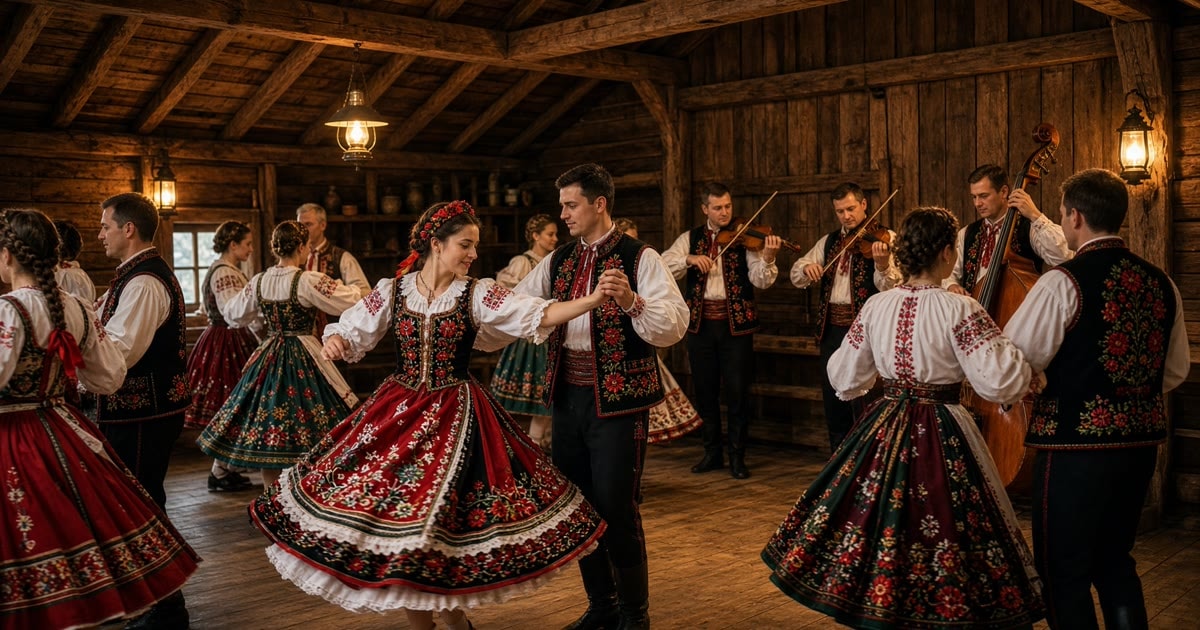
During the Christmas season people went from house to house to greet their neighbours. According to the lexicon, they sang carols under the window or inside, then thanked the household for the gift and said goodbye [3]. They went in age groups: children at noon, young people after supper, adults after nine in the evening. Children received walnuts, apples and hazelnuts, and adults were offered food and drink [3]. The custom had many names: kántálás, angyali vigasság, kóringyálás, mendikálás, pásztorlizás [3].
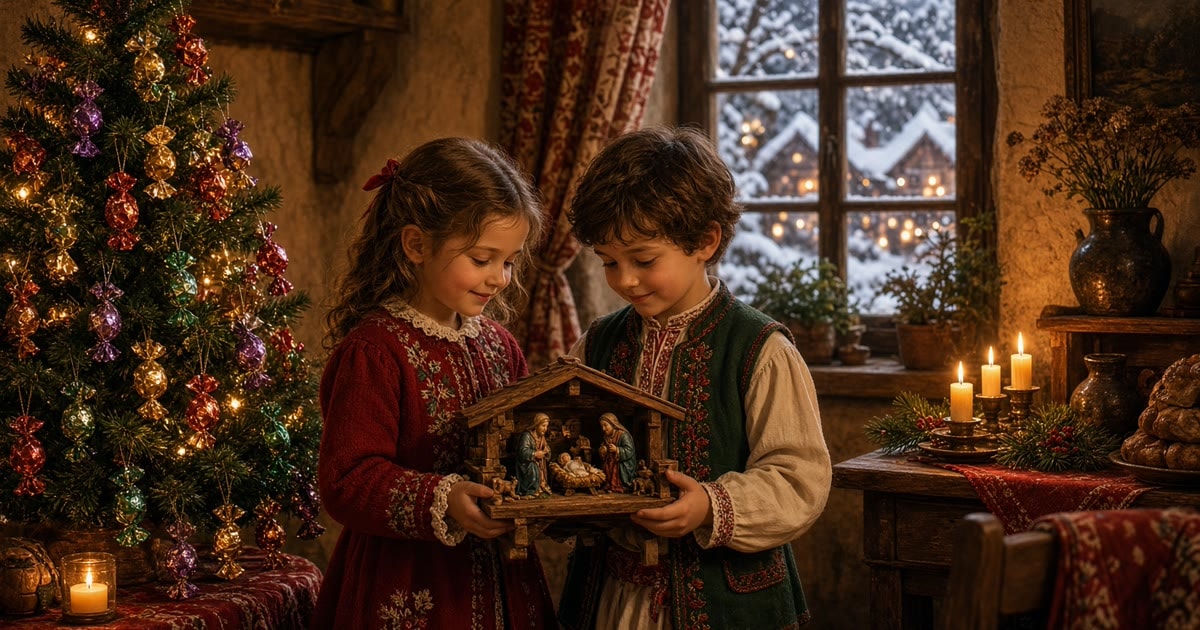
The nativity play (betlehemezés) is one of the Christmas plays: the angel brings the news, the shepherds speak, and the holy figures appear. The nativity songs were first printed in 1651, but on stylistic grounds they are thought to be older. The lexicon distinguishes variants from the Great Plain, Transylvania and Transdanubia [4].
Christmas Eve and Christmas Day
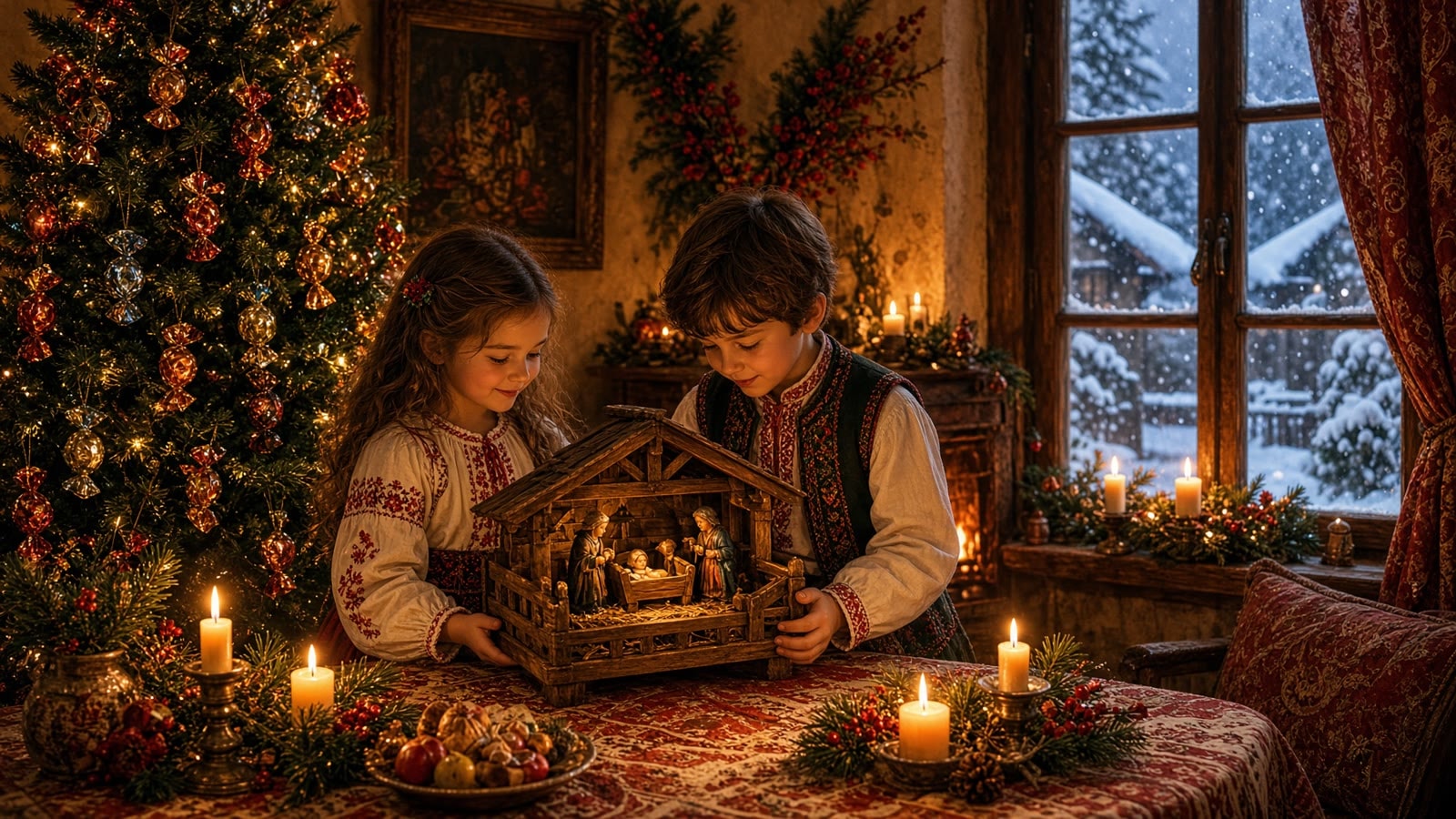
On the evening of 24 December the tree is decorated. Tradition says the tree and the presents are brought by the Christ Child or an angel. Presents are opened after dinner and carol singing [9]. The festive table has fish soup, carp or other fish, stuffed cabbage, meats and aspic, followed by bejgli, a poppy-seed or walnut roll [9].
The Christmas tree and szaloncukor
The Christmas tree arrived in Hungary in the 1820s. According to the memoirs of Frigyes Podmaniczky, one of his aunts set up the first one in 1825; other sources credit Teréz Brunszvik in 1828 [8].
Szaloncukor, the wrapped Christmas tree sweet, descends from French fondant, which probably arrived via Germany in the early 19th century. It takes its name from the bourgeois "szalon" (drawing room) of the Reform Era, where the tree stood [8]. As early as 1870 the novelist Mór Jókai wrote that his family hung "szalonczukkedli" on the tree [8]. According to the Hungarian news site Telex, szaloncukor is not officially a Hungarikum, but hanging it on the tree is almost certainly a Hungarian custom [8].
26 December: regölés
Regölés is a custom of parts of Transdanubia and Transylvania. The regös song has three parts: an epic introduction, a fertility-wishing section and a request for gifts [5]. The introduction often features the miraculous stag: a stag with shining antlers, carrying heavenly bodies, grazing on the bank of a clear river. In the matchmaking section a young man and a young woman are "sung together" [5]. The lexicon says regölés lived on especially in Göcsej and the Kemenes region, and in Udvarhely county [5].
28 December: Holy Innocents' Day
On this day the Church remembers the infants of Bethlehem killed by Herod [6]. By folk custom young men lightly struck girls and women with birch rods or braided twigs while wishing them good health. Later the custom passed mainly to boys, who switched every member of the household and received gifts [6]. The lexicon says the rite probably comes from fertility and cleansing rituals and is documented from the 15th century [6].
6 January: Epiphany
Epiphany (vízkereszt) closes the Christmas season: the tree comes down, and the carnival season (farsang) begins [7]. Around this day the priest blesses homes with holy water. Above the door the household writes the year and the letters C+M+B in blessed chalk ("Christus Mansionem Benedicat", may Christ bless this house), for example 20+C+M+B+27 in early 2027 [7]. Some write G+M+B instead, the initials of the three kings in Hungarian: Gáspár, Menyhért, Boldizsár [7]. The Three Kings procession (csillagozás) is documented since the 16th century [7].
5 things many people don't know
- Lucy wheat was not only decoration: its growth was used to predict the next harvest [1].
- Lucy's chair had to be made from seven kinds of wood, and it was burnt before dawn [2].
- Hungarian nativity songs were first printed in 1651 [4].
- Szaloncukor is not officially a Hungarikum, although hanging it on the tree is almost certainly a Hungarian custom [8].
- The C+M+B written at Epiphany is not the kings' names but the abbreviation of a Latin blessing [7].
Sources
- Magyar Néprajzi Lexikon – lucabúza (in Hungarian)
- Eduline – Love spells and that famous chair: what is Lucy's Day about? (2024, in Hungarian)
- Magyar Néprajzi Lexikon – karácsonyi köszöntés (in Hungarian)
- Magyar Néprajzi Lexikon – betlehemes (in Hungarian)
- Magyar Néprajzi Lexikon – regösének (in Hungarian)
- Magyar Néprajzi Lexikon – aprószentek napja (in Hungarian)
- We Love Budapest – Epiphany: folk customs, house blessing, Three Kings (2026, in Hungarian)
- Telex – Why is it a "szalon" sweet? And is it really a Hungarikum? (2021, in Hungarian)
- Wikipedia – Christmas in Hungary
Educational content. Images marked "AI illustration" are not photographs.
Continue on DAI
Explore Topics
Written by
Data Analytic Investments
Content creator and writer sharing insights and stories.