The Liszt Academy building: history and architecture on Liszt Ferenc Square
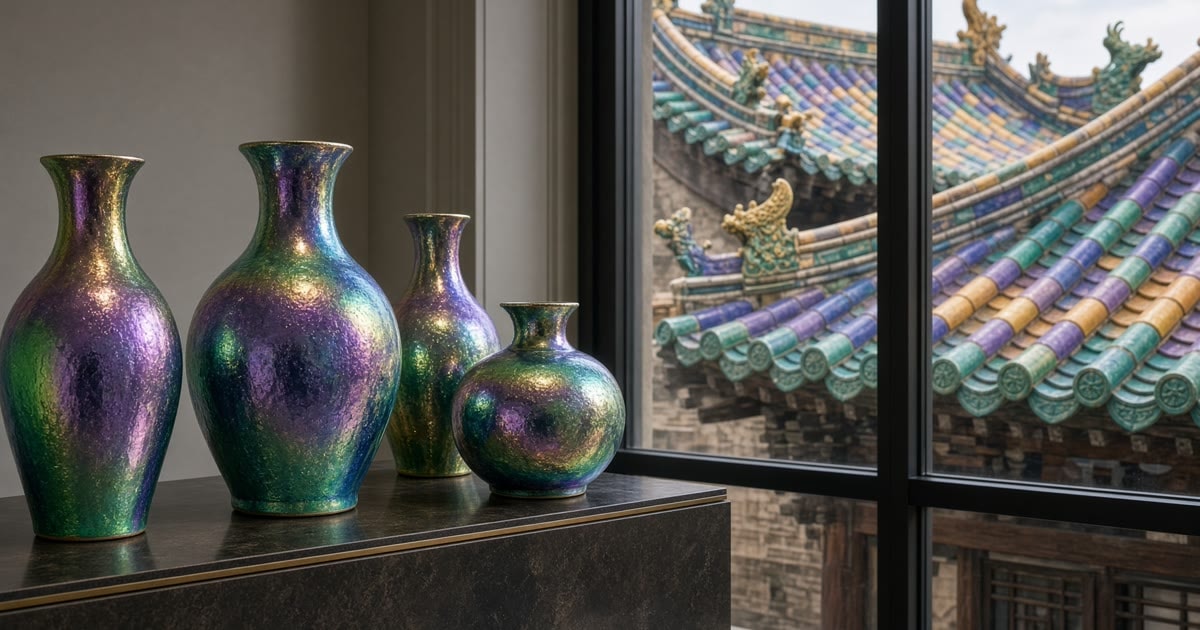
Flóris Korb and Kálmán Giergl's Art Nouveau palace opened in 1907, with Zsolnay ceramics and stained glass by Miksa Róth. It reopened on Liszt's birthday in 2013.
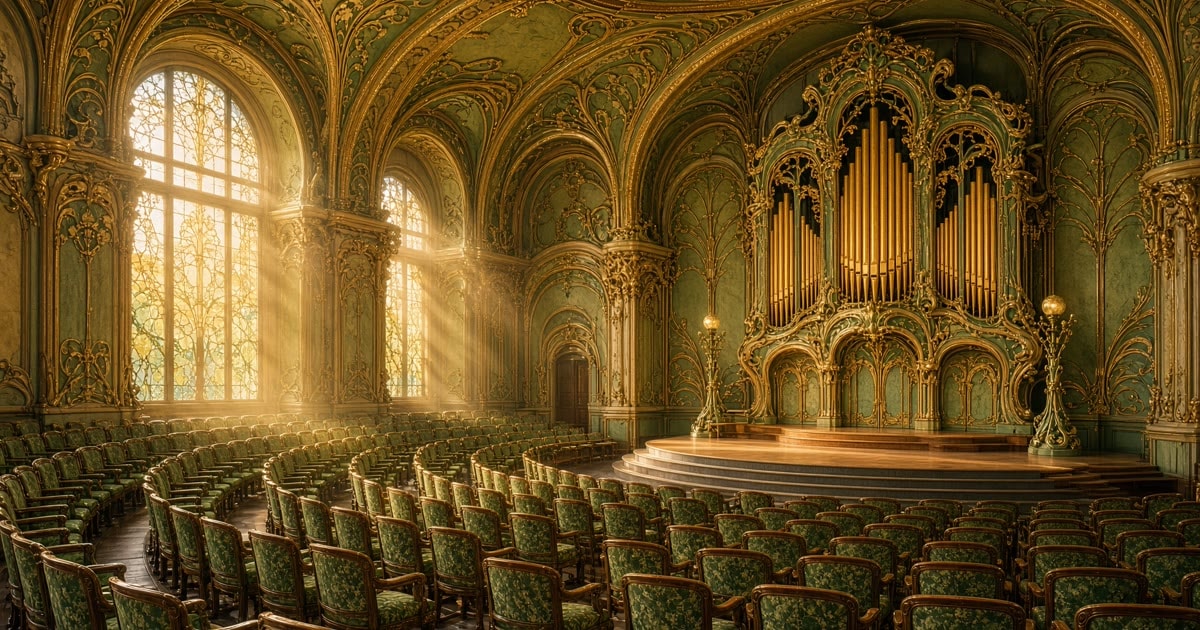
One of Budapest's finest concert halls sits inside a university building. Since 1907 the Liszt Academy's palace on Liszt Ferenc Square has taught, staged concerts and welcomed visitors. It is a key work of Hungarian Art Nouveau, made jointly by architects, sculptors, painters, glass artists and ceramicists. This article shows how the institution moved from its first home on Andrássy Avenue to today's building, who decorated it, and what the major renovation of 2013 changed.
The institution: from 1875
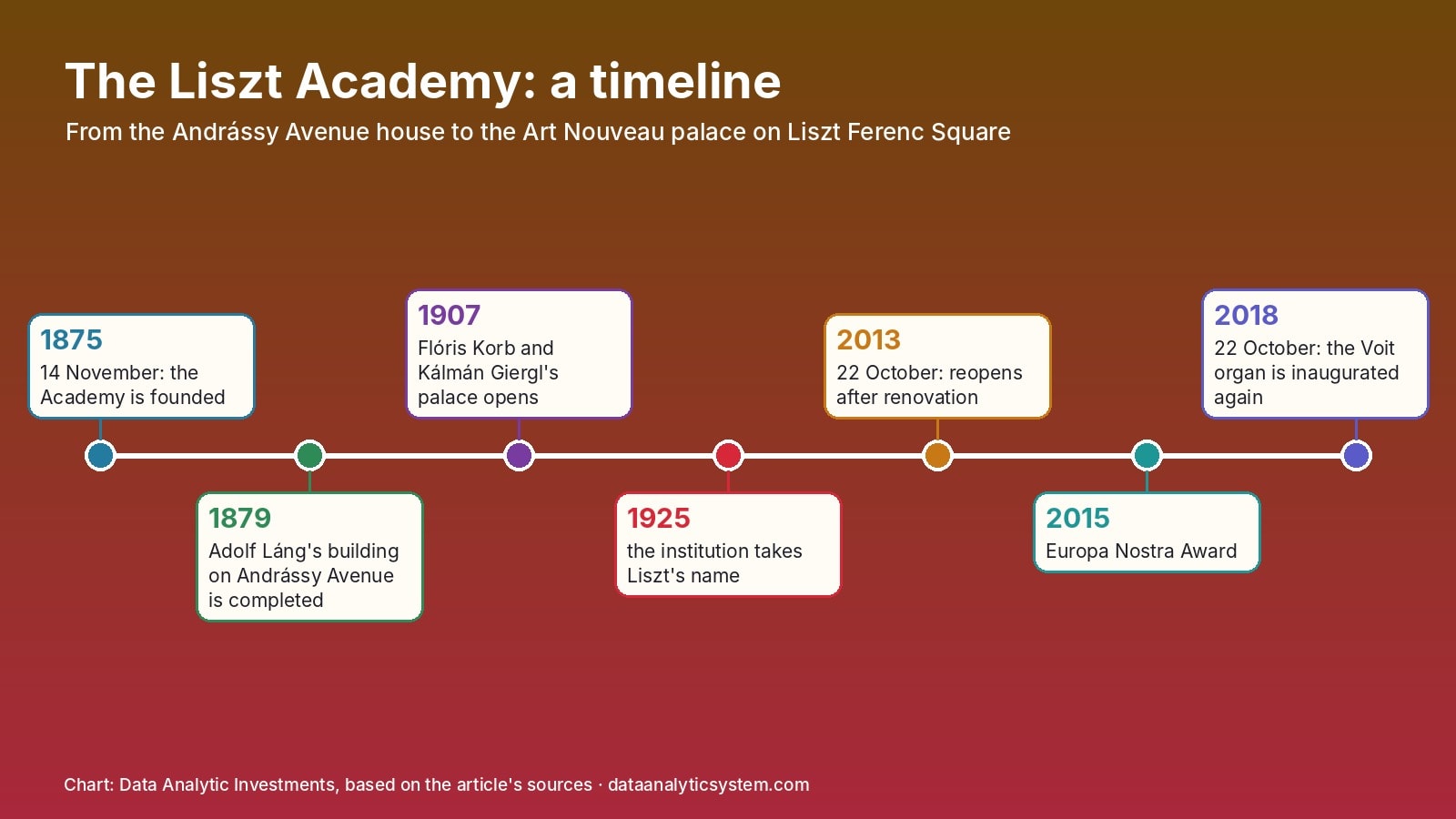
The Academy was founded on 14 November 1875. Wikipedia names Franz Liszt as its founder, and it has borne his name since 1925 [1]. Its first home was on Andrássy Avenue: a three-storey Neo-Renaissance house designed by Adolf Láng and built between 1877 and 1879, known today as the Old Music Academy. A memorial plaque by Zoltán Farkas was added in 1934, and the Academy bought the building back in the 1980s [1].
The new palace: 1907
At the initiative of Gyula Wlassics, then Minister of Culture, a new building went up on the corner of Király Street and Liszt Ferenc Square. It was designed by Flóris Korb and Kálmán Giergl in the Art Nouveau style and opened in 1907 [1][2].
The Council of Europe's heritage page describes the building as a "Gesamtkunstwerk", a total work of art in which artistic and technical design form a single whole [3].
Who decorated it?
| Element | Artist | Source |
|---|---|---|
| Design | Flóris Korb, Kálmán Giergl | [1][2] |
| Statue of Liszt on the façade | Alajos Stróbl | [1][3] |
| Stained-glass windows | Miksa Róth | [1][2] |
| Ornamental ceramics | Zsolnay factory | [1][2] |
| Lobby fresco | Aladár Körösfői-Kriesch | [2] |
The façade is dominated by Alajos Stróbl's statue of Liszt [1]. Inside there are frescoes, Zsolnay ceramics and statues, including figures of Béla Bartók and Frédéric Chopin [1]. The original stained-glass windows were made by Miksa Róth [1].
The renovation: 2013
After a century of use the building needed urgent restoration. According to the Council of Europe, alterations in the 1950s had damaged the concert halls and other interiors [3]. Work began with structural reinforcement, followed by new mechanical and electrical systems and air conditioning, which reused the original ventilation principles and the existing vertical shafts [3]. Archive photographs and on-site research guided the restoration of the original motifs, materials, textures and colours [3].
The renovated building reopened with a gala concert on 22 October 2013, Liszt's birthday [4][5]. According to the reports:
- Cost: 40 million euros, 90 percent from EU funds and 10 percent from the Hungarian government [4].
- New hall: a 300-seat chamber hall named after Georg Solti [4].
- Duration: the main hall was closed for four years [4][5]. According to We Love Budapest, the construction itself took a little over two years, and more than 1,100 people worked on it [6].
- Details: air conditioning that makes summer concerts possible, a 26-tonne technical bridge above the concert halls, and the return of the original, darker colours [6].
In 2015 the project won a Europa Nostra Award in the conservation category. The jury praised it as "an outstanding example of best practice in restoration" that combined the Art Nouveau building with modern performance technology. The renovation added 3,000 square metres of interior space [7].
The organ
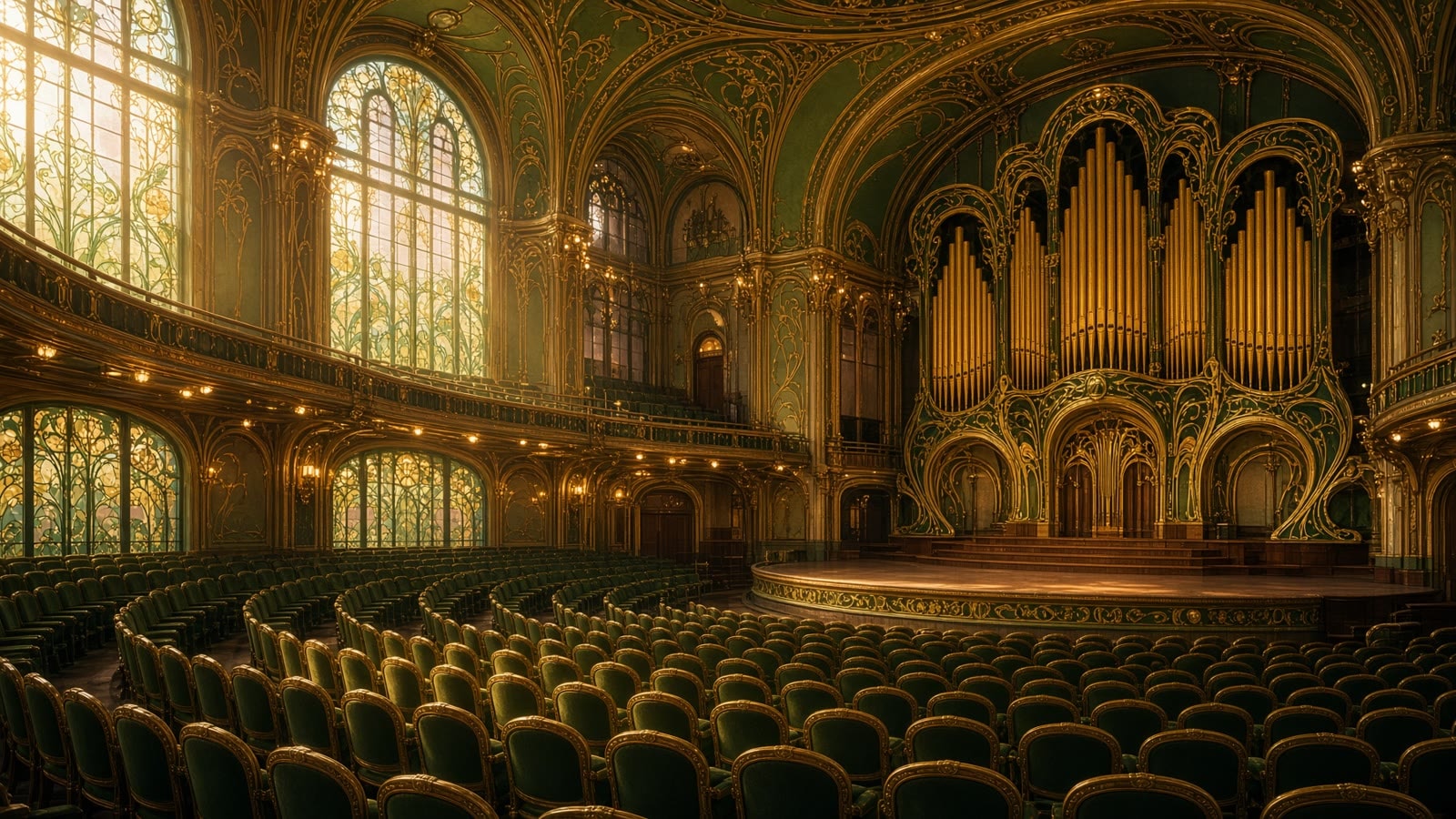
The main hall's organ also dates from 1907: the historic Voit organ. After a complex restoration funded by Hungary's Ministry of Human Capacities, it was inaugurated again in the main hall on 22 October 2018 [8]. That is the same date on which the building had reopened five years earlier: Liszt's birthday.
What to look for when you go in
If you go to a concert or a visit, start outside. Alajos Stróbl's statue of Liszt sits at the centre of the façade [1]. In the lobby you are greeted by Aladár Körösfői-Kriesch's fresco [2], and the Zsolnay factory's ornamental ceramics decorate the walls and staircases [1][2]. In the main hall you will see the darker original colours restored in 2013 and the restored Voit organ [6][8]. In a single walk the building shows almost every discipline of Hungarian Art Nouveau: architecture, sculpture, mural painting, stained glass and ceramics.
Who studied here
Wikipedia lists Béla Bartók, Zoltán Kodály, Georg Solti, Ernő Dohnányi, György Ligeti, György Kurtág, Georges Cziffra, Annie Fischer and Eugene Ormandy among the Academy's notable alumni [1].
5 things many people don't know
- The Academy had an earlier building on Andrássy Avenue, Adolf Láng's Neo-Renaissance house [1].
- The new palace was built at a minister's initiative: Gyula Wlassics pushed for it [1].
- The reopening date was deliberate: 22 October 2013, Liszt's birthday [4].
- The renovation brought back darker original colours in place of the lighter surfaces of recent decades [6].
- The project won a Europa Nostra Award in 2015 [7].
Summary
The Liszt Academy on Liszt Ferenc Square is at once a university, a concert hall and a monument. When it opened in 1907, the best masters of Hungarian Art Nouveau worked on it. Since the 2013 renovation it can again be seen in its original colours, with technology suited to today's performances.
Sources
- Wikipedia – Franz Liszt Academy of Music
- Kultura.hu – Music Academy Celebrates 100 Years in New Home
- Council of Europe – Liszt Academy of Music in Budapest
- Malay Mail / AFP – Famed Hungarian music academy gets new lease on life (22 October 2013)
- Gramophone – Budapest's Liszt Academy reopens restored Concert Centre
- We Love Budapest – What changed at the Liszt Academy? (29 October 2013, in Hungarian)
- Liszt Academy – Liszt Academy Wins Europa Nostra Award
- Government of Hungary – The inauguration of the restored historic Voit organ in the Grand Hall of the Liszt Academy (22 October 2018)
Educational content. Images marked "AI illustration" are not photographs.
Continue on DAI
Explore Topics
Written by
Data Analytic Investments
Content creator and writer sharing insights and stories.