TOP500, 68th list: an unchanged top ten, five exascale systems and the fewest newcomers in the list's history – what HPL and the Green500 measure, and why JUPITER is first in Europe
2.198 exaflop/s at the top, five machines above one exaflop, 27 newcomers out of five hundred, and a French machine that performs 73 billion operations per watt. What the supercomputer ranking shows, and what it does not – with sources, without product recommendations.

Twice a year, in June and November, a list of the world's five hundred fastest supercomputers is published: the TOP500. The 68th edition was released at the SC26 conference in Chicago in November. Based on Network World's article of 16 November, StorageReview's roundup of 19 November, Tom's Hardware's weekly digest of 21 November and the official TOP500 highlights, this article goes through the main figures and explains what the list measures. It is not a product recommendation.
| Fact sheet | |
|---|---|
| List | 68th TOP500, November 2026 (SC26, Chicago) |
| No. 1 | LineShine, Shenzhen (China) — 2,198.40 PF/s (2.198 EF/s) HPL |
| No. 2 | El Capitan, LLNL (USA) — 1,809.00 PF/s |
| Nos. 3–5 | Frontier (USA) 1,353 · Aurora (USA) 1,012 · JUPITER Booster (Germany) 1,000 PF/s |
| Above one exaflop | five systems |
| New systems | 27 — the fewest newcomers in the list's history |
| Entry threshold (No. 500) | about 2.86 PF/s |
| Green500 No. 1 | KAIROS (Toulouse, France) — 73.28 GFlop/s/W |
Sources: TOP500, Network World, 16 Nov, StorageReview, 19 Nov.
The top ten has not changed
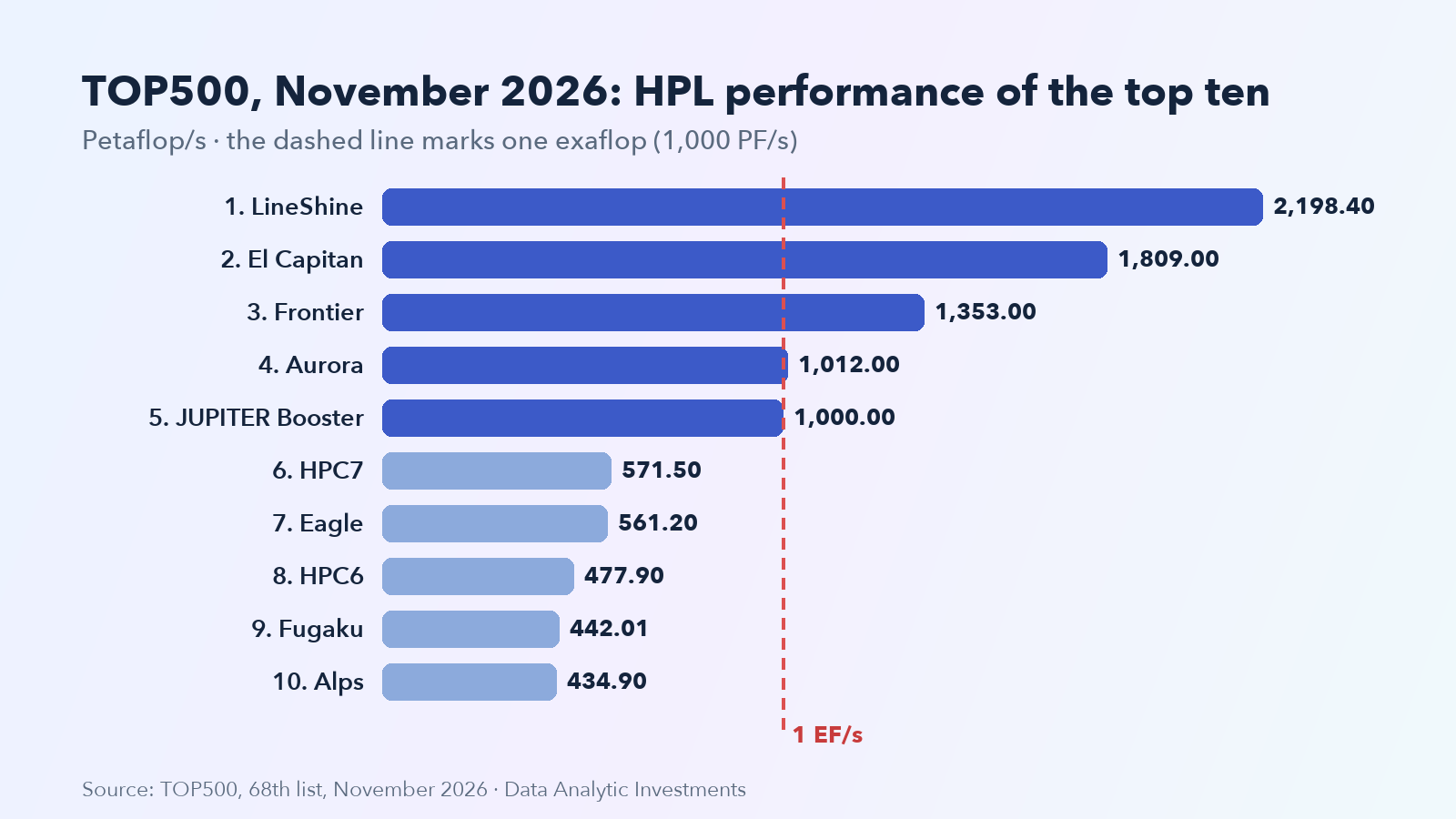
According to Network World, the top ten systems kept their June positions. At the top is LineShine at the National Supercomputing Centre in Shenzhen, at 2.198 exaflop/s; according to TOP500, it took first place in June and draws about 42.2 megawatts. Behind it come the American El Capitan, Frontier and Aurora, with Germany's JUPITER Booster fifth at exactly 1,000 petaflop/s.
| Rank | System | Country | HPL (PF/s) |
|---|---|---|---|
| 1 | LineShine | China | 2,198.40 |
| 2 | El Capitan | USA | 1,809.00 |
| 3 | Frontier | USA | 1,353.00 |
| 4 | Aurora | USA | 1,012.00 |
| 5 | JUPITER Booster | Germany | 1,000.00 |
| 6 | HPC7 (Eni) | Italy | 571.50 |
| 7 | Eagle | USA | 561.20 |
| 8 | HPC6 (Eni) | Italy | 477.90 |
| 9 | Fugaku | Japan | 442.01 |
| 10 | Alps | Switzerland | 434.90 |
Source: TOP500, November 2026.
What HPL measures
The list is ranked by the HPL (High-Performance Linpack) benchmark: it measures how fast a machine solves a large system of linear equations, in floating-point operations per second (this article's own knowledge, based on TOP500's description of its method). One exaflop/s is 10¹⁸ operations per second; a petaflop/s is a thousandth of that.
HPL is a single type of task. That is why the list reports two other measurements: HPCG, which tests memory loads closer to real applications — where, according to the source, LineShine is also first at 22 PF/s — and HPL-MxP, which measures mixed-precision computing, led by El Capitan at 16.7 EF/s. The order therefore also depends on what is measured.
Why JUPITER is first in Europe
TOP500 names JUPITER Booster in Jülich as Europe's first exascale system. This article's note: 1,000.00 PF/s is exactly the exaflop threshold; according to Network World, the top five are the only systems to reach one exaflop on HPL.
Record-low turnover
According to StorageReview, only 27 new systems joined the list — 5.4 percent of the 500 places, and, according to the organisers, the lowest turnover in the list's history. This article's check: 27 / 500 = 5.4%. The highest new entry is KISTI's HANGANG in South Korea, at No. 12 with 342.6 PF/s.
Total performance and the entry threshold differ slightly between sources: the official highlights give 19.71 EF/s and 2.87 PF/s, while Network World and StorageReview give 19.57 EF/s and 2.857 PF/s. This article notes both; the official TOP500 table is decisive.
Energy efficiency: the Green500
The Green500 ranks the same machines by performance per watt. According to the source, first place goes to KAIROS in Toulouse at 73.28 GFlop/s/W, second to the also-French ROMEO-2025, and third to the GPU extension of Germany's Levante. KAIROS delivers about 3 PF/s in total and draws 46 kW — so the most efficient machine is not the fastest.
5 things many people don't know
- The TOP500 is based on a single benchmark. HPL measures the solution of one system of equations — TOP500 also reports other measurements.
- Only submitted machines appear on the list. A system is listed only if a benchmark result is submitted (this article's own knowledge).
- The most efficient and the fastest machine are not the same. A 46 kW system leads the Green500.
- The top five are all exascale. One of them is European.
- There have never been so few newcomers. 27 new systems out of five hundred.
Summary
- At the top: LineShine, 2.198 EF/s; the top ten is unchanged.
- Above one exaflop: five machines, including Europe's first exascale system, JUPITER Booster.
- Newcomers: 27, a record low.
- Efficiency: KAIROS, 73.28 GFlop/s/W.
- The exact figures are set by the official TOP500 list.
Related reading: Blog archive.
Educational content. Not a product recommendation and not investment advice. This article describes public press sources and the figures published by TOP500; the methodological background is this article's own knowledge and is marked as such. Data Analytic Investments is not affiliated with the TOP500 project, the institutions or manufacturers listed, or the portals cited; names are used for identification only.
Continue on DAI
Explore Topics
Written by
Data Analytic Investments
Content creator and writer sharing insights and stories.