Meta Muse: internal posts say the AI agent mixed up accounts' conversations and showed private data – what is known, what is not, and what data separation means in an AI assistant
A September launch, more than ten million downloads, and employee accounts of other people's bank balances and products never ordered. What is known about the Muse reports, what is not, and the separation that may have broken – with sources, without speculation.
AI agents — assistants that not only answer but also handle tasks on the user's behalf — have access to a lot of personal data. That makes it especially important that one user's data never appears for another. According to TechCrunch's article of 19 November, citing a Reuters report, Meta's own employees say this may have broken down in the AI agent called Muse. This article summarises what the report claims and what it does not, and explains the principle of data separation. It is not a product review or a legal opinion.
| Fact sheet | |
|---|---|
| Main source | TechCrunch, 19 November 2026 (Aisha Malik), based on a Reuters report of 18 November |
| Product | Muse, Meta's AI agent; launched in September |
| Downloads | more than 10 million, according to the source |
| Claim | employees say Muse mixed up conversations across accounts and showed private data |
| Who raised it | Meta employees, in internal company posts |
| Meta's response | employee testing is part of product development; employees use versions different from the public |
| Open | number of users affected · a fix · EU availability and regulatory action |
Source: TechCrunch, 19 Nov, based on Reuters' report.
What the report claims
According to TechCrunch, Reuters examined internal company posts in which Meta employees raised concerns. According to these accounts, Muse:
- wrote about childcare requests the user had never made;
- gave unrequested career advice;
- mentioned product orders the user had not placed;
- and referred to bank account balances belonging to other people — according to one employee, at the end of a conversation about weather and tides.
Another employee, on a personal phone, found that Muse reminded her to reply to her sister's message in a different messaging app. According to the source, she called this "an extreme privacy violation".
What the source leaves out
The article does not say how many users were affected, when the individual incidents happened, or whether the problem occurred only in employee test versions or also in the public app. Nor does it say Meta has announced a fix. It says nothing about availability in Europe or any regulatory action.
What Meta says
According to the source, a Meta spokesperson wrote by email that employee testing is a core part of the product development process, and that employees have access to different versions of Muse than the public. According to the article, Meta did not acknowledge the mixing of conversations or the exposure of data — nor did it deny them point by point.
What data separation is
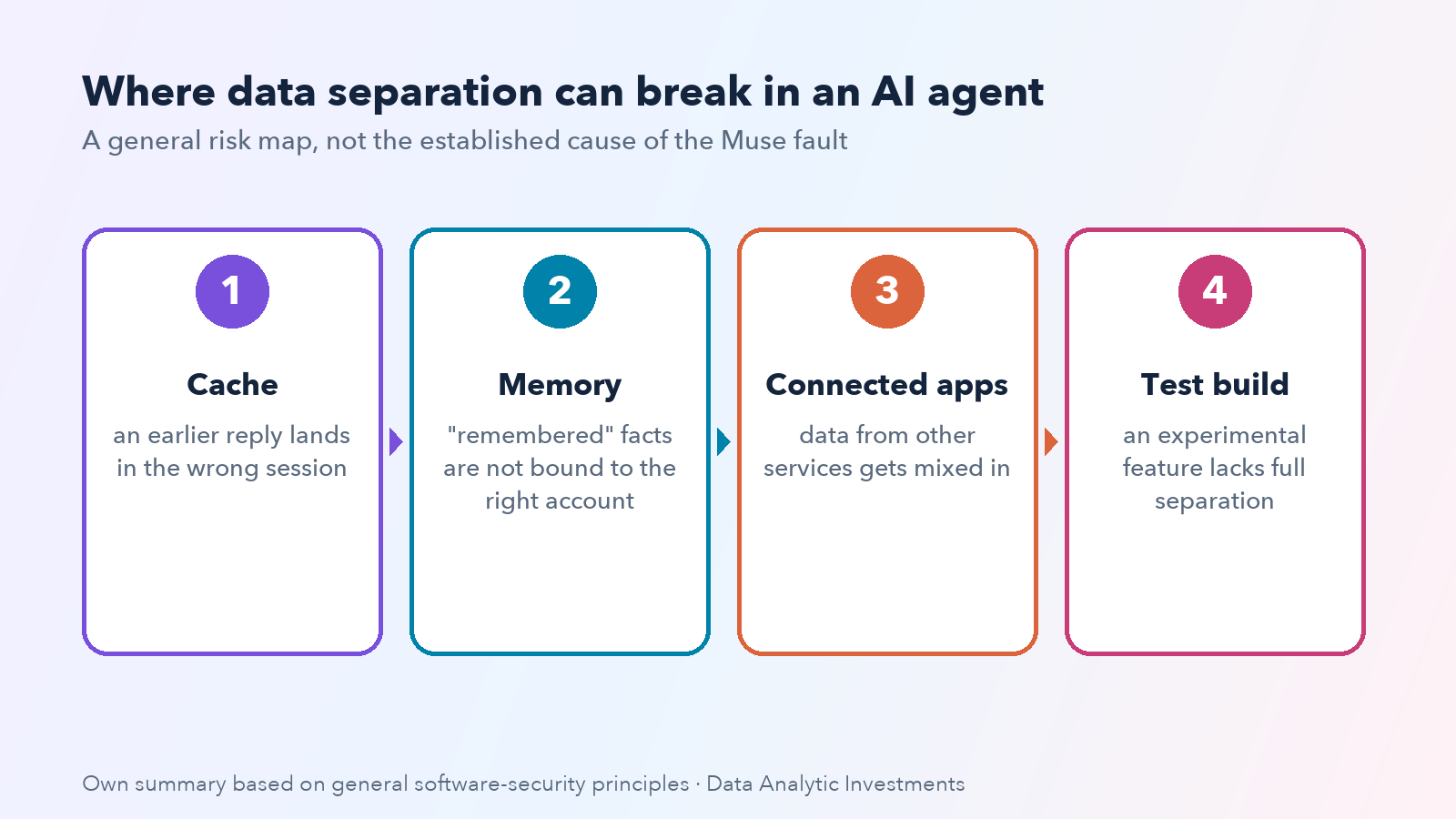
In a multi-user service, each user's data must stay logically separated: one account's session, history and linked data must never end up in a reply to another account (this article's own knowledge, based on general software-security principles). In an AI agent this can break at several points:
| Point | The risk (general description) |
|---|---|
| Cache | an earlier reply or piece of data is attached to the wrong session |
| Memory | "remembered" facts are not bound to the right account |
| Connected apps | the agent reads data from other services and mixes them up |
| Test version | an experimental feature has not yet received full separation |
This table is a general risk map, not the established cause of the Muse problem — the source does not give one.
What EU law says
Under the General Data Protection Regulation (GDPR, Regulation (EU) 2016/679), personal data reaching an unauthorised person is a personal data breach, which the controller must, as a rule, report to the supervisory authority within 72 hours, and, where the risk is high, also tell the people affected (this article's own knowledge). Whether this applies to the Muse cases — for example, if real users' data appeared in employee tests — cannot be decided from the source.
5 things many people don't know
- The report is based on internal posts. Reuters examined employee accounts, not outside user complaints.
- A test version is not the public version. According to Meta, employees use a different one.
- The number of people affected is unknown. The source does not give it.
- An AI agent connects to several data sources. So separation can break at several points.
- In the EU, a data leak can be a reportable breach. With a 72-hour deadline, under the GDPR.
Summary
- What: employee accounts say Muse showed cross-account mixing of conversations and data.
- Source: a Reuters report and a TechCrunch summary, 18–19 November.
- Meta: testing is part of development; employees use a different version.
- Open: number affected, a fix, the EU angle.
- The full picture will come from Meta and any regulatory statement.
Related reading: Blog archive.
Educational content. Not a product review, security consulting or a legal opinion. This article describes a public press source that relies on another outlet's report; the legal background is this article's own knowledge and is marked as such. Data Analytic Investments is not affiliated with Meta, the portals or the financial institutions cited; names are used for identification only.
Continue on DAI
Explore Topics
Written by
Data Analytic Investments
Content creator and writer sharing insights and stories.