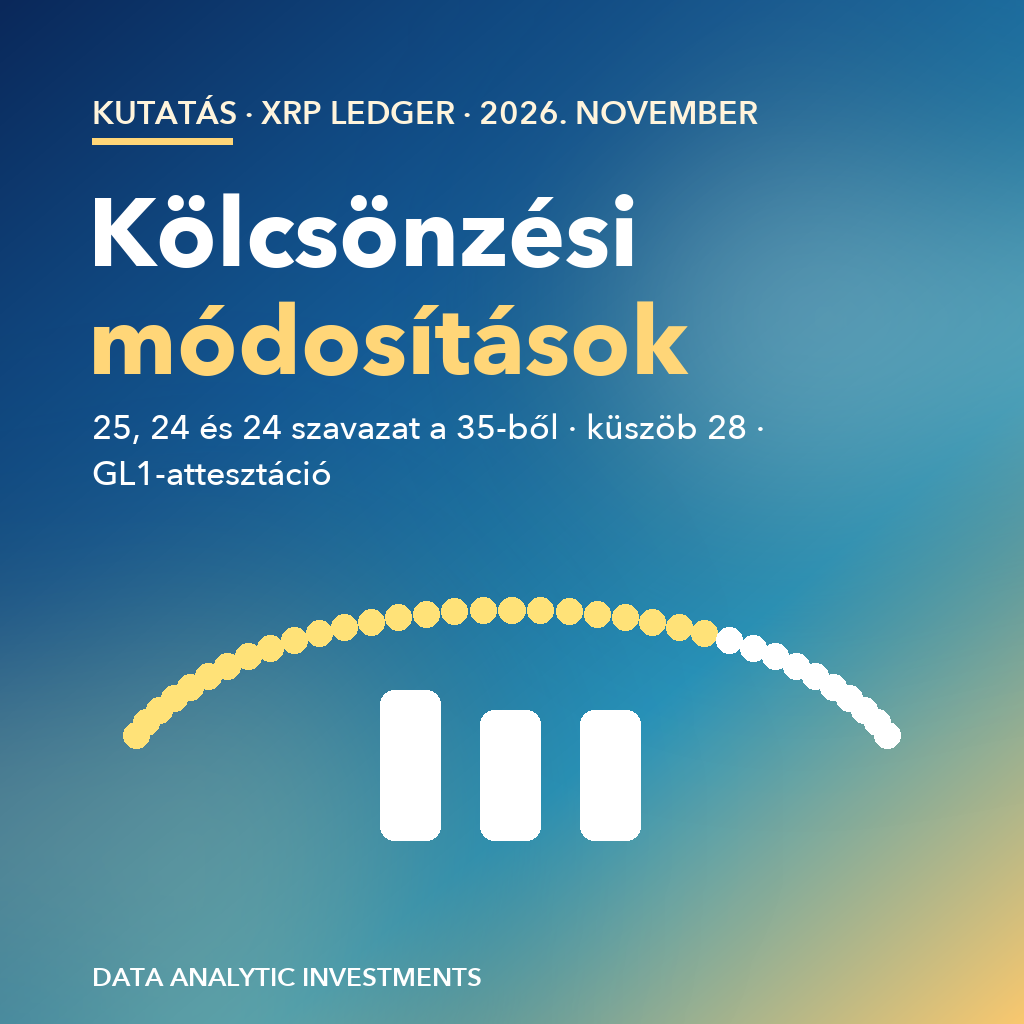
XRP Ledger: the lending amendments stand at 25, 24 and 24 votes out of 35 – three to four short of the threshold; and what CertiK checked in the GL1 attestation
Three amendments that only make sense together; two votes in three days; a run-through on the developer network; and an attestation only part of which was checked by an outside party. Where XRPL lending stands – with sources, without prices.
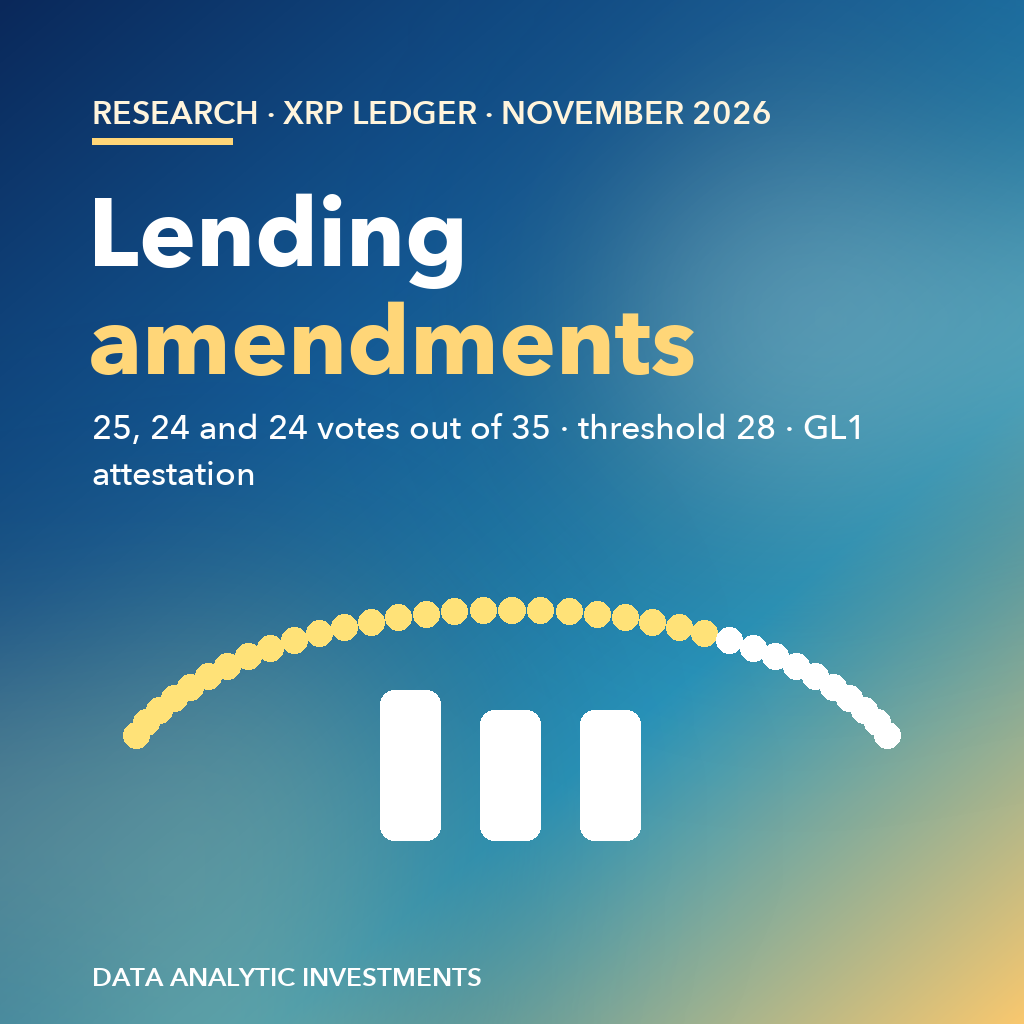
Native lending on the XRP Ledger does not depend on one amendment but on three. A summary published on cryptonews.net on 20 November and CoinTurk's article the same day, both citing XRPScan data, report that all three have gained two votes since 17 November. Another XRPL story ran the same week: CertiK's verification of a GL1 self-attestation. This article explains both. It says nothing about price.
| Fact sheet | |
|---|---|
| Single Asset Vault (XLS-65) | 25 / 35 votes (20 Nov) |
| Lending Protocol (XLS-66) | 24 / 35 |
| LendingProtocolV1_1 | 24 / 35 |
| Required | at least 80% for two weeks; 28 with 35 validators (XRPScan, 21 Nov) |
| Earliest activation | no date; at least 14 days after the 28th vote |
| Test run | Clearpool, Devnet, 19 November |
| GL1 | XRPLF self-attestation (18 Nov); CertiK verified the architecture and resiliency part |
Sources: cryptonews.net / U.Today, 20 Nov, CoinTurk, 20 Nov, cryptonews.net / Crypto Briefing, 18 Nov.
The three amendments
According to the sources, lending is built like this:
| Amendment | Role, according to the source |
|---|---|
| Single Asset Vault (XLS-65) | lenders deposit assets into a shared liquidity pool (vault) |
| Lending Protocol (XLS-66) | loan brokers issue loans from the vault's capital; the ledger tracks repayments |
| LendingProtocolV1_1 | a fix-and-extension package; shipped with release 3.4.0 on 29 September |
An earlier blog article covers how it works, and another the vault's November vote — then still at 24.
According to the sources, the logic is built into the ledger rather than a third-party smart contract, and follows a bank-like model: fixed terms, a repayment schedule, and a broker who vets the borrower off-chain. It follows that the protocol does not remove credit risk.
How the vote has moved
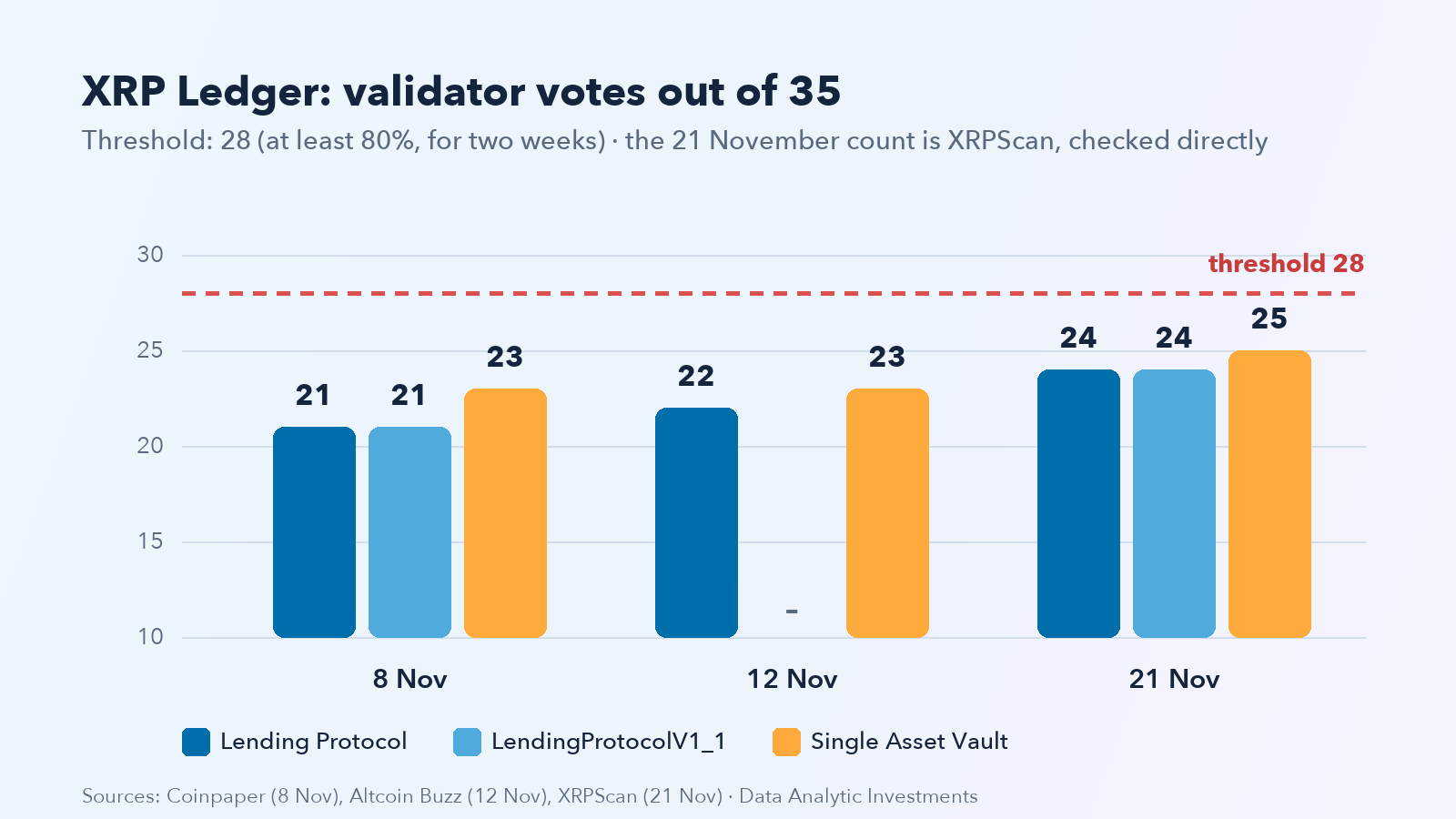
| Date | Lending Protocol | V1_1 | Single Asset Vault | Source |
|---|---|---|---|---|
| most of October | – | about 19 | – | U.Today, CoinTurk |
| 8 November | 21 | 21 | 23 | Coinpaper (background) |
| 12 November | 22 | – | 23 | Altcoin Buzz (background) |
| 20 November | 24 | 24 | 25 | XRPScan, per the 20 Nov articles |
This article's calculation: 28 / 35 = 80.0%; 25 / 35 ≈ 71.4%; 24 / 35 ≈ 68.6%. The vault is three votes short, the other two four. XRPScan data for 21 November, checked before publication, shows the same 25–24–24 count and a threshold of 28.
Contradiction: the 20 November articles say all three amendments gained two votes since 17 November; for the vault that implies a starting value of 23, matching the 8 and 12 November figures, but no source describes any movement in between. Nor do they say what ended the "stall" — only that the numbers rose.
Why there is no date
Once the threshold is reached, support must stay at 80% or more for two uninterrupted weeks. If it dips, the clock restarts — as happened in October with fixCleanup3_4_0; according to a background source, that amendment finally went live on 4 November. Lending needs all three amendments, so the earliest date depends on the slowest vote.
The run-through on the developer network
According to the sources, on 19 November Clearpool ran the full flow on the XRPL Devnet using the RLUSD stablecoin: a broker assesses the borrower off-chain, the borrower accepts and repays the loan, and the lender redeems at a higher share price. The Devnet is a test environment with no real value.
The GL1 attestation
According to Crypto Briefing on 18 November, the XRP Ledger Foundation (XRPLF) published a self-attestation against all ten principles of the GL1 Market Infrastructure Toolkit (including governance, legal basis, settlement finality, operational resilience and data privacy). CertiK independently verified only the architecture and resiliency part, in a report dated 13 November. According to the source, GL1 began as an initiative of the Monetary Authority of Singapore (MAS). The "first public, permissionless layer-1" description is XRPLF's own claim.
What this means in the EU
In the EU, MiCA applies to crypto-asset issuers and service providers (this article's own knowledge, based on Regulation (EU) 2023/1114). Neither a ledger amendment nor an industry self-attestation is a regulatory authorisation, and neither means that any lending service has been authorised.
5 things many people don't know
- Lending needs three amendments. Vault, protocol and fix package — according to the sources.
- A person vets the borrower. The broker, off-chain.
- The 28th vote is not activation. Two weeks follow.
- The Devnet run is not live operation. It is a test environment.
- Only part of the GL1 attestation was checked by an outside party. Architecture and resiliency.
Summary
- Votes (20 Nov): vault 25, protocol 24, V1_1 24 out of 35.
- Threshold: 28, for two weeks.
- Date: none; at least 14 days after the threshold.
- Test run: Devnet, 19 November.
- GL1: self-attestation, partly externally verified.
Related reading: XRPL Lending Protocol (XLS-66): how it works · Single Asset Vault: 24 of 35 · Blog archive.
Educational content. Not investment advice. This article describes public press sources and the public workings of the XRP Ledger, says nothing about price, and does not assess any specific crypto-asset or service. Vote counts come from secondary sources; the current position is shown by the ledger. Data Analytic Investments is not affiliated with Ripple Labs, the XRP Ledger Foundation, CertiK, Clearpool, the validators or the portals cited.
Continue on DAI
Explore Topics
Written by
Data Analytic Investments
Content creator and writer sharing insights and stories.
Related tools & research
This article is a companion piece to the book.
RIPPLE — the book
An Unofficial Documentary Study of Ripple and the XRP Ledger
22 chapters · every claim with a named source · numbered first edition · $29