France proposes tougher MiCA rules: staking, crypto lending, stablecoins, advertising, overseas platforms and customer data – what the CCSF's six points contain, and where the MiCA review stands
Six areas, one advisory committee, one central-bank publication and an EU review that is still under way. What France's CCSF proposes for staking, crypto lending and advertising, and what it does not mean for today's rules – with sources, without prices.

The EU's crypto-asset regulation, MiCA, has applied in full, with no transitional period, since 1 July 2026. Its rules are not final, however: the European Commission has opened a consultation on reviewing them, and member states and the EU supervisory authority are making proposals. According to crypto.news on 20 November, a French advisory committee now wants tougher rules in six areas. This article summarises the proposals and explains where the process stands. It is not investment or legal advice.
| Fact sheet | |
|---|---|
| Main source | crypto.news, 20 November 2026 (Rony Roy) |
| Proposed by | CCSF (Comité consultatif du secteur financier), a French financial advisory committee |
| Adopted | 10 November |
| Published by | Banque de France, 17 November |
| Requested by | France's economy ministry, in April |
| Areas covered | staking · lending · stablecoins · advertising · overseas platforms · data protection |
| Background | ESMA's proposed MiCA amendments, 2 October |
| Legal status | a proposal — not a rule in force |
Sources: crypto.news, 20 Nov, The TRADE, 2 Oct.
Who the CCSF is, and what it did
The CCSF is a French advisory committee that gives opinions on relations between the financial sector and its customers. According to the source, France's economy ministry asked it in April to review crypto services; the committee adopted its proposals on 10 November, and the Banque de France made them public on 17 November. The proposal is not law: it is a national body's position for the EU review.
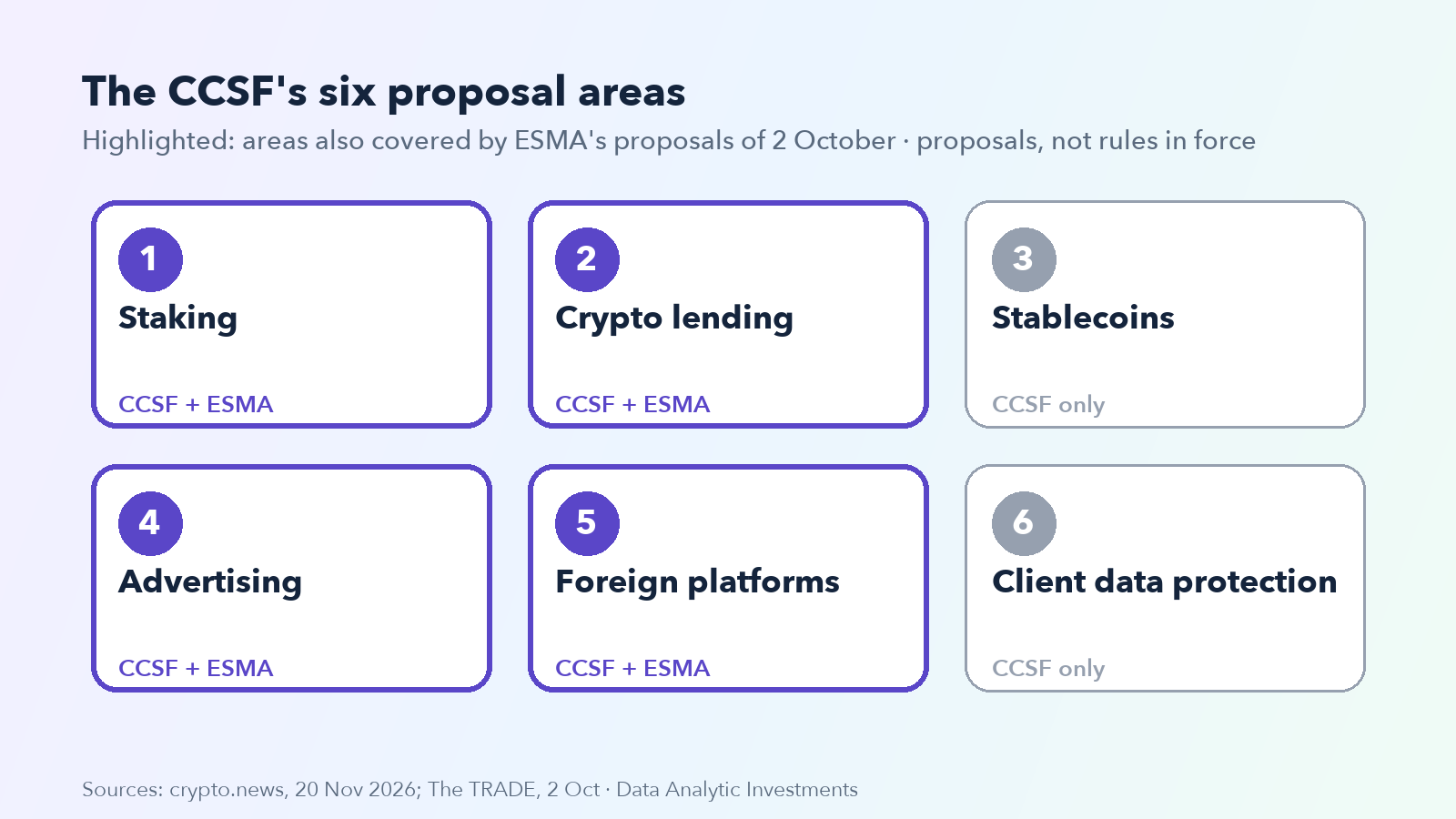
The six areas
1. Staking
Staking means locking up a crypto-asset to help secure a network's operation, for which a reward may be paid (this article's own knowledge, general description). According to the source, the CCSF asks platforms to disclose in advance the risks of validator penalties, smart-contract flaws and hacking, as well as unlock times — and to stake customers' assets only with explicit consent.
2. Crypto lending
According to the source, platforms should explain what happens if a borrower defaults, how compensation is calculated, and whether assets can be withdrawn early. The committee also questioned whether the word "savings" may be used for products without bank-deposit-style protection.
3. Stablecoins
It asks for clearer disclosure of the risk of losing the peg, and of the difference between redeeming with the issuer and selling on an exchange. An earlier blog article covers stablecoins that do not comply with MiCA.
4. Advertising
According to the source, it proposes tighter controls on influencer marketing, social media ads, referral rewards and reward programmes, especially for highly speculative assets. If the riskiest assets cannot be reliably identified, the stricter standard would apply to all retail crypto products — without a general advertising ban.
5. Overseas platforms
The CCSF asks the European Commission to tighten the rules on reverse solicitation, and to give ESMA stronger powers against unauthorised services. Reverse solicitation is when a customer, on their own initiative, approaches a provider without EU authorisation (this article's own knowledge, based on Article 61 of MiCA).
6. Protecting customer data
According to the source, following physical threats targeting crypto holders, the committee asks for stricter internal access controls and logging of access to customer records, using MiCA, DORA and EU data-protection law as the benchmark.
How this relates to ESMA's proposals
According to The TRADE on 2 October, ESMA itself proposed amendments in response to the Commission's consultation: stricter marketing rules (including for influencers), proportionate requirements for staking and lending backed by mandatory disclosures, powers against unauthorised third-country firms, and simpler white-paper notification. The two sets of proposals point the same way on several points — but neither has yet changed the regulation.
5 things many people don't know
- MiCA's transitional period has ended. On 1 July 2026, according to The TRADE.
- The review is still under way. Proposals are coming in following the Commission's consultation.
- A national advisory committee's opinion is not binding. An EU regulation can be changed only by EU legislation.
- The word "savings" is also a legal question. The CCSF says it can mislead for products without deposit protection.
- Reverse solicitation is an exception, not a loophole. The CCSF says it should be tightened.
Summary
- Who: France's CCSF, published by the Banque de France.
- What: six areas — staking, lending, stablecoins, advertising, overseas platforms, data protection.
- Link: overlaps on several points with ESMA's October proposals.
- Status: a proposal; the MiCA text has not changed.
- The rules in force are set by Regulation (EU) 2023/1114.
Related reading: ESMA: non-MiCA-compliant stablecoins · MiCA: seven questions before choosing a crypto provider · Blog archive.
Educational content. Not investment or legal advice. This article describes public press sources and EU regulatory proposals, says nothing about price, and does not assess any specific crypto-asset or provider. Data Analytic Investments is not a crypto-asset service provider and is not affiliated with the CCSF, the Banque de France, ESMA or the portals cited.
Continue on DAI
Explore Topics
Written by
Data Analytic Investments
Content creator and writer sharing insights and stories.