Ripple and XRP – the full picture: one company, one ledger, one lawsuit, and what happened through September 2026
Ripple is a company, XRP is a digital asset, the XRP Ledger is a public network – three different things that headlines often call by one name. This overview moves from document to document: from the 100 billion supply and the 80/20 split, through escrow and the SEC lawsuit, to the regulatory turn of 2025–2026. Every claim carries its source, and every source is read for what it does not say.

Few subjects attract this many strong opinions from this few people who have read the documents. Headlines use the word "Ripple" for a San Francisco company, a digital asset and a public network at the same time. And in the arguments, what a court actually said is often blended with what a community would like to hear.
This article does not try to settle anything, and it says nothing about where any price is heading. It does what the documentary method does: it goes through the public record – court documents, regulatory releases, the ledger's own data – and for each one it notes what it records and what it does not. At the end you will find the full source list, the book and the songs written for it.
Listen: audio version of this article (19 min, mp3) · Magyarul: Ripple és XRP – a teljes kép
1. Three names, three things
Before anything else, it is worth separating the three concepts, because most misunderstandings start here.
Ripple is a private company (officially Ripple Labs Inc. today), headquartered in San Francisco. It was founded in 2012 as OpenCoin, became Ripple Labs in September 2013 and simply Ripple in October 2015. Its chief executive is Brad Garlinghouse; its co-founder and chairman is Chris Larsen.
The XRP Ledger (XRPL) is a public, open-source distributed ledger. It has been running since 2012, and it is not Ripple's "property": anyone can run a server on it, and its rules are changed by the votes of independent validators.
XRP is the ledger's native digital asset. It pays transaction fees, it is the reserve required to open an account, and it serves as a common "bridge" on the ledger's built-in exchange.
The three are connected, but not the same. Ripple is the largest holder of XRP and one of the most active developers of the ledger, yet the ledger would run without the company, and the price of XRP is not set on the company's balance sheet. When a headline says "Ripple did this or that", the first question is always whether it means the company, the asset or the network.
2. The prehistory: from a Canadian payment idea to the ledger
The name "Ripple" is older than the company. In 2004, the Canadian programmer Ryan Fugger designed a system called RipplePay, in which people paid each other along chains of personal trust, without a central bank. The project stayed small, but the idea – that value can travel across a network of trust – survived.
In 2011–2012, Jed McCaleb, David Schwartz and Arthur Britto began working on a ledger that reaches agreement through consensus instead of Bitcoin-style mining. That became the XRP Ledger. In 2012, Chris Larsen joined, and OpenCoin was founded, taking over the name of Fugger's project as well. The rest is the history of today's company.
The first chapters of RIPPLE – An Unofficial Documentary Study reconstruct this early period from documents, and the book's timeline starts even earlier, in 1988.
3. How the XRP Ledger works – without mining
A few basic features of the ledger can be described without technical jargon.
Consensus, not mining. Transactions are approved by validators: servers that agree every few seconds on the next state of the ledger. There is no block reward and no mining race. Each server decides which validators it trusts (the so-called UNL, Unique Node List); according to the XRPL.org documentation, servers typically use a publicly published default list.
The fee is destroyed. Every transaction pays a small fee in XRP, and that fee goes to no one: the system destroys it. This is why the total amount of XRP has been shrinking slowly, transaction by transaction, from the 100 billion of 2012.
Reserve. Opening an account requires a minimum XRP reserve. It protects the ledger against junk accounts and is adjusted from time to time by validator vote.
A built-in exchange. Since 2012 the ledger has had its own order book – the built-in decentralised exchange (DEX). Since 2024, automated market maker pools (AMM) have also run on it as a native feature.
Changing the rules: the "amendment". A new feature can enter the ledger only if at least 80 per cent of validators support it continuously for two weeks. This is a public process that anyone can trace. A recent example is documented item by item in a separate article: the BatchV1_1 amendment's support from 30 of 35 validators, with the threshold of 28 and a possible activation on 29 September.
These features explain why the Ripple story is so much about speed and cost. They are engineering properties, not promises.
4. The 100 billion and the 80/20
The entire supply of XRP was created at once when the ledger launched in December 2012: 100 billion units. No new XRP has been created since.
How that supply was divided is recorded, item by item, not in a blog post but in a court document: the complaint the SEC filed on 22 December 2020. According to it, 80 billion XRP went to the company and 20 billion to the founders. That decision shaped much of the next ten years of dispute, because from then on the company became the world's largest seller of XRP.
The details – three paragraphs of the complaint and two early legal memos – are laid out in a separate article: The 80 and the 20 – one decision that echoed for ten years.
5. Escrow: 55 billion, one billion a month
In December 2017, Ripple placed 55 billion XRP from its own holdings into time-locked escrow, using the ledger's native escrow function. The escrows are set up so that on the first day of each month at most 1 billion XRP becomes available. Whatever the company does not use that month it typically places back into new escrow with a later expiry.
The mechanism can be checked by anyone on the ledger. The most recent release was on 1 September 2026: 1 billion XRP was released in three transactions (500, 400 and 100 million), and the amount remaining in escrow fell from 32.28 billion to 31.28 billion (according to crypto.news). According to press summaries, 70–90 per cent of each monthly release is usually placed back into escrow.
What this does not mean: a release from escrow is not the same as a sale. The ledger records the fact and the size of the escrow. What happens to the released XRP – sale, allocation to a partner or re-escrow – the ledger shows only in part, and the company's intentions not at all.
6. The lawsuit: 2020–2025
The complaint
On 22 December 2020, the U.S. Securities and Exchange Commission (SEC) sued Ripple, Brad Garlinghouse and Chris Larsen. The core allegation: since 2013 the company had sold unregistered securities when it sold XRP. The question at the heart of the case was the old American Howey test: did buyers expect profits from the managerial efforts of others?
The Torres ruling – 13 July 2023
The 34-page decision of U.S. District Judge Analisa Torres is not best read as "won" or "lost". The court examined the manner of the sales:
- the company's contract-based sales to institutional investors (about $728.9 million, according to the decision) were investment contracts, and therefore securities transactions;
- programmatic sales on exchanges – where buyers could not know whom they were buying from – were not;
- executives' personal sales and other distributions (for example to developers and employees) were not either.
No sentence of the decision says that "XRP is not a security" in general. It says that the same asset may or may not be the subject of an investment contract, depending on the circumstances of the sale. The full analysis: What the Torres ruling says – and what it does not.
The final judgment – 7 August 2024
The court imposed a civil penalty of $125,035,150 on the company and an injunction against future violations of the registration provisions of the Securities Act of 1933. The SEC had originally asked for far more.
The close – 2025
In spring 2025, the SEC and Ripple would have settled: a smaller ($50 million) penalty and the lifting of the injunction. Judge Torres, however, declined on 15 May and again on 26 June 2025 to allow this through a modification of the final judgment. The parties then chose to withdraw their appeals. According to the SEC's release of 7 August 2025, the appeal and cross-appeal pending before the Second Circuit Court of Appeals were dismissed by joint stipulation, and the district court's final judgment remains in effect – including the $125,035,150 penalty and the injunction.
What the close of the case does not mean: it does not mean that a higher court confirmed or overturned the Torres ruling – the appeals were withdrawn and no decision was made. The Torres ruling is a district court decision and does not bind other courts.
7. 2025–2026: the company's transformation
Alongside the close of the case, Ripple as a company changed markedly. The following are facts recorded in announcements and regulatory documents. None of them says anything about the price of XRP.
Its own stablecoin – RLUSD. The New York State Department of Financial Services (NYDFS) approved it on 10 December 2024, and distribution began on 17 December. The dollar-backed token lives on Ethereum and on the XRP Ledger. According to RWA.xyz data, on 14 September 2026 about $2.38 billion was in circulation (about $1.37 billion on Ethereum and about $1.01 billion on the XRP Ledger; the amount has kept changing since). According to The Crypto Basic's summary, that made it the eighth-largest dollar stablecoin. How the issuer creates and destroys RLUSD is covered in a separate article: Ripple burns 15 million RLUSD.
A U.S. stablecoin law. In July 2025 the GENIUS Act, the first federal stablecoin law, was signed. It provided the framework for the next step.
A bank charter. On 12 December 2025, the U.S. banking regulator (OCC) granted conditional approval to establish Ripple National Trust Bank, a federally supervised trust bank that would, among other things, manage the reserves of RLUSD. Conditional approval is not a final charter: until the conditions are met, the bank cannot begin operating.
Acquisitions. Between 2023 and 2025 the company bought a complete financial infrastructure:
- Metaco (custody, 2023, $250 million);
- Rail (stablecoin payments, 2025, $200 million);
- Hidden Road (multi-asset prime broker, 2025, $1.25 billion, now operating as Ripple Prime);
- GTreasury (corporate treasury software, 2025, $1 billion).
Capital raise. In November 2025, Ripple announced a $500 million strategic investment at a $40 billion valuation.
An exchange-traded fund. On 13 November 2025, the first U.S. spot XRP ETF – Canary Capital's fund, ticker XRPC – began trading on Nasdaq. Funds from other issuers followed. The existence of an ETF is about the form of access, not the quality of the asset.
An exchange rule, 3 September 2026. SEC order 34-106268 approved an exchange rule change in which an example sentence refers to Bitcoin, Ether, Solana and XRP as "currently eligible commodities". This is a rulebook, not a law and not a ruling. The detailed reading: Digital commodity – what the SEC wrote on 3 September, and what it did not.
A central-bank experiment. A project of the Bank for International Settlements (BIS) tested the verification of official statistics on the XRP Ledger. What that means and what it does not: BIS tested verification of official statistics on the XRP Ledger.
A public, sourced map of the company's partnerships from 2012 to 2026: Ripple partner network 2012–2026.
8. What the numbers and documents do not say
The most important part of an overview like this is what cannot be read from it.
- A court decision is not a price forecast. The Torres ruling was about the legal classification of sales, not about the value of the asset.
- A company's success is not the asset's success. RLUSD's growth, the acquisitions and the bank approval strengthen Ripple's corporate business. What follows for demand for XRP is not recorded in these documents.
- An ETF is not a rating. It shows that a regulated product may hold the asset, not that the asset is "safe".
- An exchange rule is not a law. In September 2026 the term "digital commodity" lives in a rulebook. Comprehensive U.S. market-structure legislation is a separate process.
- Escrow is not a sale. The monthly escrow release is visible on the ledger; the company's sales decisions are not.
Keep these five sentences in mind, and most Ripple headlines fall into place.
9. The book: RIPPLE – An Unofficial Documentary Study
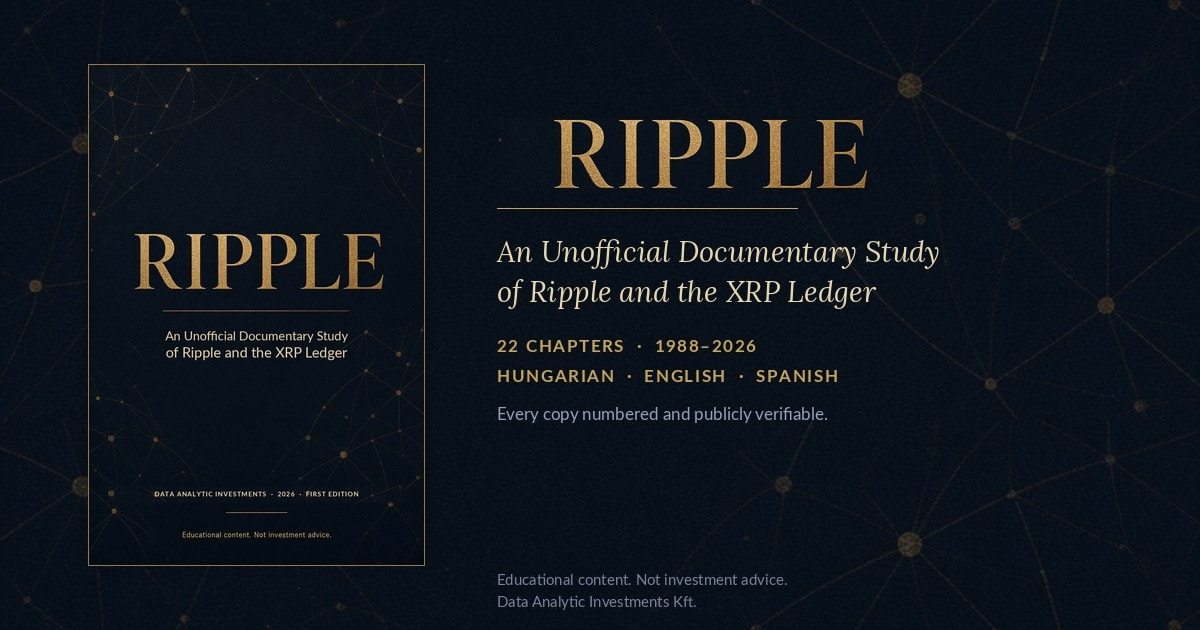
Everything this article sketches in a few thousand words is documented source by source in the book RIPPLE, in 22 chapters, from 1988 to 2026. The book is built from court records, regulatory filings, conference transcripts and the ledger itself. It includes a chronological table, a source list and a methodology note.
- The book's page: dataanalyticsystem.com/ripple
- PDF in four languages – English, Hungarian, Spanish and German, $29: /ripple/book
- Audiobook in the same four languages: /ripple/audiobook
- How it was made: Inside RIPPLE the book – how a 22-chapter documentary study was built
The book is not an official publication, is not affiliated with Ripple Labs Inc., does not forecast prices and does not give advice to buy or sell. Its subject is the public record: what was said, by whom, when, and what was later confirmed or contradicted.
10. The songs: TRUE LEDGER and Living Ledger
Two original pieces were made for the book, released by Data Analytic Investments.
TRUE LEDGER – a music piece set to the themes of the book.
- YouTube: youtube.com/shorts/SS8EjBkQXfU
- Streaming services (HyperFollow – pre-save here; release date 7 October 2026): distrokid.com/hyperfollow/dataanalyticinvestments/true-ledger
Living Ledger – the book's "spoken companion", a recording built on the book's visual world.
- YouTube: youtube.com/shorts/9P-hq5NYfjU
- Streaming services (HyperFollow): distrokid.com/hyperfollow/dataanalyticinvestments/living-ledger
The songs circle the same question as the book – what remains of a story when only what was written down remains – with music instead of footnotes.
What this article does NOT claim
It does not claim that the legal status of XRP has been settled in every jurisdiction. It does not claim that Ripple's corporate results would have any particular effect on the price of XRP. It does not forecast prices, it does not give advice to buy, sell or hold, and it does not promise returns. The figures come from the named sources at the named times. Market data (RLUSD supply, escrow balance) change continuously.
Educational content, not investment advice. Independent publication, not affiliated with Ripple Labs Inc.
Sources
- U.S. Securities and Exchange Commission, SEC v. Ripple Labs Inc., Bradley Garlinghouse, and Christian A. Larsen, 1:20-cv-10832 (S.D.N.Y.), complaint, 22 December 2020.
- SEC v. Ripple Labs Inc., Opinion and Order, Judge Analisa Torres, 13 July 2023.
- SEC Litigation Release LR-26369 – joint dismissal of the appeals; the final judgment ($125,035,150 civil penalty, injunction) remains in effect – sec.gov/enforcement-litigation/litigation-releases/lr-26369
- CoinDesk, 26 June 2025 – Judge Torres's second denial; Banking Dive, 2025 – the first and second denials.
- SEC Release No. 34-106268, File No. SR-NasdaqTX-2026-039, 3 September 2026.
- Ripple – "Ripple Secures Federal Approval to Establish National Trust Bank", 12 December 2025; OCC news release NR 2025-125.
- Business Wire, 16 December 2024 – RLUSD global launch; NYDFS approval, 10 December 2024.
- The Crypto Basic, 14 September 2026, based on RWA.xyz data – RLUSD supply in circulation.
- crypto.news – transactions of the 1 September 2026 escrow release and the escrow balance.
- CoinDesk, 13 November 2025 – the first U.S. spot XRP ETF (Canary Capital, XRPC, Nasdaq).
- Wikipedia: Ripple Labs – company history, name changes and acquisitions (with dates checked).
- XRP Ledger – amendment table (XRPScan API), read on 20 September 2026.
- XRPL.org documentation – consensus, UNL (Unique Node List), the amendment process, fees and reserve.
Continue on DAI
Explore Topics
Written by
Editorial team · Data Analytic Investments
Content creator and writer sharing insights and stories.
Related tools & research
This article is a companion piece to the book.
RIPPLE — the book
An Unofficial Documentary Study of Ripple and the XRP Ledger
22 chapters · every claim with a named source · numbered first edition · $29