The BIS tested the verification of official statistics on the XRP Ledger
On 2 September the Bank for International Settlements published a 56-page working paper: a prototype built on the XRP Ledger records the origin and integrity of an official dataset in 3–5 seconds and verifies it in 1–2. What the paper says – and what it does not.
There is an institution whose name rarely comes up in a flattering context in the crypto world: the Bank for International Settlements, the BIS – the "central bank of central banks" in Basel. That is why it is worth pausing at the fact that on 2 September 2026 the BIS published a working paper whose prototype runs on the XRP Ledger.
This is not a press release. It is a 56-page research paper (BIS Working Paper No. 1374, five authors, among them the heads of the BIS statistics and IT units). We quote the paper, not the headlines written about it.
The problem they set out to solve
Official statistics – central-bank data, financial-stability time series – are exchanged between international organisations under a standard called SDMX. The paper's starting point is simple: that standard has no built-in way for a user to check that a dataset really came from the issuing institution and has not been altered since publication, "for example by third-party platforms or artificial intelligence systems" (the wording of the paper's Focus section).
The question, then, is not about cryptocurrency but about trust: how can users be given an independent means of verifying the origin and integrity of published data, without disrupting the workflows statistical authorities already operate.
What they built
The method, per the paper's Contribution section: a cryptographic fingerprint is computed for each published SDMX dataset – and, where needed, for each individual time series within it – and a single summary value covering a whole batch of datasets is recorded on the XRP Ledger, where it is timestamped and cannot subsequently be altered. The published file itself carries everything needed to check it, including a digitally signed credential identifying the publisher. A user can therefore confirm both who issued the data and that the figures are unchanged, from the file alone plus one lookup on the ledger.
The paper also provides an open-source reference implementation and an economic model of the cost of running the system.
The measured numbers – and the sentence that stands next to them
According to the Findings section, on the prototype publishing takes three to five seconds and verification one to two seconds (median values, under controlled test conditions). The same section adds the sentence the headlines routinely drop: "These figures describe a proof of concept rather than a hardened production system."
The cost analysis shows that on-chain fees become negligible once modest batches are used: a single ledger entry can cover thousands of datasets. The practical trade-off is between batching for cost efficiency and the delay it imposes on urgent releases – for which the paper derives an optimal batch size.
And one detail on confidentiality that is the essence of the whole design: only fingerprints are placed on the ledger, never the underlying data. The paper says the same approach extends to other structured reporting formats, such as XBRL.
Why this matters from our book's point of view
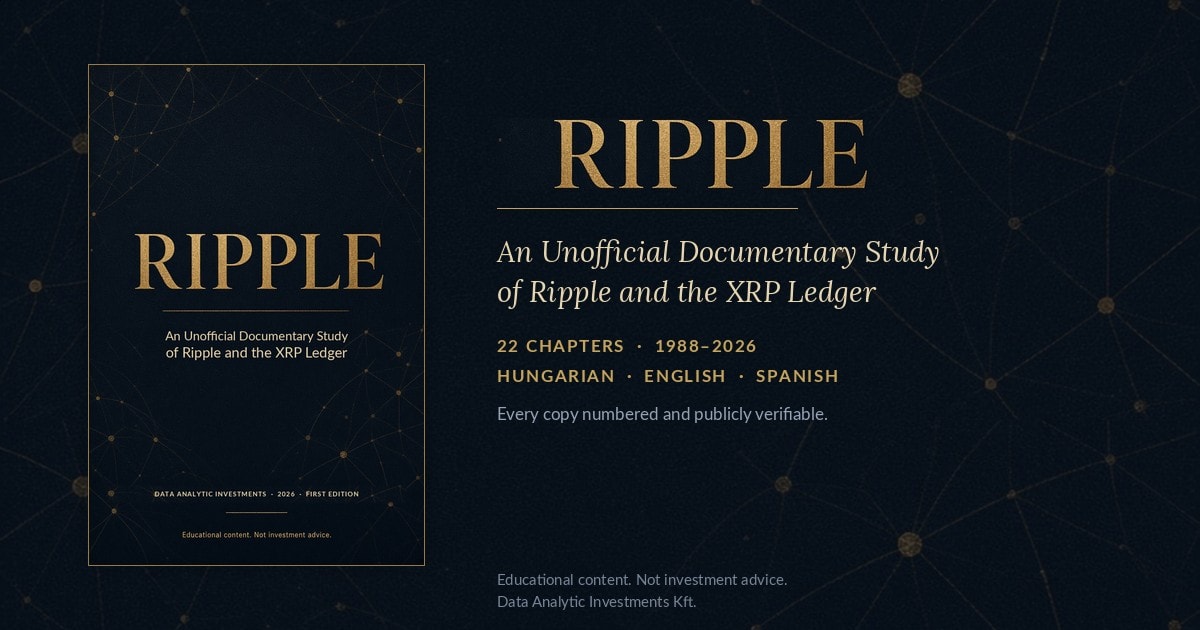
One recurring question of RIPPLE – An Unofficial Documentary Study is what the XRP Ledger is actually for: a payment rail, a token platform, or a general-purpose, timestamped register. This paper gives a documented example of the latter – and it comes from an institution that speaks on behalf of central banks and has no reason to favour any single crypto project.
The book arranges its 2020–2026 timeline around the Ripple case: who claimed what, when, in which document, about what XRP is. We wrote separately about the ruling. The BIS paper asks a different question – not what XRP is, but what the ledger is good for – and that question is settled by measurement, not by a court.
It is also worth noting that the BIS applies to data the same method we apply to the claims in the book: a verifiable origin next to every item. That is not a coincidence; it is the same problem seen from two sides.
The full timeline, from 1988 to 2026, source by source, is in RIPPLE – An Unofficial Documentary Study, 22 chapters, in English, Hungarian and Spanish.
What this article does NOT claim
It does not claim that the BIS is "adopting" or "recommending" the XRP Ledger: the paper describes a prototype and says itself that it is not a production system. It does not claim any relationship between the BIS and Ripple Labs Inc. – the company's name does not appear in the paper. It does not claim that the paper is the official position of the BIS: by its own disclaimer, "the views expressed are those of the authors and do not necessarily reflect the views of the BIS or its member central banks." And it claims nothing about the price of XRP, nor that this paper has, or should have, any effect on it.
Educational content, not investment advice. Independent publication, not affiliated with Ripple Labs Inc.
Source: Bank for International Settlements, Verifiable official statistics: a blockchain-based approach, BIS Working Paper No. 1374, 2 September 2026, 56 pages (authors: Mario Rusev, Rafael Schmidt, Edward Lambe, Christian Schmieder, Glenn Philip Tice) – the Focus, Contribution, Findings and Abstract sections, bis.org.
Continue on DAI
Explore Topics
Written by
DAI Research Desk
Content creator and writer sharing insights and stories.
Related tools & research
This article is a companion piece to the book.
RIPPLE — the book
An Unofficial Documentary Study of Ripple and the XRP Ledger
22 chapters · every claim with a named source · numbered first edition · $9.99