What the Torres ruling says – and what it does not
On 13 July 2023 Judge Analisa Torres issued a 34-page order in SEC v. Ripple. It is the most quoted – and most misquoted – document in the legal history of crypto markets. It did not say "XRP is not a security". Here is what it did say, page by page.

On 13 July 2023 Judge Analisa Torres issued a 34-page order in the case of SEC v. Ripple. Since then it has been the most quoted – and probably the most misquoted – document in the legal history of the crypto market. The most common summary runs: "the court ruled that XRP is not a security."
That is not what the order says.
This article works from the text of the order itself – SEC v. Ripple, 1:20-cv-10832 (AT), Doc. 874, 13 July 2023, 34 pages – and goes through, item by item, what the court decided, what it decided differently from what many believe, and what it expressly left open.
The order did not make one decision, but four
The root of the misunderstanding is the attempt to compress the ruling into a single sentence. The court examined four distinct sales channels and reached four distinct results. Separating the channels is not legal hair-splitting – it is the spine of the ruling.
1. Institutional sales – securities. Here the SEC won. Contractual sales to known buyers were held to be investment contracts. The reasoning is on pages 21–22 of the order: the buyer was known, the proceeds flowed into a shared network of bank accounts, the sales agreements contained resale restrictions and lock-up periods, and there were "solely to resell" type provisions.
2. Programmatic (exchange) sales – not securities. Here Ripple won. For sales made into exchange order books, the court held that the buyer did not know from whom they were buying – these were blind bid/ask transactions. Pages 23–25 add that since 2017 Ripple's sales accounted for less than one per cent of global XRP trading volume.
3. Other distributions – not securities. For salaries paid in XRP and developer programmes, the "investment of money" element was missing: no money ever flowed to Ripple (pages 26–27).
4. The personal sales of Larsen and Garlinghouse – not securities. These were treated in the same way as the programmatic sales (pages 27–28).
Two further elements belong here that are rarely quoted: the court rejected Ripple's "fair notice" defence on the institutional channel (pages 29–30), and on the aiding-and-abetting question it made no summary ruling – that remained open as a question of fact for a jury (pages 30–33).
What the order expressly left open
This is the most important clarification, and it is the one the popular summary erases. The decision on programmatic sales concerned Ripple's own sales. The secondary-market question – what happens when private individuals trade XRP among themselves – was expressly left open by the court in footnote 16 on page 23.
In other words: the order does not produce a general statement that "XRP is not a security". What it produces is that certain of Ripple's forms of sale did not constitute investment contracts, while others did. The classification attached to the channel, not to the asset itself.
If the concept of an investment contract is itself unclear, we have gathered the definitions in one place in our glossary.
Two sets of figures coexist – and cause confusion
The figures in the ruling record are not the same as those in the 2020 complaint, and the difference is worth keeping in mind because public summaries frequently mix the two.
According to the ruling record (working from the 2021 amended complaint, pages 4–6 and 15–16): the institutional channel was in the order of USD 728.9 million, the programmatic channel in the order of USD 757.6 million, and other distributions USD 609 million in "non-cash consideration". Larsen at least USD 450 million, Garlinghouse in the order of USD 150 million.
The 2020 complaint gave different amounts for the same channels (763.4 and 624.9 million respectively) because it covered a shorter period. Same case, two sets of figures. Whoever quotes a number must name the document it comes from – which is what we do throughout the book and in these articles.
The defence arguments that rarely surface
Pages 31–32 of the order also record what Ripple argued in its defence – and that is the other half of the story. Ripple pointed out that the regulators of Japan, Singapore, Switzerland, the United Arab Emirates and the United Kingdom had not classified XRP as a security; that it had read the 2015 FinCEN classification ("virtual currency") as an official government designation; and that Larsen had read the 2018 Hinman speech – which said that Bitcoin and Ether are not securities – as confirmation.
The court did not accept these arguments on the institutional channel. But an argument that is rejected still remains part of the story – and a documentary treatment must quote the losing arguments too.
How a jurisdiction classifies an asset is still changing continuously. We follow the current state of the European picture – which providers hold a licence – in our MiCA register.
Why this was more than a corporate lawsuit
Page 9 of the order lists those who filed amicus curiae briefs: Coinbase, the Blockchain Association, the Chamber of Digital Commerce, Paradigm, I-Remit, TapJets – and a group of XRP holders. A regulatory proceeding rarely attracts this many outside participants. It is one of the scenes in which it becomes visible that the case was not one company's affair but an industry's.
How we worked
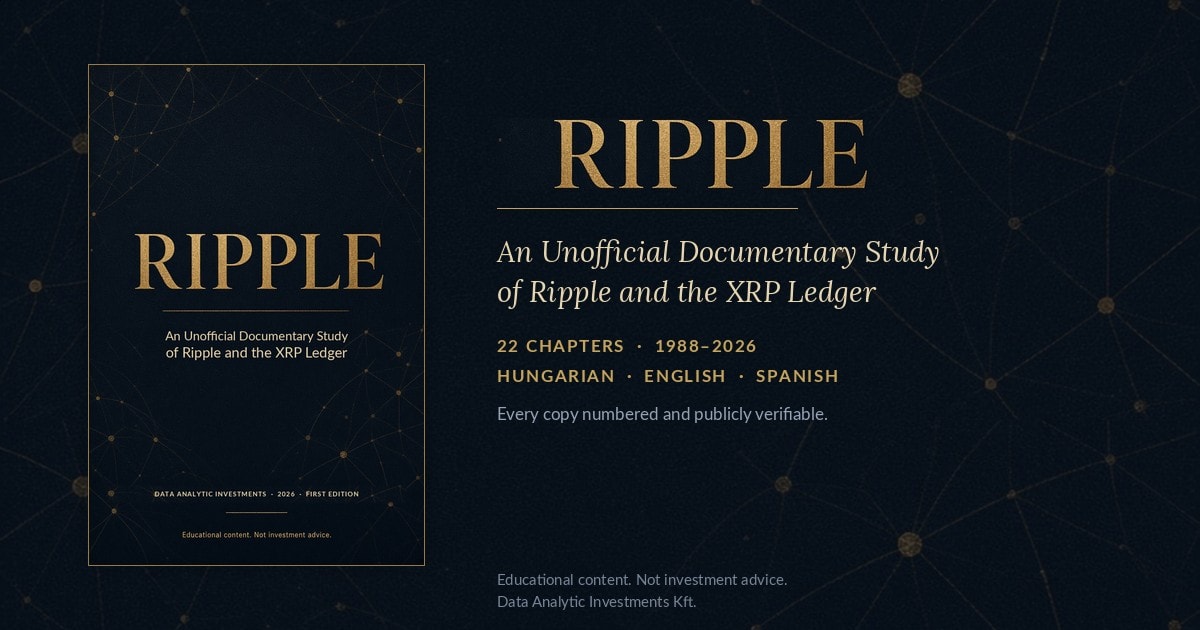
This article works from a single primary document: the order itself, with page references. The same method is followed by RIPPLE – An Unofficial Documentary Study, our 22-chapter book, which traces the story from 1988 to 2026 in English, Hungarian and Spanish. Every chapter of the book closes with the same block that closes this article – and every claim carries its source level.
The verification workflow behind it is documented and public at the Uncle Sunny Academy.
What this article does NOT claim
It does not claim that the order closed the question: the aiding-and-abetting issue remained a question of fact for a jury, and the documents of the case's closing phase are not covered here. It does not claim that the legal status of secondary-market XRP has been settled – the order expressly left that open. It does not claim that the figures quoted here are final: two sets of figures coexist, and this article quotes from the ruling record. It takes no position on whether the court's decision was correct. And it does not extend to how other jurisdictions have classified the asset since.
Educational content, not investment advice. Independent publication, not affiliated with Ripple Labs Inc.
Source: SEC v. Ripple Labs Inc., 1:20-cv-10832 (AT), Doc. 874, Order, S.D.N.Y., 13 July 2023.
Continue on DAI
Explore Topics
Written by
DAI Research Desk
Content creator and writer sharing insights and stories.
Related tools & research
This article is a companion piece to the book.
RIPPLE — the book
An Unofficial Documentary Study of Ripple and the XRP Ledger
22 chapters · every claim with a named source · numbered first edition · $9.99