
Coinbase announces conversion of 14 assets to USDC in the EEA on 30 October, according to Crypto Briefing – what MiCA requires and what happens in practice
MiCA's transitional period for stablecoin issuers ended on 1 July. A large crypto provider is now showing in practice what that means for its customers – with sources, without value judgements or forecasts.

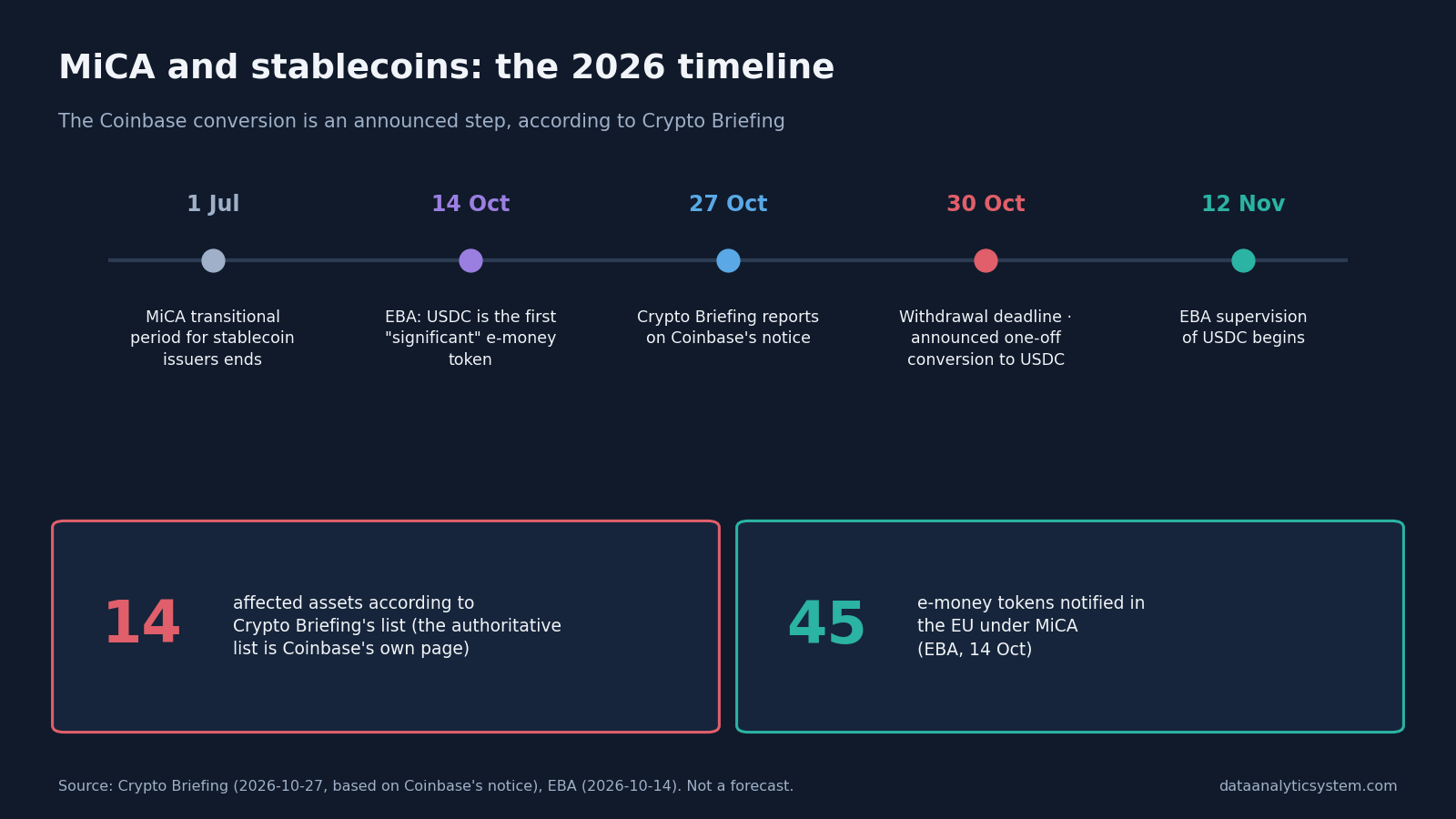
According to Crypto Briefing, Coinbase gave its retail customers in the European Economic Area (EEA) until 30 October to withdraw 14 restricted assets from the platform. According to the announcement, whatever remains is swapped through a one-off conversion at the market rate into USDC or another supported asset. The reason given is MiCA, the EU's crypto-asset regulation. This article describes what is known about the move and the rule behind it. It offers no value judgement on any asset.
| Fact sheet | |
|---|---|
| Number of assets affected | 14 (according to Crypto Briefing) |
| Withdrawal deadline | 30 October 2026 |
| Default destination asset | USDC, where suitable (as announced) |
| MiCA transitional period (stablecoin issuers) | ended 1 July 2026 |
| Coinbase EEA entity | Coinbase Luxembourg S.A. (CSSF-authorised) |
| USDC as "significant" e-money token | EBA decision 14 Oct, effective 12 Nov |
Sources: Crypto Briefing, 27 Oct, Coinbase help page, EBA, 14 Oct.

What Coinbase announced for 30 October
Based on Coinbase's notice, Crypto Briefing reports that:
- buying, selling and converting the affected assets had already been restricted in the EEA;
- customers who want to keep them can withdraw them to an external wallet by 30 October;
- Coinbase converts remaining balances once, at the market rate, by default into USDC, or where that is not suitable, into another supported crypto asset or currency;
- deposits arriving after the deadline will not appear in balances and are not included in the conversion; in some cases the company's asset recovery process may help, but this is not guaranteed;
- crypto-to-crypto conversion may have tax consequences;
- if an affected stablecoin later complies with MiCA, Coinbase may reconsider support, but this would not reverse a completed conversion.
The 14 assets according to Crypto Briefing
Crypto Briefing's list: USDT, PAX, PYUSD, GUSD, GYEN, DAI, BUST, UST, RAI, PAXG, MUSD, USD1, USDS, TGBP. The length of the list varies between sources: several reports name only a few examples, so the authoritative list is Coinbase's own page. The list is mixed: it includes dollar-pegged stablecoins, tokens pegged to other currencies, and a gold-backed token.
The rule behind it
MiCA sorts stablecoins into two groups: the e-money token (EMT), which tracks the value of a single official currency, and the asset-referenced token (ART), which tracks several assets or a basket. In the EU an EMT may be issued only by an authorised credit institution or e-money institution. According to Crypto Briefing, Coinbase's notice says the MiCA transitional period for stablecoin issuers ended on 1 July 2026 and was not extended, so the company cannot support stablecoins whose issuers lack the required authorisation.
The rule therefore applies to the provider within the EEA. It says nothing about what a given token is like in itself; only what an authorised European crypto provider may offer its retail customers.
Why USDC
USDC's EU issuer is Circle Internet Financial Europe SAS. On 14 October the EBA classified USDC as the EU's first significant e-money token. According to the EBA's press release:
- 45 e-money tokens have so far been notified in the EU under MiCA;
- from 12 November the EBA supervises USDC's own funds, reserve of assets, liquidity, and recovery and redemption plans;
- France's ACPR keeps supervision of matters including governance, qualifying holdings and outsourcing;
- the EBA reassesses every year whether the token still counts as significant.
How to check a provider
Crypto-asset service providers (CASPs) and issuers authorised under MiCA are listed in ESMA's public register. According to Crypto Briefing, Coinbase's EEA customers are served by Coinbase Luxembourg S.A., authorised by Luxembourg's supervisor (CSSF). Using the register was covered in an earlier article (see below).
5 things many people don't know
- The announced conversion is not at face value. According to Crypto Briefing, Coinbase converts at the market rate, so the result may differ from a nominal 1:1.
- Late deposits are left out. According to Crypto Briefing, transfers arriving after the deadline will not appear in balances.
- "Significant" is a supervisory label. The EBA decision determines who supervises what, not the quality of the token.
- The status can be reviewed every year. The EBA reassesses annually.
- The transitional period was not extended. According to Coinbase, the deadline for stablecoin issuers ended on 1 July and was not extended.
Summary
- According to Crypto Briefing, Coinbase has announced the conversion of remaining EEA retail balances of 14 restricted assets on 30 October, by default into USDC.
- The reason given is MiCA: the transitional period for stablecoin issuers ended on 1 July.
- On 14 October the EBA classified USDC as the first significant e-money token; its supervision starts on 12 November.
- The authoritative asset list is Coinbase's own page.
Related reading: ESMA: non-MiCA-compliant stablecoins, three months · ESMA MiCA register: how to check a crypto provider · MiCA stablecoins: EMT and ART · Blog archive.
Data Analytic Investments is not affiliated with Coinbase, Circle, the EBA or the portals cited; names are used for identification only. On tax questions, professional information about one's own situation applies.
Educational content. Not investment advice.
Continue on DAI
Explore Topics
Written by
Data Analytic Investments
Content creator and writer sharing insights and stories.