
How to check whether a crypto provider is authorised: ESMA's MiCA register, step by step
With MiCA's transitional period over, ESMA advises clients to look up their provider in its register. What is in the register, where do you find it, and what should you watch for when reading it?
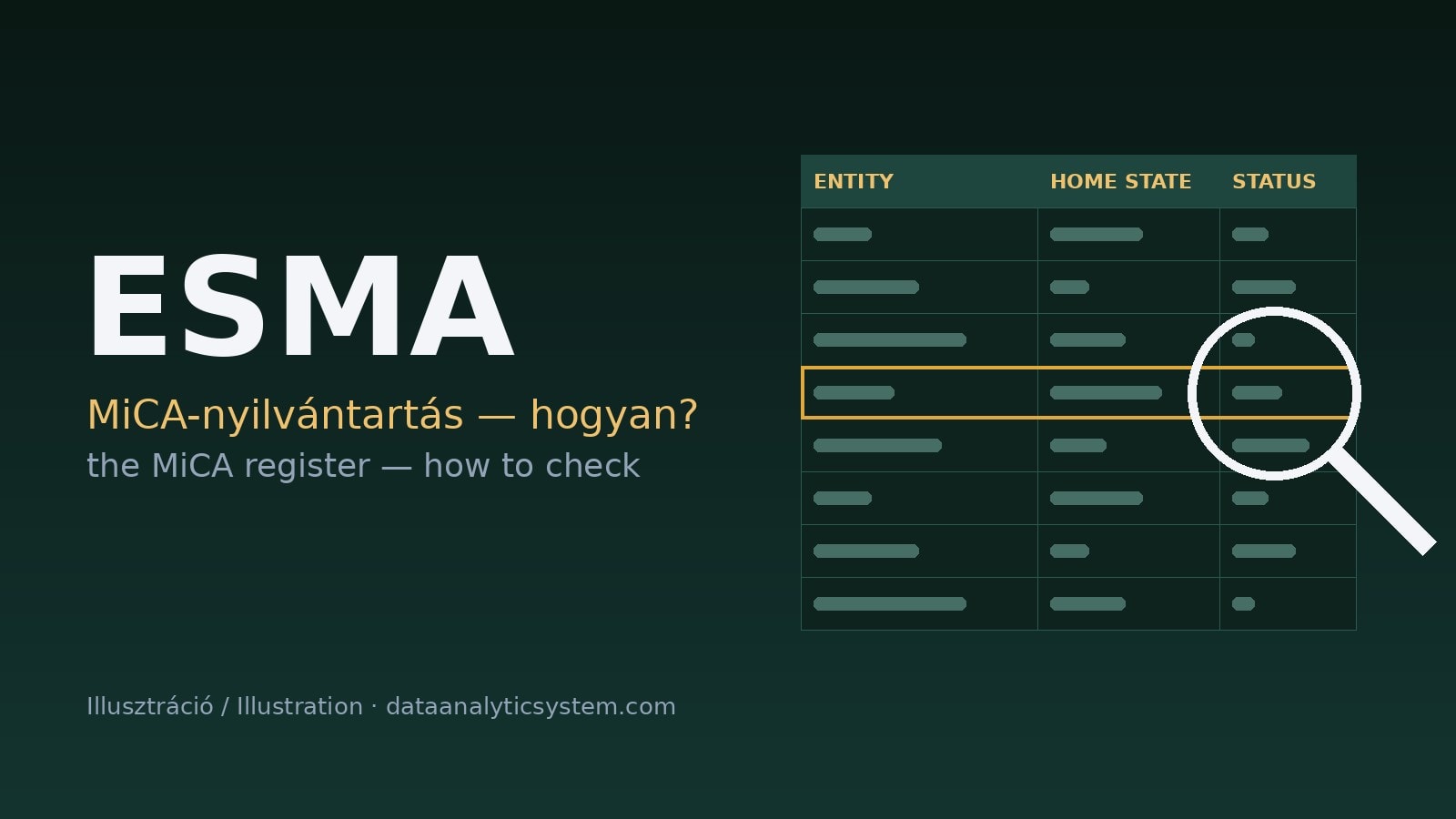
MiCA's transitional period ended on 1 July 2026. In its statement of 23 June, the European Securities and Markets Authority (ESMA) suggests one simple step for every client: check in the ESMA register whether the provider is authorised under MiCA. This article explains what that register is and how to read it.
What the register is
Articles 109 and 110 of MiCA require ESMA to keep a register. ESMA publishes it on its MiCA page as an "interim MiCA register" made of five downloadable CSV files:
- White papers for crypto-assets other than ARTs and EMTs (Title II)
- Issuers of asset-referenced tokens (ART) (Title III)
- Issuers of e-money tokens (EMT) (Title IV)
- Authorised crypto-asset service providers, or CASPs (Title V)
- Non-compliant entities providing crypto-asset services
A separate CSV file describes what each column means.
Where to find it
On the ESMA website: Digital finance and innovation → Markets in Crypto-Assets Regulation (MiCA). The files can be downloaded from that page and opened in any spreadsheet program, such as Excel or LibreOffice.
How to read it
- The exact company name matters. Search for the provider's legal name, not its brand. The French supervisor (AMF) warned that MiCA protection covers only the authorised EU legal entity, not other members of the group.
- Check the home country and the authority. The CASP file shows which authority in which member state granted the licence.
- Withdrawn licences stay listed. According to ESMA, a withdrawn authorisation remains in the file with the date the withdrawal took effect, so read the dates too.
- The fifth file is a warning list. It lists entities that supervisors have reported as providing crypto-asset services without authorisation.
What to watch for
- It is not real time. ESMA updates the files weekly, using data from national supervisors. A new licence or a withdrawal can appear with a delay. If in doubt, the national supervisor's own register is more current.
- White papers are not approved. ESMA states that the listed white papers have not been reviewed or approved by any competent authority. The issuer is responsible for their content.
- An interim format. ESMA says the CSV-based register is to be integrated into its IT systems from mid-2026, so its location and format may change.
Sources
- ESMA: Markets in Crypto-Assets Regulation (MiCA) — interim MiCA register page — https://www.esma.europa.eu/esmas-activities/digital-finance-and-innovation/markets-crypto-assets-regulation-mica
- ESMA: Public Statement, 23 June 2026, ESMA75-113276571-1710 — https://www.esma.europa.eu/sites/default/files/2026-06/ESMA75-113276571-1710_Public_Statement_MiCA_transitional_period_ends.pdf
- AMF: End of the MiCA transitional period, 23 June 2026 — https://www.amf-france.org/en/news-publications/news/end-mica-transitional-period-esma-sets-out-its-expectations-professionals-and-warns-retail-investors
Educational content, not investment advice. Data Analytic Investments is an information provider under Article 3 of MiCA, not a crypto-asset service provider.
Continue on DAI
Written by
Szabó János
Content creator and writer sharing insights and stories.