Digital euro: another trilogue on 18 November – what is still open, and how it compares with MiCA e-money tokens
After six political trilogues, the 18 November round could be decisive. What remains open between the Council and Parliament, what the timeline looks like, and how a digital euro differs from a euro stablecoin issued under MiCA.
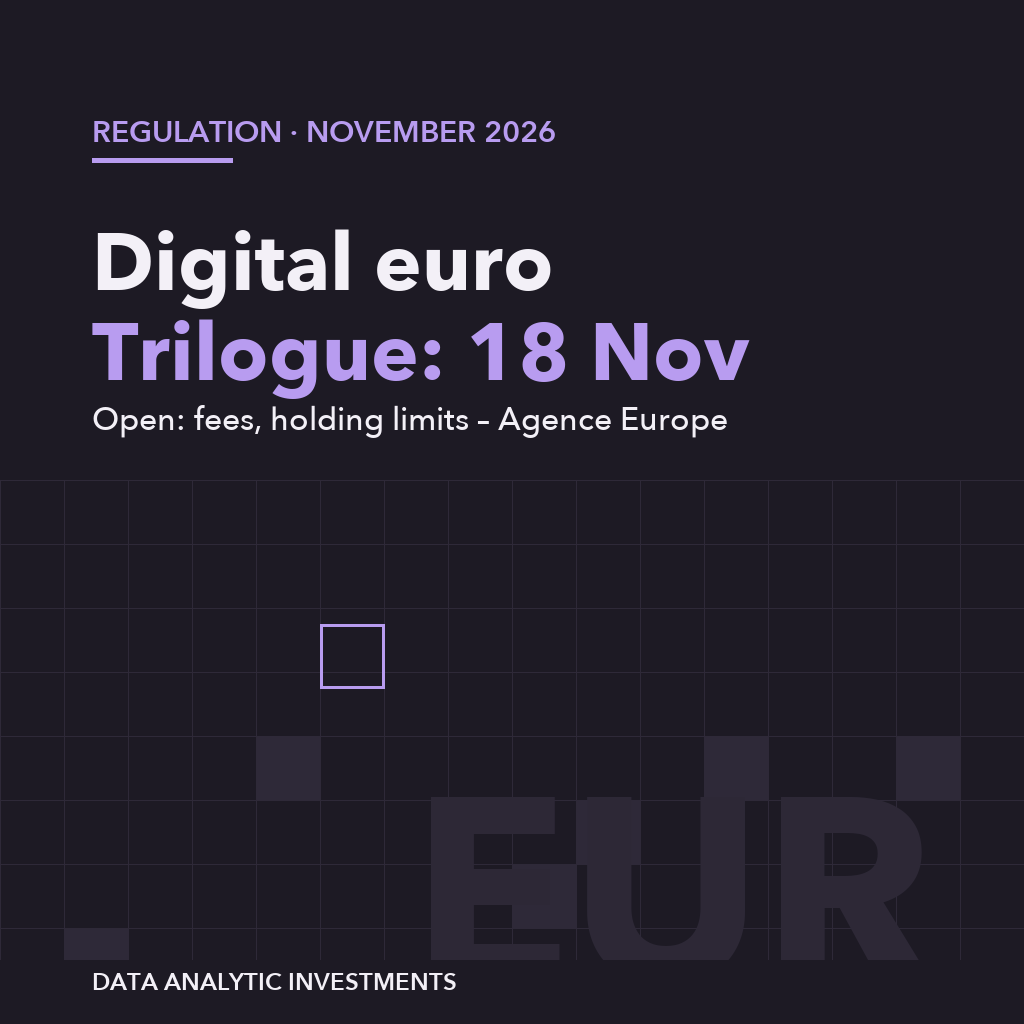
The European Parliament, the Council and the Commission meet on Wednesday 18 November 2026 for another trilogue on the regulation establishing the digital euro. The Irish Council Presidency has set this round as the target for a political agreement, "if at all possible" (Agence Europe, 7 November 2026). The sixth political trilogue, on 5 November, did not close the open points (Ecommerce Europe, 9 November 2026).
This article was written before the 18 November meeting, and its outcome was not known at the time of writing. What follows is what public sources document: where the file stands, what is still open, and how a digital euro differs from an e-money token under MiCA.
| Data sheet | |
|---|---|
| Legislation | Proposal for a regulation on the establishment of the digital euro, COM(2023) 369 |
| Commission proposal | 28 June 2023 |
| Council negotiating position | 19 December 2025 |
| Parliament plenary vote to open talks | 9 July 2026 (416 for, 169 against, 22 abstentions) |
| First trilogue | 13 July 2026 |
| Fifth and sixth political trilogues | 20 October and 5 November 2026 |
| Target for agreement | 18 November 2026 |
| ECB timeline | pilot in 2027, potential first issuance in 2029 |
Where the file stands
The Commission tabled the proposal on 28 June 2023. The Council adopted its negotiating position on 19 December 2025 and Parliament adopted its own on 9 July 2026 (Freshfields, 15 July 2026). The plenary vote to open talks passed by 416 to 169, with 22 abstentions. Parliament's team is led by rapporteur Fernando Navarrete Rojas (EPP), and the first trilogue took place on 13 July (Eunews, 9 July 2026).
A trilogue is a closed negotiation between the three institutions. A political agreement still has to be finalised at technical level and then formally adopted by both Parliament and the Council. An agreement on 18 November would not mean the regulation is in force.
What is still open
According to Agence Europe on 7 November and the Ecommerce Europe summary of 9 November, the main points are these:
- Merchant fees. There is no agreement yet on the method for setting what merchants pay for a digital euro transaction. Parliament wants a "no worse off" rule, so that a merchant would not pay more than for a comparable payment method. A French finance ministry source said the reference to other payment types raises questions.
- Transitional fee model. The Council wants the transitional model to end after ten years at the latest. Parliament's position is more open-ended (Freshfields). On 5 November the Commission presented a hybrid compromise.
- Sanctioned persons. It is unresolved whether people sanctioned by a third country could receive digital euro services. The co-legislators are waiting for Commission guidance.
- Cash acceptance and distribution. The 5 November meeting also covered exceptions to mandatory cash acceptance. The remaining distribution questions are seen as largely technical.
The holding limit question
Both institutions accept that individuals should only be able to hold a limited amount of digital euro. The regulation does not contain a figure. The dispute is over who sets the ceiling and how (Freshfields):
| Council | Parliament | |
|---|---|---|
| Who sets the ceiling | the Council, by implementing decision with reinforced qualified majority, based on an ECB recommendation | the Commission, by delegated act, based on an ECB recommendation |
| Legal persons | details left to the ECB | near-total ban written into the regulation |
| Merchant fee cap | at national level | per merchant |
None of the sources used here reports an agreed amount.
How it differs from a MiCA stablecoin
A digital euro would be central bank money: a liability of the ECB and the Eurosystem. A euro stablecoin under MiCA is an e-money token (EMT), issued by a credit institution or an electronic money institution and owed by that issuer (MiCA, Regulation (EU) 2023/1114).
| Digital euro | MiCA e-money token | |
|---|---|---|
| Who owes it | ECB / Eurosystem | the issuer (bank or e-money institution) |
| Legal basis | the regulation under negotiation (not yet adopted) | MiCA, applicable since 2024 |
| Redemption | – | at any time, at par value (MiCA Article 49) |
| Interest | – | the issuer may not pay interest (MiCA Article 50) |
| Holding limit | planned, per person | none in MiCA |
The rules for e-money tokens, and how to check them, are covered in the earlier article on stablecoins under MiCA. The terms are explained in the glossary.
The timeline
On 30 October 2025 the ECB Governing Council decided to move the project to its next phase (ECB, 30 October 2025). If the regulation is adopted in 2026, a pilot could start in mid-2027, and the Eurosystem aims to be ready for a potential first issuance in 2029 (ECB, digital euro page). A final decision on issuance can only come after the legislation is adopted.
What this does not mean
- The 18 November meeting is not the adoption of the regulation. Even with a political agreement, technical work and formal votes in both institutions remain.
- The outcome of the meeting is not known here. An agreement is possible, and so is another round.
- There is no fixed holding limit. Any specific amount is, for now, a press estimate.
- A digital euro is not a crypto-asset under MiCA. MiCA does not apply to the ECB and national central banks acting as monetary authorities (MiCA, Article 2).
- The latest reports are dated 7 and 9 November. No public source on negotiations between 13 and 17 November was available at the time of writing.
A running overview of regulatory developments is on the regulatory page, and the sourcing approach is set out on the transparency page.
Related on dataanalyticsystem.com
- MiCA tracker
- Regulatory overview
- Stablecoins under MiCA – how to check whether a stablecoin complies
- Glossary and FAQ
- Transparency
Sources
- Agence Europe (7 November 2026): Negotiations intensify between European Parliament and EU Council on digital euro: https://agenceurope.eu/en/bulletin/article/13977/18/negotiations-intensify-between-european-parliament-and-eu-council-on-digital-euro
- Ecommerce Europe (9 November 2026): Trilogue negotiations on the digital euro: https://ecommerce-europe.eu/news-item/trilogue-negotiations-on-the-digital-euro/
- Freshfields (15 July 2026): Digital euro enters trilogues: https://www.freshfields.com/en/our-thinking/blogs/technology-quotient/digital-euro-enters-trilogues-what-the-councilparliament-positions-mean-for-ban-102nbx6
- Eunews (9 July 2026): Digital euro: Parliament says 'yes': https://www.eunews.it/en/2026/07/09/digital-euro-parliament-says-yes-inter-institutional-negotiations-to-start-on-13-july/
- European Commission (28 June 2023): COM(2023) 369, proposal for a regulation on the digital euro: https://eur-lex.europa.eu/legal-content/EN/TXT/?uri=CELEX:52023PC0369
- ECB (30 October 2025): Eurosystem moving to next phase of digital euro project: https://www.ecb.europa.eu/press/pr/date/2025/html/ecb.pr251030~8c5b5beef0.en.html
- ECB: Digital euro (accessed 18 November 2026): https://www.ecb.europa.eu/euro/digital_euro/html/index.en.html
- Regulation (EU) 2023/1114 (MiCA): https://eur-lex.europa.eu/eli/reg/2023/1114/oj
Data Analytic Investments is not affiliated with the institutions cited; names are used for identification only.
Educational content, not investment advice.
Continue on DAI
Explore Topics
Written by
Data Analytic Investments
Content creator and writer sharing insights and stories.