FSB cross-border payments report, 2026: the policy work is largely done, end-user results are improving slowly
57% of wholesale payments are credited within an hour, a USD 200 remittance costs 5.7% on average against a 3% target. The FSB says the international policy design is largely finished, and delivery now depends on individual jurisdictions.
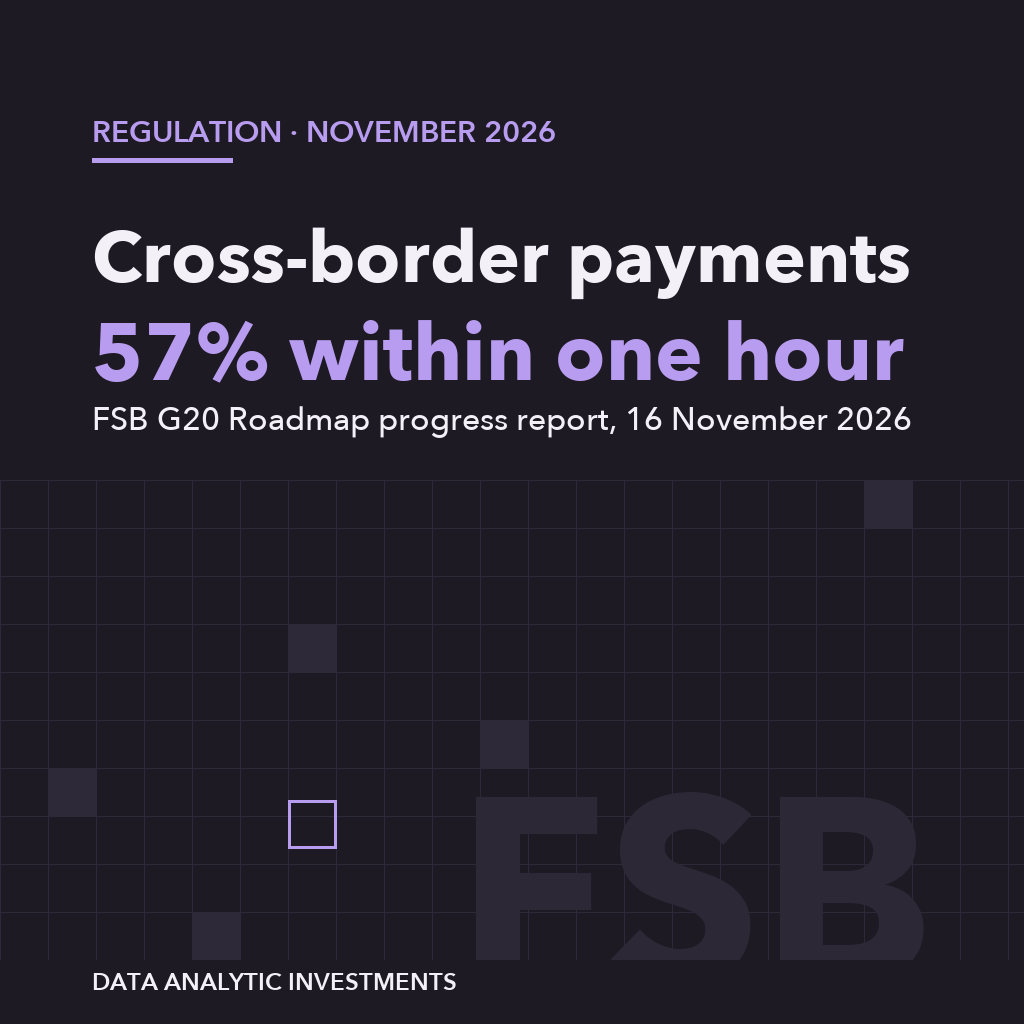
On 16 November 2026 the Financial Stability Board (FSB) published its consolidated progress report for 2026 on the G20 Roadmap for Enhancing Cross-border Payments (FSB). Its central finding: the FSB, the BIS Committee on Payments and Market Infrastructures (CPMI) and partner organisations have largely completed the international policy work, but outcomes for end users are improving only gradually and unevenly across payment segments and jurisdictions (FSB press release).
The Roadmap was launched in 2020 to make cross-border payments cheaper, faster, more transparent and more accessible. In 2021 the G20 endorsed quantitative targets, most of which fall due at end-2027 (FSB, 2021).
| Fact sheet | |
|---|---|
| Publisher | Financial Stability Board (FSB) |
| Document | G20 Roadmap for Enhancing Cross-border Payments: Consolidated progress report for 2026 |
| Published | 16 November 2026 |
| Legal status | non-binding; FSB activities create no legal rights or obligations |
| Addressed to | authorities in G20 and other jurisdictions, central banks, banks and non-bank payment service providers |
| Target dates | mostly end-2027; the remittance cost target is 2030 |
| Wholesale payments credited within one hour (2026) | 57% (target: 75%) |
| Average retail payment cost | 1.5% to 2.7% depending on use case (target: no more than 1%) |
| Average cost of a USD 200 remittance | 5.7% (2030 target: no more than 3%) |
What the report covers
The full report is organised around three priority themes:
- Payment system interoperability and extension. According to the CPMI-FSB monitoring survey, 11 of the 82 responding real-time gross settlement (RTGS) systems were operating 24/7 in 2025, up from five in 2024. In 2025, 45% of the surveyed fast payment systems and 39% of RTGS systems offered access to non-bank payment service providers. The number of fast payment systems planning new links to systems abroad doubled compared with the previous year.
- Legal, regulatory and supervisory frameworks. Progress varies widely between jurisdictions. Some licensing regimes are old and have not been updated, little progress was made in 2026 on sharing targeted data such as payment fraud information, and the number of jurisdictions with data localisation policies increased.
- Cross-border data exchange and message standards. November 2025 was the industry deadline for moving cross-border payment messages to the ISO 20022 standard. More payment systems now plan to align with the CPMI's 2023 harmonised ISO 20022 data requirements.
Who it applies to
The FSB does not make law. The report itself states that the FSB's activities and decisions are not binding and do not give rise to legal rights or obligations (FSB). It is aimed at national authorities, central banks and market participants, who are expected to implement the toolkits and recommendations already agreed. The FSB invited jurisdictions to prepare action plans, and almost all G20 members responded.
For crypto-asset service providers, the most direct link is FATF Recommendation 16, the so-called travel rule. The FATF revised it in June 2025, and the report says the changes are expected to take effect by end-2030. A public consultation on draft guidance ran from June to August 2026 and drew more than 180 respondents; the FATF aims to adopt the final guidance in 2027. The report notes that jurisdictions have improved technical compliance on virtual assets, while gaps remain in risk assessment, supervision and enforcement.
Where the numbers stand
The key performance indicators in the report's annex track change since 2023 (FSB, Annex 3):
| Indicator | 2023 | 2026 | G20 target |
|---|---|---|---|
| Wholesale payments credited within one hour | 53.8% | 57% | 75% by end-2027 |
| Retail payment services crediting within one hour | 34.2% | 32.9% | 75% by end-2027 |
| Retail payment services crediting within one business day | 74% | 59.8% | the remainder, by end-2027 |
| Remittance services available within one hour | 52.6% | 60% | 75% by end-2027 |
| Retail corridors costing more than 3% | 23.7% | 15.1% | none by end-2027 |
| Average cost of a USD 200 remittance | 6.3% | 5.7% | 3% or less by 2030 |
The targets are taken from the FSB's 2021 report.
Average retail costs have not moved since 2023: 1.5% for business-to-business, 1.8% for business-to-person, 1.9% for person-to-business and 2.7% for person-to-person payments. The report says the fall in remittance costs is entirely due to a methodological change: in 2026 the local-currency equivalents of the benchmark amounts were rebased for several countries. Without that adjustment, the cost of a USD 200 remittance would have stayed at 6.2%.
Europe in the data
In the euro area, 69.6% of incoming wholesale payments are credited within one hour, up 4.2 percentage points since 2023, against a global figure of 57%. Sending remittances to Europe and Central Asia costs 5.4% on average, below the global average, and the region has the highest share of USD 200 remittances available within one hour (FSB). The report also describes the TIPS Clone project led by the Banca d'Italia, which gives five Western Balkan central banks a shared instant payment platform modelled on the Eurosystem's TIPS.
What happens next
- End-2027: the deadline for most G20 targets. The FSB says progress will depend on implementation by jurisdictions and the private sector, public-private coordination, and continued support from international organisations (FSB press release).
- 2027: the FATF plans to adopt its final guidance on Recommendation 16.
- End-2030: the expected implementation date for the revised Recommendation 16, and the year of the remittance cost target.
What the report does not tell you
- It is not a new rule. The report is an assessment, not legislation. Obligations arise only through national law or the domestic implementation of FATF standards.
- The indicators are partial. Wholesale data come from the Swift network, and Swift states that its figures are not complete market statistics. The retail speed indicator relies on advertised execution times, not measured ones.
- The sample changes every year. The report says changes in sample composition make it hard to separate genuine improvement from changes in coverage.
- There is no country-level reading. Regional indicators cover groups of jurisdictions; the position of any single country cannot be read from them.
Summary
- The FSB report of 16 November 2026 says the policy side of the G20 cross-border payments Roadmap is largely complete.
- Wholesale and remittance speeds have improved since 2023; retail costs and retail speed have not.
- Most targets fall due at end-2027, and delivery now rests with individual jurisdictions and market participants.
Related reading: Blog archive.
Sources
- FSB: G20 Roadmap for Enhancing Cross-border Payments: Consolidated progress report for 2026 (16 November 2026): https://www.fsb.org/2026/11/g20-roadmap-for-enhancing-cross-border-payments-consolidated-progress-report-for-2026/
- FSB: full report, PDF (16 November 2026): https://www.fsb.org/uploads/P161126.pdf
- FSB press release: Further work by jurisdictional authorities and private sector necessary to enhance cross-border payments (16 November 2026): https://www.fsb.org/2026/11/further-work-by-jurisdictional-authorities-and-private-sector-necessary-to-enhance-cross-border-payments/
- FSB: Targets for addressing the four challenges of cross-border payments: Final report (13 October 2021): https://www.fsb.org/2021/10/targets-for-addressing-the-four-challenges-of-cross-border-payments-final-report/
- FSB: G20 Roadmap for Enhancing Cross-border Payments: First consolidated progress report, with the targets table (13 October 2021): https://www.fsb.org/uploads/P131021-1.pdf
Data Analytic Investments is not affiliated with the institutions cited; names are used for identification only.
Educational content. Not investment advice.
Continue on DAI
Explore Topics
Written by
Data Analytic Investments
Content creator and writer sharing insights and stories.