If Hungary withdrew the 20,000-forint note: where would the real risk be?
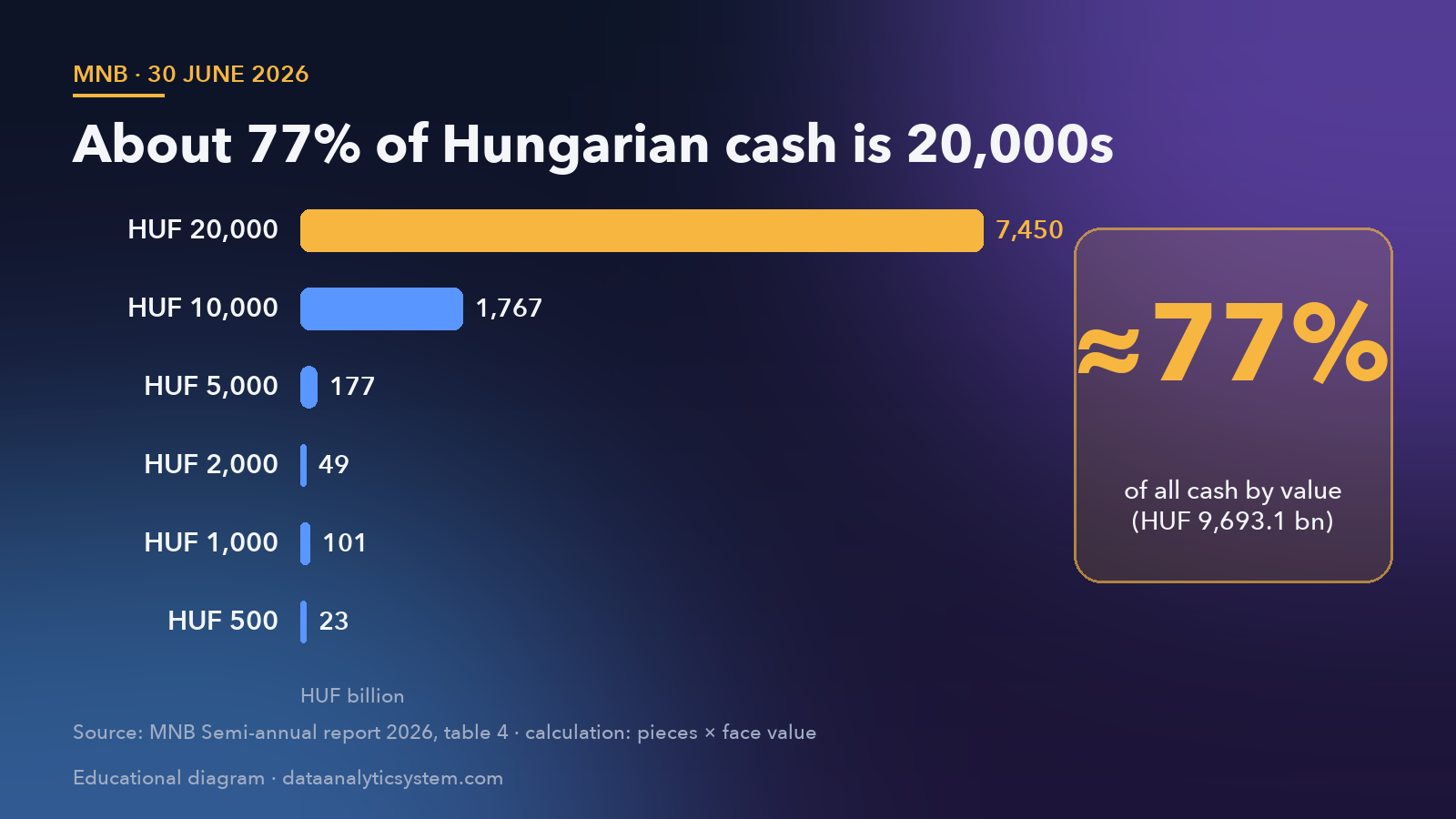
Roughly 77 per cent of Hungarian cash by value sits in 20,000-forint notes. No withdrawal has been announced, but the question is worth thinking through: official channels already check identity. The attention belongs where they do not, at unlicensed money changers.
First, the facts: the Magyar Nemzeti Bank (MNB), Hungary's central bank, has not announced any withdrawal of the current 20,000-forint note. This article is a thought experiment. If a withdrawal ever came up, the authorities would not need to watch bank branches, because those already identify customers. The risk would sit where identification is skipped: unlicensed currency exchange.
Fact sheet
| 30 June 2026 (MNB) | |
|---|---|
| Cash in circulation | HUF 9,693.1 billion |
| Banknotes in circulation | 756.7 million pieces |
| Of which 20,000-forint notes | 372.5 million pieces (49.2%) |
| Change in 20,000-forint notes over one year | +9.0% |
| Face value of 20,000-forint notes (calculation: 372.5 million × HUF 20,000) | about HUF 7,450 billion, roughly 77% of cash |
| Decision on withdrawal | none |
Source: MNB, Semi-annual report 2026, table 4 and chart 10 (in Hungarian).
Why the 20,000-forint note?
The largest denomination carries most of the value of cash. According to the MNB, the growth in 2026 also came mainly from this note. The same report says most counterfeits seized were 10,000- and 20,000-forint notes.
A large note stores a lot of value in little space. That was the reasoning when the European Central Bank decided in 2016 to stop producing the €500 note, citing concerns that it could facilitate illicit activity (OCCRP, 2016). Existing €500 notes remained legal tender.
How a withdrawal works in Hungary
There is a recent precedent. The old-design 20,000-forint note stopped being legal tender on 31 December 2017. Banks and the post office then exchanged it free of charge for three more years, and the MNB exchanges it until 31 December 2037 (MNB FAQ on withdrawn notes).
So the question in a withdrawal is not whether money "disappears". It is which channel it comes back through, and who can see whose money it is.
Official channels already check identity
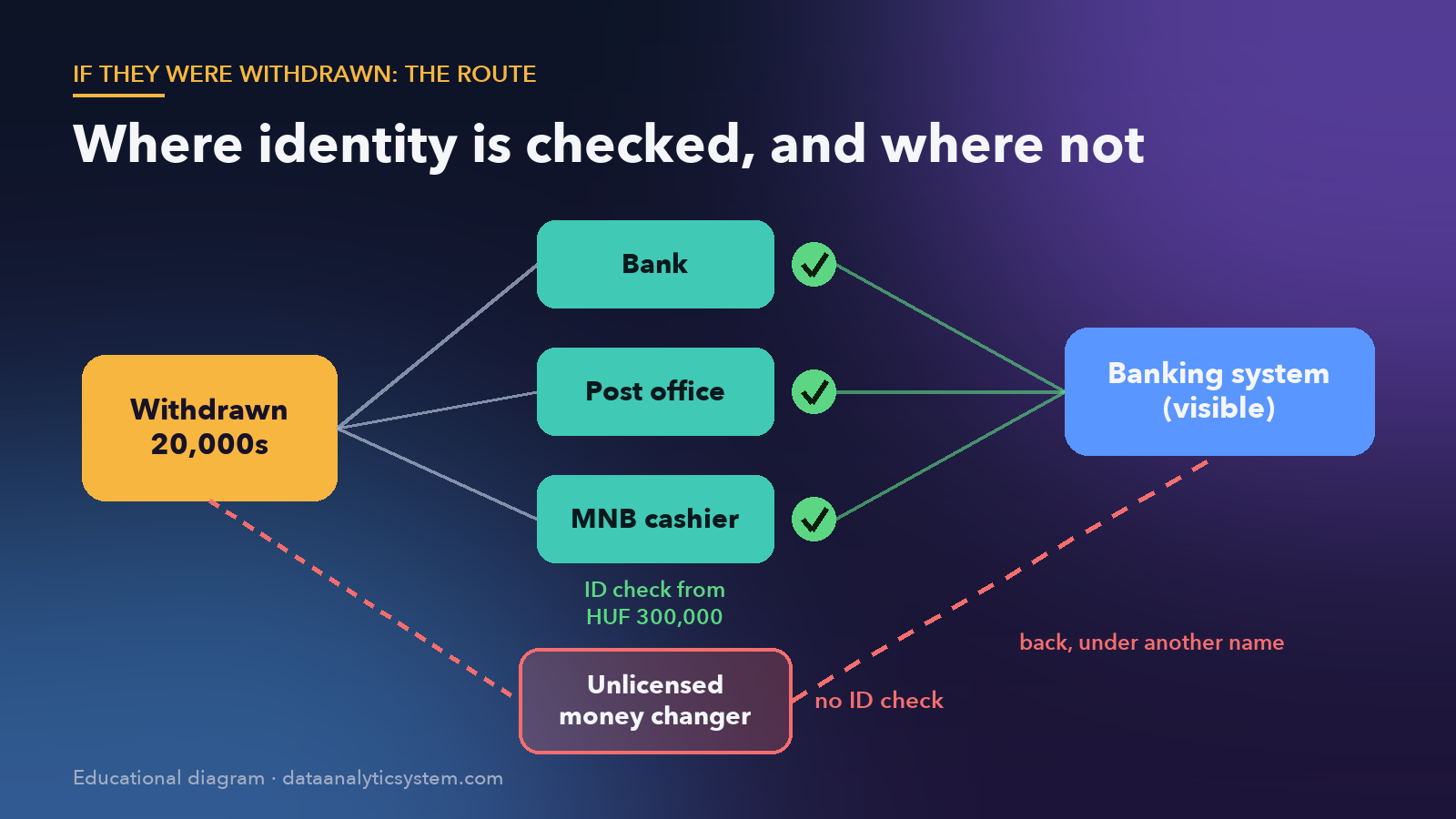
Under Hungary's anti-money laundering act, section 6(1)(i), customer due diligence is mandatory for any currency exchange of HUF 300,000 or more (Act LIII of 2017). Banks must also report unusual transactions.
Anyone bringing a large amount of withdrawn notes to a bank branch or the MNB cashier is identified. If the origin of the money cannot be explained, a report goes to the authority. That channel filters by itself.
Where would the gap open?
Where cash changes hands without identification. In Hungary, currency exchange as a business requires an MNB licence. An unlicensed exchanger does not carry out due diligence either.
This is not a theoretical risk. In recent years the MNB has fined several unlicensed money changers and filed criminal complaints (Economx, 2020; Pénzcentrum, 2023; Portfolio, 2024, all in Hungarian).
During a withdrawal, such an operator could offer what a bank does not: swap old notes "quietly" for foreign currency or new notes, no questions asked, for a fee. The withdrawn money would then re-enter the system without identification, and reach the official channel under someone else's name.
The supervisory logic follows. Attention does not need to be spread across thousands of bank branches, where the filter works. It needs to be concentrated where the filter is missing: unlicensed currency exchange, and businesses with sudden, large cash turnover.
What India showed
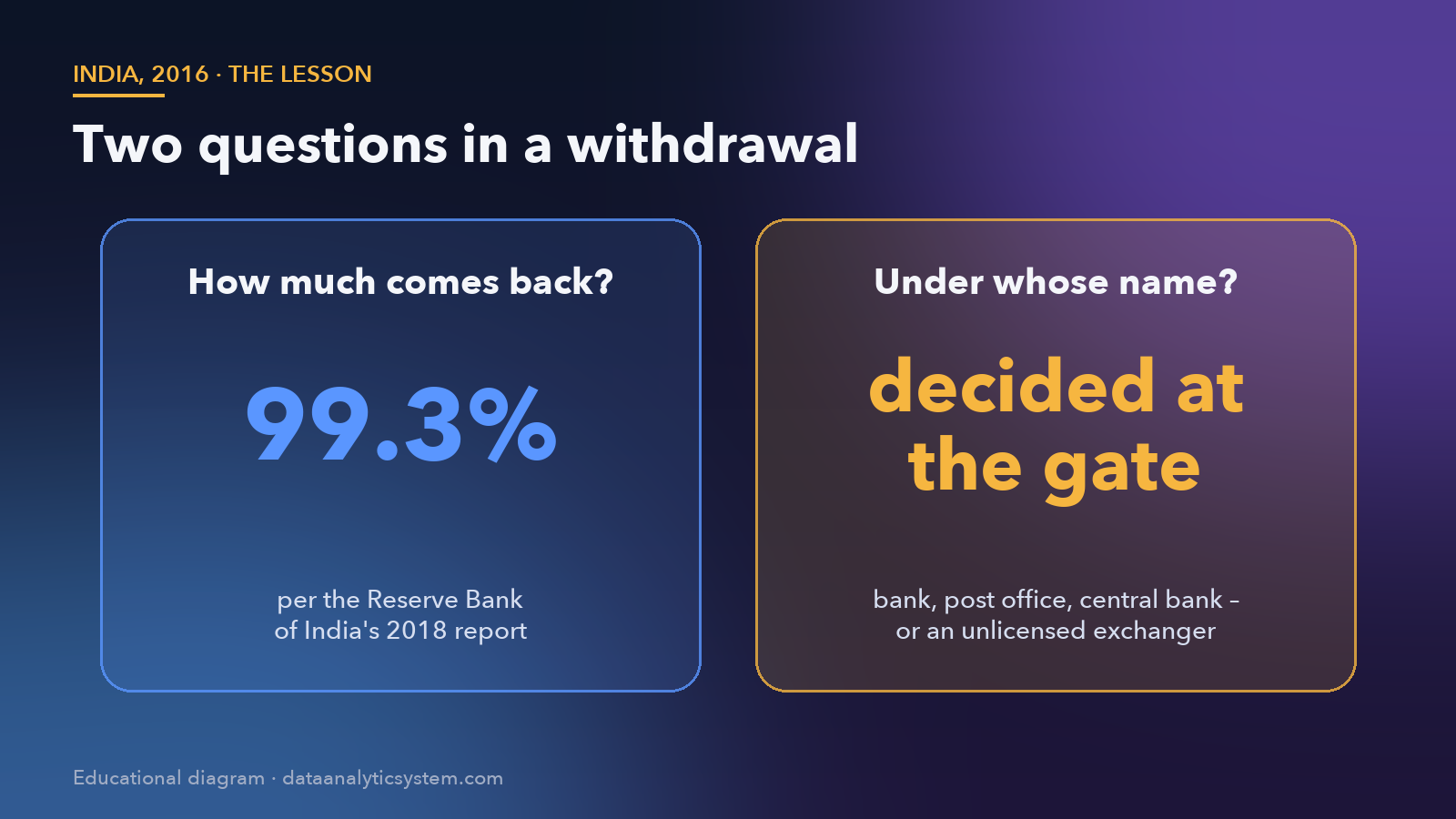
In November 2016 India withdrew its 500- and 1,000-rupee notes overnight. According to the Reserve Bank of India's 2018 annual report, 99.3 per cent of the withdrawn value came back into the banking system (The Wire, 2018). Critics read this as a sign that much undeclared cash found its way back through intermediaries (Business Today, 2018).
The lesson: a withdrawal does not filter out undeclared money by itself. Whether the return flow is visible is decided at the gatekeepers.
What this article does not say
- It does not say a withdrawal of the 20,000-forint note is on the agenda. The MNB has announced nothing of the kind.
- It does not say holding 20,000-forint notes is suspicious. Cash is legal, and many households save or pay with it.
- It does not say every money changer is suspect. Licensed exchangers identify customers and report. The gap is in unlicensed activity.
- The 77 per cent is a calculation from the MNB's piece count and total cash. Total cash includes coins, so the share is a rounded estimate.
Live currency data are on the market observation page; the regulatory background is collected in the regulatory tracker and the MiCA tracker. Terms such as due diligence and AML are explained in the glossary.
Sources
- MNB: Semi-annual report on the MNB's activity in the first half of 2026 (table 4, chart 10; Hungarian) – https://www.mnb.hu/letoltes/mnb-feleves-jelentes-2026-hun-vegleges.pdf
- MNB: Withdrawn forint banknotes – frequently asked questions (1 January 2021; Hungarian) – https://www.mnb.hu/letoltes/bevonasi-gyik-2021-01-01.pdf
- Act LIII of 2017 on the prevention of money laundering and terrorist financing, section 6(1)(i) (Hungarian) – https://net.jogtar.hu/jogszabaly?docid=a1700053.tv
- Economx: Fine and criminal complaint over unlicensed currency exchange (13 July 2020) – https://www.economx.hu/vallalatok/2020/07/13/hanifa-birsag-mnb-penz-valuta-penzvalto-bunteto-feljelentes-rendorseg-terrorizmus-penzmosas-709765/
- Pénzcentrum: MNB acts against an illegal money changer (15 June 2023) – https://www.penzcentrum.hu/gazdasag/20230615/illegalis-penzvaltora-csapott-le-az-mnb-csaknem-masfel-evig-mukodtek-engedely-nelkul-1138093
- Portfolio: MNB files a complaint against an unlicensed money changer (29 April 2024) – https://www.portfolio.hu/bank/20240429/feljelentest-tesz-az-mnb-egy-engedely-nelkuli-penzvalto-ellen-683259
- OCCRP: Europe to stop printing 500 euro banknote (May 2016) – https://occrp.org/en/news/europe-to-stop-printing-500-euro-banknote
- The Wire: RBI says 99.3% of scrapped money returned to the banking system (29 August 2018) – https://thewire.in/banking/rbi-says-99-3-of-scrapped-money-returned-to-the-banking-system
- Business Today: RBI says 99.3% demonetised notes were returned (29 August 2018) – https://www.businesstoday.in/amp/latest/economy-politics/story/rbi-says-99pc-demonetised-notes-were-returned-10-major-points-108971-2018-08-29
Related on dataanalyticsystem.com
Continue on DAI
Explore Topics
Written by
Data Analytic Investments
Content creator and writer sharing insights and stories.