Inside RIPPLE, the Book: How a 22-Chapter Documentary Study Was Built From Court Filings — and What It Refuses to Claim
On 22 December 2020 a 71-page complaint asked a New York court one question: what is XRP? Our book follows that question from a 1988 patent to the summer of 2026, in 22 chapters, four languages and a free audiobook — with every claim tied to a source and a closing chapter about what the record cannot tell you. Here is how it was made, chapter by chapter.

Photo: the Thurgood Marshall United States Courthouse at Foley Square, Lower Manhattan — the federal court district of the Southern District of New York, the court that heard SEC v. Ripple. Photo: Ajay Suresh, CC BY 2.0 (Wikimedia Commons).
On 22 December 2020, a seventy-one-page document was filed in a federal court in New York. It asked a question that the American legal system would spend four and a half years answering: what is XRP? Most accounts of the Ripple story begin on that day. Our book does not. It begins where the people in it begin — with a patent application from 1988, a file-sharing network, an online lending platform — and it walks forward from there, document by document, to the summer of 2026.
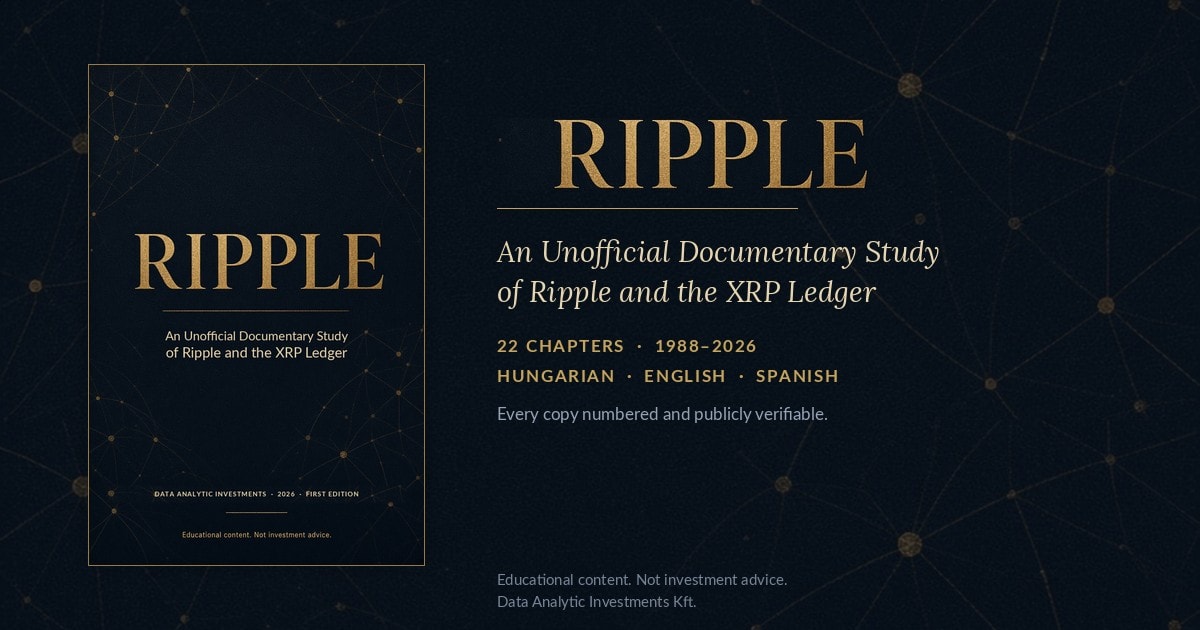
RIPPLE — An Unofficial Documentary Study of Ripple and the XRP Ledger is the longest thing this company has published. This article explains how it was built, what is in it, what the numbered copies are for, and — because it is the part we care most about — what the book deliberately does not claim. Nothing here is a promise about a market. It is a description of a book.
Why a documentary study, and why "unofficial"
The word "unofficial" is on the cover, on the product page and in the preface, and it is not modesty. The book was not commissioned, assisted, reviewed or approved by Ripple Labs, Inc. Its authors and publisher have no relationship with the company. The names that appear in it — Ripple, XRP, RLUSD and the other product and brand names — are the trademarks of their owners, and the book uses them the way a biography uses the name of its subject: to identify, not to endorse. Where the book quotes the company's own statements, it says so every time: "according to Ripple's statement".
The reason for the format is that the Ripple story had, until now, lived in pieces: in court filings, in regulatory releases, in exchange announcements, in press articles that contradict each other. The book's job was to arrange that scattered material into a single narrative that carries its sources with it — documenting every step, inventing nothing. That is the same rule this site applies to a price table on the Market Observation pages: a number is only shown if its source can be named, and the sources are listed openly on the Data Sources page.
The structure: seven eras, twenty-two chapters
The book is organised as seven eras. The first, the prehistory, runs from 1996 to 2011 and introduces the people before the company existed: the founder of a file-sharing network who went on to build an early bitcoin exchange, the founder of an online lending company, and the two engineers whose names appear on the ledger's earliest code. The second era, 2011 to 2013, is the birth: a proposal for a ledger that would work "without mining", the creation of a fixed supply of one hundred billion units, the decision about how that supply was split — and the break between the founders that sent one of them to build a rival network.
The third era, 2013 to 2019, covers the building years: the first regulatory penalty in 2015, the banking partnerships, the escrow arrangement for a large part of the supply, and the change of chief executive. The fourth era is the lawsuit, 2020 to 2025: the day the complaint was filed, the internal documents that became known as the Hinman files, the delistings that the book calls the exile, the 2023 ruling that split the question in two, and the closure. The fifth era, 2023 to 2026, is the rebuilding — an acquisition campaign, a stablecoin, what the book calls the bank gate, and the arrival of exchange-traded funds. The sixth era is about people: portraits of the figures who shaped the company, and a critical chapter on the disputes that follow it. The seventh era is the present: where the company stands in 2026, and the final chapter, which we will come back to.
Twenty-two chapters in all, followed by a chronological table and an apparatus of sources. The product page lists the chapter titles; three of the chapters have already appeared here in shortened form, as articles on the Torres ruling, on the 80/20 split and on the ledger's use by the Bank for International Settlements, so a reader can sample the method before buying the book.
The method: three levels of source, and an identifier behind every claim
No factual statement in the book stands without a source. Each chapter ends with source notes, and behind every claim sits a registry identifier that records where the claim came from. Sources are sorted into three levels. Level A is the primary record — court filings, judgments, regulatory releases, exchange filings. Level B is named, reliable press. Level C is a flag: a claim that so far has only a weaker source, and that does not enter the body of the book until it receives A- or B-level confirmation — or enters only with the reservation stated in the text.
Two examples show what this discipline does in practice.
The first is the genesis of the supply. Chapter VI, "The 80 and the 20", is built around the numbers in the 2020 complaint. Paragraph 45 of that filing records the creation of the ledger in December 2012 and states that the company "created—at little cost—the final version of what today is a fixed supply of 100 billion XRP." The book quotes the paragraph, attributes it to the regulator's filing rather than treating it as neutral fact, and then follows the split of that supply between the company and its founders. One number in that split — how much one of the founders received — is given as two billion units by the regulator and as one billion by a living counter-source. The book's registry carries that row as disputed. It does not pick a side; it prints both figures and their sources.
The second is the ruling. Chapter XV, "The Anatomy of the Torres Ruling", reads the thirty-four pages that Judge Analisa Torres handed down on 13 July 2023, after two and a half years of litigation — the ruling that gave neither side what it wanted. The chapter opens with an unusual feature of the case: the number of outside parties who asked to be heard. Coinbase, the Blockchain Association, the Chamber of Digital Commerce, Paradigm, I-Remit, TapJets and — most unusually — XRP holders themselves, represented by John Deaton, filed briefs. By that point, the book argues, the lawsuit was no longer a dispute between two parties but an industry's attempt to find out which rules it lived under. The chapter then goes through the ruling's distinctions one at a time, and the article version on this site gives the outline.
The chapter we are proudest of is the one that says what we do not know
Most books end by summarising what they have said. This one ends the other way round. Chapter XXII, "What This Book Does Not Tell You", collects what the previous twenty-one chapters could not establish — because the source was missing, because the sources contradicted each other, or because no public answer exists. Every earlier chapter ends with its own "does not claim" block; the final chapter is the synthesis of all of them, in four layers.
The first layer is motive. The book was built from documents, and documents record actions, not intentions. It does not know how the two founders met. It does not know what really happened at the 2013 split — "a philosophical disagreement" is a framing, not a disclosed story. It does not know the internal reasons for the change of chief executive beyond the text of the announcement, and it does not know why the regulator moved to a settlement position in 2025. Where the book does suggest a motive, it names whose claim it is relaying — usually a party to the lawsuit with an interest in its own version.
The second layer is numbers that never closed. Two series run through the book and neither resolves. The complaint alleged the sale of 14.6 billion units for 1.38 billion dollars; the record in the remedies phase gives a different breakdown — 757.6 million dollars programmatic, 728.9 million dollars institutional. The complaint is one side's pleading; the remedies figure is a record built for a narrower legal question. They do not measure the same thing, and the book promotes neither to a fact. The founder allocation, mentioned above, is the second unresolved series.
There are two further layers, and together the four are the reason the closing chapter is the longest honest chapter we could write. A reader who finishes the book should know exactly where the ground is firm and where it is not.
What you actually get
The book is sold as a download from the product page. Four language editions — Hungarian, English, Spanish and German — as PDF, each with the free AI-narrated audiobook in the same four languages, about five and a half hours of listening. The launch price is 9.99 dollars for a numbered first edition; the page shows the regular price and how long the launch price runs.
The numbering is not decorative. Every copy receives its own serial number, a security page and a QR code, and any copy can be checked on the public verification page. The idea is simple: a documentary book should itself be verifiable. If someone shows you a copy, you can confirm it is one of ours.
How this fits the rest of what we do
Data Analytic Investments is an educational and market-information company in Budapest. We do not give advice, we do not manage anyone's money and we do not publish forecasts; we teach people to read the record for themselves, and we publish the record so they can. The book is the long form of that. The Analyst Room is where we discuss the method in conversation; the Uncle Sunny Academy teaches the vocabulary; the About page explains who we are and how the four AI systems and one human who make this site divide the work. The book was written the same way: the machines gathered, structured and cross-checked; a person decided what stayed in and what stayed out.
If you read only one chapter, read the last one. It will tell you more about how the rest of the book was made than any introduction could.
Sources for this article: the book's own preface, chapters VI, XV and XXII and its methodology apparatus (RIPPLE — An Unofficial Documentary Study of Ripple and the XRP Ledger, first edition, 2026); the product page at dataanalyticsystem.com/ripple as read on 10 September 2026; the SEC complaint of 22 December 2020 and the ruling of 13 July 2023 as quoted in the book. The book is not affiliated with, endorsed by, or sponsored by Ripple Labs Inc.
Educational content. Not investment advice.
Continue on DAI
Explore Topics
Written by
DAI Research Desk
Content creator and writer sharing insights and stories.
Related tools & research
This article is a companion piece to the book.
RIPPLE — the book
An Unofficial Documentary Study of Ripple and the XRP Ledger
22 chapters · every claim with a named source · numbered first edition · $9.99