Hungary's central bank holds its base rate at 5.50% on 17 November 2026: what the statement says
October inflation 2.0%, core inflation 2.1%, Q3 GDP up 1.5% year on year. Hungary's Monetary Council held rates and said it will assess its room for manoeuvre using the December Inflation Report.
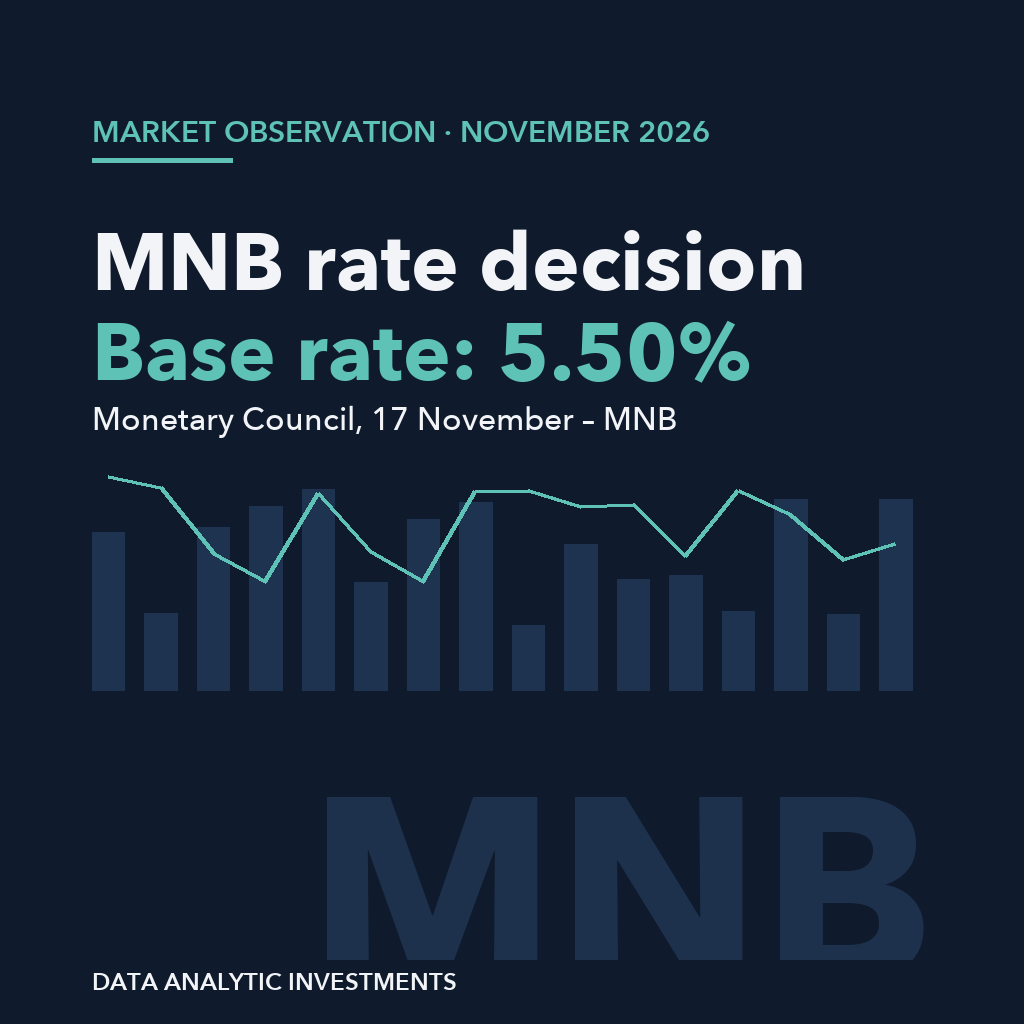
Hungary's central bank, the Magyar Nemzeti Bank (MNB), kept its policy rates unchanged at its Monetary Council meeting on 17 November 2026. The base rate stays at 5.50%, inside a corridor of 4.50% to 6.50%. The statement says holding rates is needed to reach the inflation target sustainably, and that the Council will judge its room for manoeuvre on the basis of the December Inflation Report.
Data sheet
| Instrument | Previous | New (from 18 November 2026) |
|---|---|---|
| Central bank base rate | 5.50% | 5.50% (unchanged) |
| Overnight deposit (base rate minus 1 pp) | 4.50% | 4.50% |
| Overnight collateralised loan (base rate plus 1 pp) | 6.50% | 6.50% |
| Figure cited in the statement | Value |
|---|---|
| Inflation, October 2026 | 2.0% |
| Core inflation, October 2026 | 2.1% |
| GDP, Q3 2026, year on year | +1.5% |
| Inflation target from 1 January 2028 | 2.5% |
| Minutes published | 2 December 2026, 14:00 CET |
Source: MNB, statement on the Monetary Council meeting of 17 November 2026 (in Hungarian)
The domestic picture
According to the statement, Hungary's GDP grew 1.5% year on year in the third quarter. Industry made the largest contribution and services helped, while agriculture was a significant drag. Industrial output and retail sales kept expanding in September, and unemployment remains low by international standards.
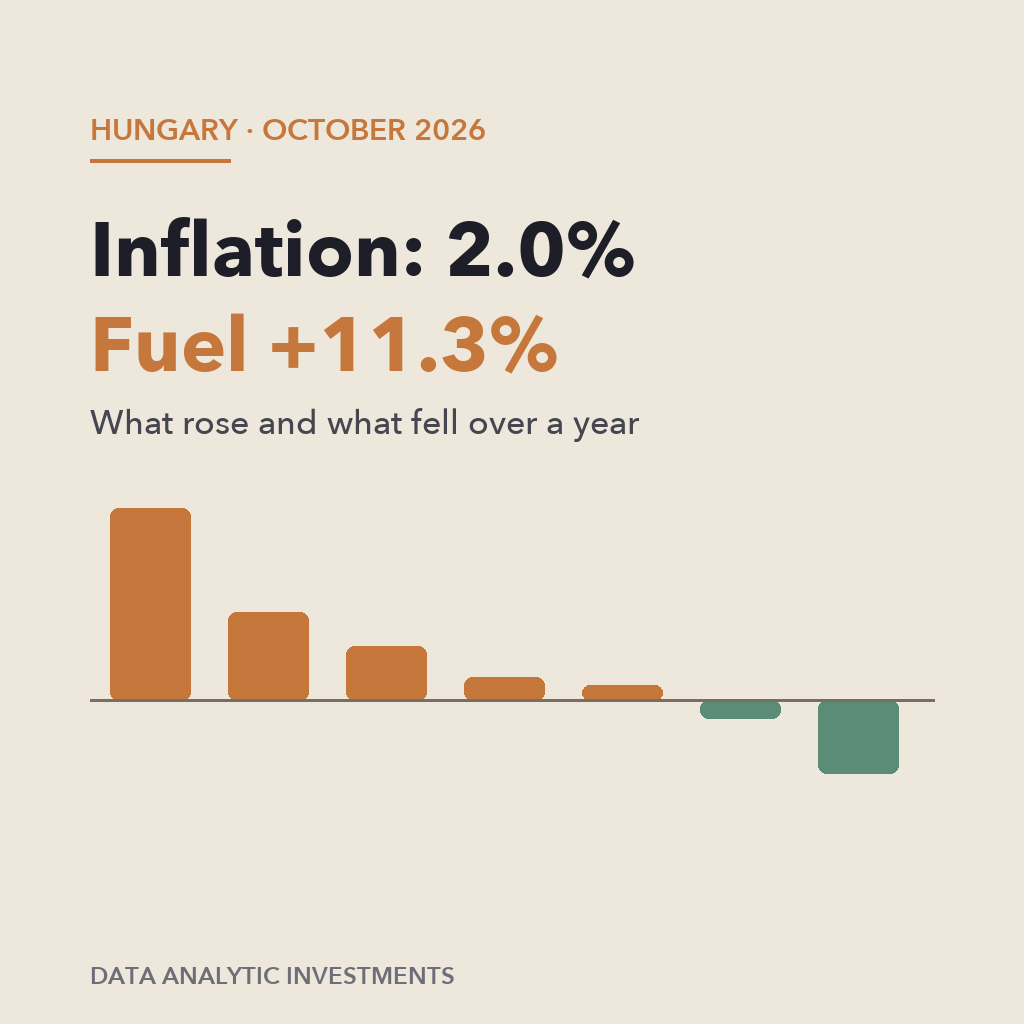
Consumer prices rose 2% in October, in line with the MNB's September forecast. Fuel did most of the work: the statement points to faster fuel price growth, while food prices are still lower than a year earlier. Core inflation was 2.1%. The October release from the statistics office is covered separately (Hungary inflation, October 2026).
Why the Council did not cut
Inflation is near the bottom of the tolerance band, and the Council expects it to rise from there. It names two drivers: higher fuel prices and economic policy measures. The statement lists the measures expected to push prices up:
- the phasing out of retail margin caps,
- higher excise duty on tobacco and spirits,
- higher retail special tax and public health product tax,
- changes to the financial transaction levy.
Spending restraint in the budget works the other way. The full macroeconomic effect of these measures will appear in the December Inflation Report.
The outside world adds uncertainty. Inflation in the euro area and the US is above central bank targets, European gas prices are high and long-term rates internationally remain unsettled. The Council calls for a "careful and data-driven" approach.
The regional and global backdrop
The statement notes that the ECB and the Federal Reserve left rates unchanged in October (ECB decision of 29 October), and that market pricing suggests major central banks may raise rates further before year-end. Within the region, the Czech National Bank raised its rate in November, while the Polish and Romanian central banks held.
On the domestic side, the MNB says Hungary's risk perception has stayed stable. It credits the market reception of the budget path and the government's commitment, set out in the medium-term fiscal plan, to adopting the euro.
How the decision was reached
Hungarian news site Index reported that the vote was not unanimous and that one member voted for a cut (Index, 17 November 2026, in Hungarian). The minutes due on 2 December will give the details. At the press conference, Governor Mihály Varga said high energy prices pose a risk to the inflation outlook, according to the same report.
The base rate was also held at 5.50% at the October meeting (MNB rate decision, October 2026).
What this means in practice
- Nothing changes for now in the rate environment. Forint deposit and loan rates linked to the base rate get no new impulse from this decision; individual banks set their own pricing.
- The statement does not commit to a December move. It only says the Council will assess its room for manoeuvre with the December Inflation Report.
- The target is changing. From 1 January 2028 the inflation target becomes 2.5%. For the terms used here (base rate, interest rate corridor, core inflation), see the glossary; a summary of macro data is on the macro page.
Related on dataanalyticsystem.com
- MNB rate decision, October 2026: base rate held at 5.50%
- Hungary inflation, October 2026: 2.0%
- ECB holds at 2.50% on 29 October 2026
- Macro overview
Sources
- MNB: Közlemény a Monetáris Tanács 2026. november 17-i üléséről (17 November 2026): https://www.mnb.hu/monetaris-politika/a-monetaris-tanacs/kozlemenyek/2026/kozlemeny-a-monetaris-tanacs-2026-november-17-i-uleserol
- Index: report on Governor Varga's press conference (17 November 2026): https://index.hu/gazdasag/2026/11/17/varga-mihaly-mnb-elnok-kamatdontes-inflacio/
Data Analytic Investments is not affiliated with the institutions and outlets cited; names are used for identification only.
Educational content, not investment advice.
Continue on DAI
Explore Topics
Written by
Data Analytic Investments
Content creator and writer sharing insights and stories.