
$13 billion or $50 billion? The EQT–Range Resources gas merger – what an all-stock deal, an exchange ratio and enterprise value mean
0.987 EQT shares for each Range share, a 20.6% premium, more than 9 billion cubic feet equivalent a day in the Appalachian Basin. Why two different dollar figures appear in the news, and what an all-stock acquisition means – with sources, without assessing any stock.

On Monday 26 October 2026, EQT announced that it will acquire Range Resources in an all-stock deal. Both companies operate in the Appalachian Basin, one of the largest natural gas regions in the United States. Two different numbers appear in the news: some summaries describe a deal "valued at more than $50 billion", while Reuters reports a share exchange worth about $13 billion. Both are correct; they measure different things. This article explains the difference and the basic concepts of the deal. It does not assess any stock.
| Fact sheet | |
|---|---|
| Announced | 26 October 2026 |
| Structure | entirely in shares (all-stock) |
| Exchange ratio | 0.987 EQT shares for each Range share |
| Deal value | about $12.83bn, $54.91 per Range share (Reuters calculation) |
| Premium | 20.6% over Friday's closing price |
| Combined enterprise value | above $50bn, including debt |
| Ownership | EQT shareholders about 73%, Range shareholders about 27% |
| Expected close | Q1 2027 |
Sources: Reuters via Investing.com, 26 Oct, TheStreet, 26 Oct.

$13 billion or $50 billion: two different measures
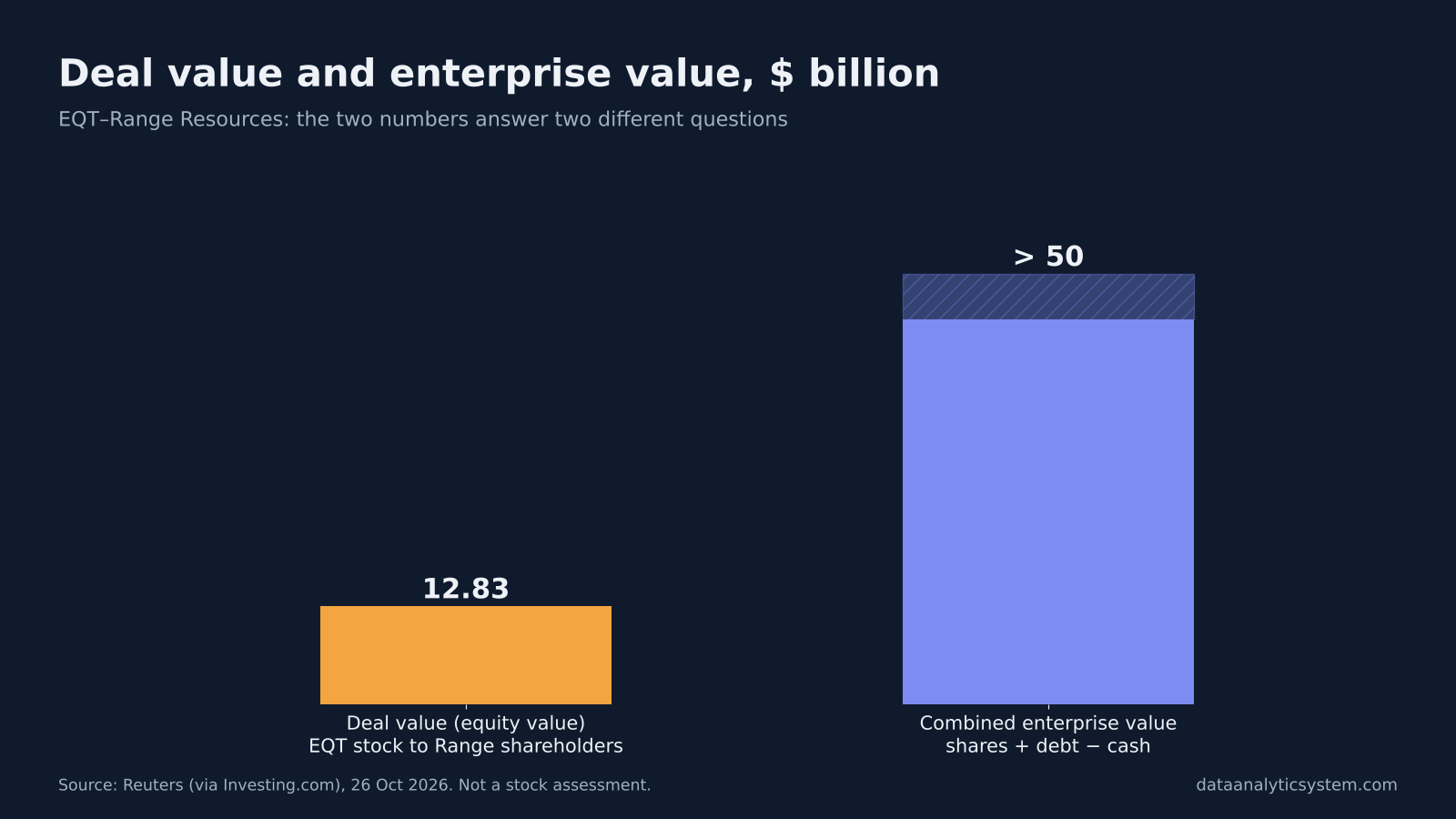
Deal value (equity value) shows what the buyer hands to the target's shareholders. Here that is EQT stock: according to Reuters' calculation, about $12.83 billion, or $54.91 per Range share.
Enterprise value is broader: it adds the company's debt to the value of its shares and subtracts its cash. According to Reuters, the enterprise value of the combined company – EQT and Range together – will exceed $50 billion including debt.
So the "$50 billion deal" describes the combined size of the two companies, not what one pays for the other.
How a share exchange works
In an all-stock deal the buyer pays not in cash but in its own shares. The exchange ratio says how many buyer shares each target share receives – here 0.987. It follows that the value Range shareholders receive moves with EQT's share price until the deal closes.
This article's own back-calculation: if 0.987 EQT shares are worth $54.91, the EQT price used in the calculation is about $55.6. On the day of the announcement, according to Reuters, EQT shares fell 3.7% while Range shares jumped 15.1% to $52.43. That is why a target's price usually stays slightly below the offered value until closing: the gap reflects the time left and the chance that the deal falls through.
The premium measures how much more the offer is worth than the pre-announcement share price: here 20.6%.
Production and the unit
According to Reuters, the combined company's net production will exceed 9 billion cubic feet equivalent per day (bcfe/d), with more than 30 years of drilling inventory across nearly 3 million net acres and more than 3,700 miles of pipelines. For comparison, the source cites Expand Energy, which produced about 7.2 bcfe/d in 2025.
A cubic foot is about 0.0283 cubic metres. By this article's conversion, 9 billion cubic feet a day is about 255 million cubic metres. "Equivalent" means that liquids produced alongside the gas are converted into gas terms.
Why now: the demand backdrop
According to Reuters, EQT is betting on demand from liquefied natural gas (LNG) exports and power generation – including data centres serving artificial intelligence. The US Energy Information Administration (EIA) forecasts US gas consumption rising from 91.9 billion cubic feet a day in 2025 to 94.3 billion in 2027. On the conference call, EQT chief executive Toby Rice put potential Appalachian gas demand at 25 billion cubic feet a day, up from an earlier 20 billion. According to Reuters, the company ties future production growth to customer demand rather than output goals.
What is still ahead
The companies expect to close in the first quarter of 2027. A deal like this typically also needs shareholder and regulatory approval; the source opened does not give details. Range chief executive Dennis Degner and one other Range representative will join EQT's board; headquarters stay in Canonsburg, Pennsylvania.
5 things many people don't know
- The two dollar figures answer two questions. One is the purchase price, the other the combined company's size including debt.
- In a share exchange the price moves. Range shareholders receive EQT stock, so the value changes with EQT's price.
- The buyer's shares often fall on the announcement. Here EQT fell 3.7%.
- "Equivalent" is a mixed product. Bcfe converts liquids produced with the gas into gas terms.
- Data centres are gas consumers too. According to Reuters, power demand from AI data centres is one driver of gas demand.
Summary
- EQT is acquiring Range Resources in shares: a 0.987 exchange ratio, a 20.6% premium.
- Deal value about $12.83bn; the combined company's enterprise value above $50bn.
- Combined production above 9 bcfe/d; closing expected in Q1 2027.
- Backdrop: LNG exports and data-centre power demand.
Related reading: Four earnings reports in one week · Blog archive.
Educational content. Not investment advice and not a stock or price assessment. Data Analytic Investments is not affiliated with EQT, Range Resources or the portals cited; names are used for identification only. Images labelled "AI illustration" are not photographs.
Continue on DAI
Explore Topics
Written by
Data Analytic Investments
Content creator and writer sharing insights and stories.