
Black Tuesday, 29 October 1929: the crash in numbers, 97 years on – what happened, what the central bank did, and why its causes are still debated
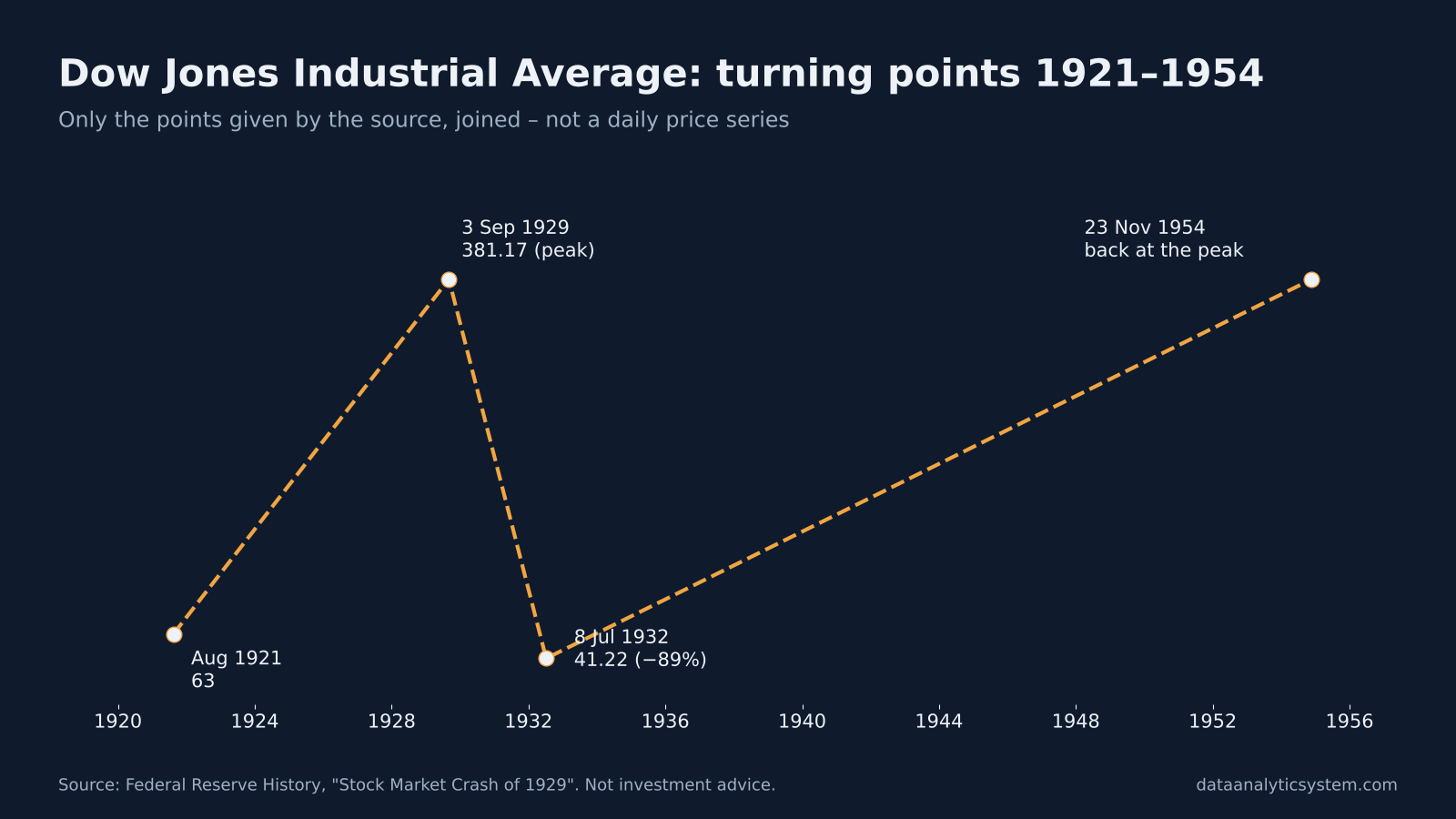
381.17 points in September 1929, 41.22 in July 1932, and 25 years to get back. What buying on margin means and what happened on Black Monday and Black Tuesday – based on a central-bank history essay, without advice.

97 years ago, on Tuesday 29 October 1929, the Dow Jones Industrial Average fell nearly 12% on the New York Stock Exchange. The day became known as "Black Tuesday". According to an essay on Federal Reserve History, the US central bank system's history site, the index had lost nearly 13% the day before, on "Black Monday". This article summarises the numbers, the concepts and the central bank's actions at the time. It draws no investment lesson from them.
| Fact sheet | |
|---|---|
| Peak | 3 September 1929, 381.17 points |
| Black Monday | 28 October 1929, nearly −13% |
| Black Tuesday | 29 October 1929, nearly −12% |
| Mid-November | the index had lost almost half its value |
| Bottom | 8 July 1932, 41.22 points (−89% from the peak) |
| Back at the peak | 23 November 1954 |
| Anniversary | 29 October 2026 = 97 years (this article's calculation) |
Source: Federal Reserve History, "Stock Market Crash of 1929".

The rise
According to the essay, the Dow Jones index stood at 63 in August 1921 and closed at 381.17 on 3 September 1929. That is roughly a sixfold rise in eight years (this article's calculation: 381.17 / 63 ≈ 6).
What buying on margin is
According to the essay, buyers typically paid about 10% of a stock's price and borrowed the rest, with the shares bought serving as collateral. This is called buying on margin. If the price falls, so does the value of the collateral, and the lender may demand more or sell the shares. In a broad decline this can trigger a self-reinforcing wave of selling. Commercial banks and other lenders put growing sums into loans to brokers.
The Fed's debate before the crash
According to the essay, there was disagreement within the central bank system about how to curb speculative lending. The Board in Washington favoured direct action: reserve banks should deny credit to member banks that lent to stock speculators. The New York Fed preferred raising the discount rate. The Board refused several times, then agreed in August 1929; New York's discount rate rose to 6%.
The discount rate is the rate at which the central bank lends directly to commercial banks.
What the central bank did after the crash
According to Federal Reserve History, after the October fall the New York Fed:
- bought government securities on the open market,
- expanded lending through the discount window,
- lowered the discount rate,
- and assured banks it would supply the reserves they needed.
These steps were controversial at the time: the Board and several reserve banks felt the New York Fed had exceeded its authority.
Did the crash cause the Depression?
According to the essay, the crash hurt commerce and manufacturing: as confidence fell, people bought fewer big-ticket items and unemployment rose. Economic historian Allan Meltzer (2003), however, argued that the crash was more a symptom of the contraction that began in 1929 than a cause. Problems elsewhere in the financial system eventually turned the downturn into the Great Depression. The question is still debated.
5 things many people don't know
- Monday fell further than Tuesday. On Black Monday the drop was nearly 13%, on Black Tuesday nearly 12%.
- The bottom came only in 1932. 41.22 points was the index's lowest close of the twentieth century.
- It took 25 years to recover. The index regained its 1929 peak on 23 November 1954.
- Ten per cent down was typical. Most of a share purchase was financed with borrowed money.
- The rescue caused an internal dispute. Part of the Board saw the New York Fed's actions as overstepping its authority.
Summary
- 28–29 October 1929: falls of nearly 13% and then nearly 12% in two days.
- Peak and bottom: 381.17 → 41.22 points, −89% by 1932.
- Recovery: in 1954, about 25 years after the peak.
- Central bank: securities purchases, cheaper and wider lending to banks — contested steps.
- Debate: whether the crash was a cause or a symptom of the Depression.
Related reading: Blog archive.
Educational content. An economic-history summary, not investment advice or a market forecast. Past events do not predict future ones. Data Analytic Investments is not affiliated with the Federal Reserve or the site cited. Images labelled "AI illustration" are not photographs.
Continue on DAI
Explore Topics
Written by
Data Analytic Investments
Content creator and writer sharing insights and stories.