
Wekerle Plus home savings: what the money can and cannot be used for – the draft law's rules, and what Hungary's central bank says about subsidised lending
Ten and twenty percent state top-ups, at least three percent interest, five to ten years – and two uses that are left out. What the bill says, what banks are offering, and what the central bank expects – with sources, without advice.
Most coverage of Hungary's Wekerle Plus scheme so far has been about its subsidised loan. The scheme has a second pillar: a new home-savings account (lakástakarék), whose state subsidy starts on 1 January 2027. Pénzcentrum's article of 19 November (in Hungarian) went through a bill published on the parliament's website to see what the savings can and cannot be spent on. This article summarises the rules, banks' November moves and the central bank's estimate. It is not financial advice.
| Fact sheet | |
|---|---|
| Main source | Pénzcentrum, 19 November 2026 (Béla Ádám Nagy) |
| Legal status | a bill; may change during debate |
| Subsidy starts | 1 January 2027 |
| Term | at least 5, at most 10 years |
| State subsidy | years 1–5: 10% of payments, max HUF 120,000 a year · from year 6: 20%, max HUF 240,000 a year |
| Interest | the provider pays at least 3% a year on subsidised payments for the first 10 years |
| Not allowed | prepaying an existing mortgage · replacing a bridge loan |
| MNB estimate | new subsidised mortgage contracts could fall by at least 34% |
Sources: Pénzcentrum, 19 Nov, THT, 20 Nov (both in Hungarian).
What the money can be used for
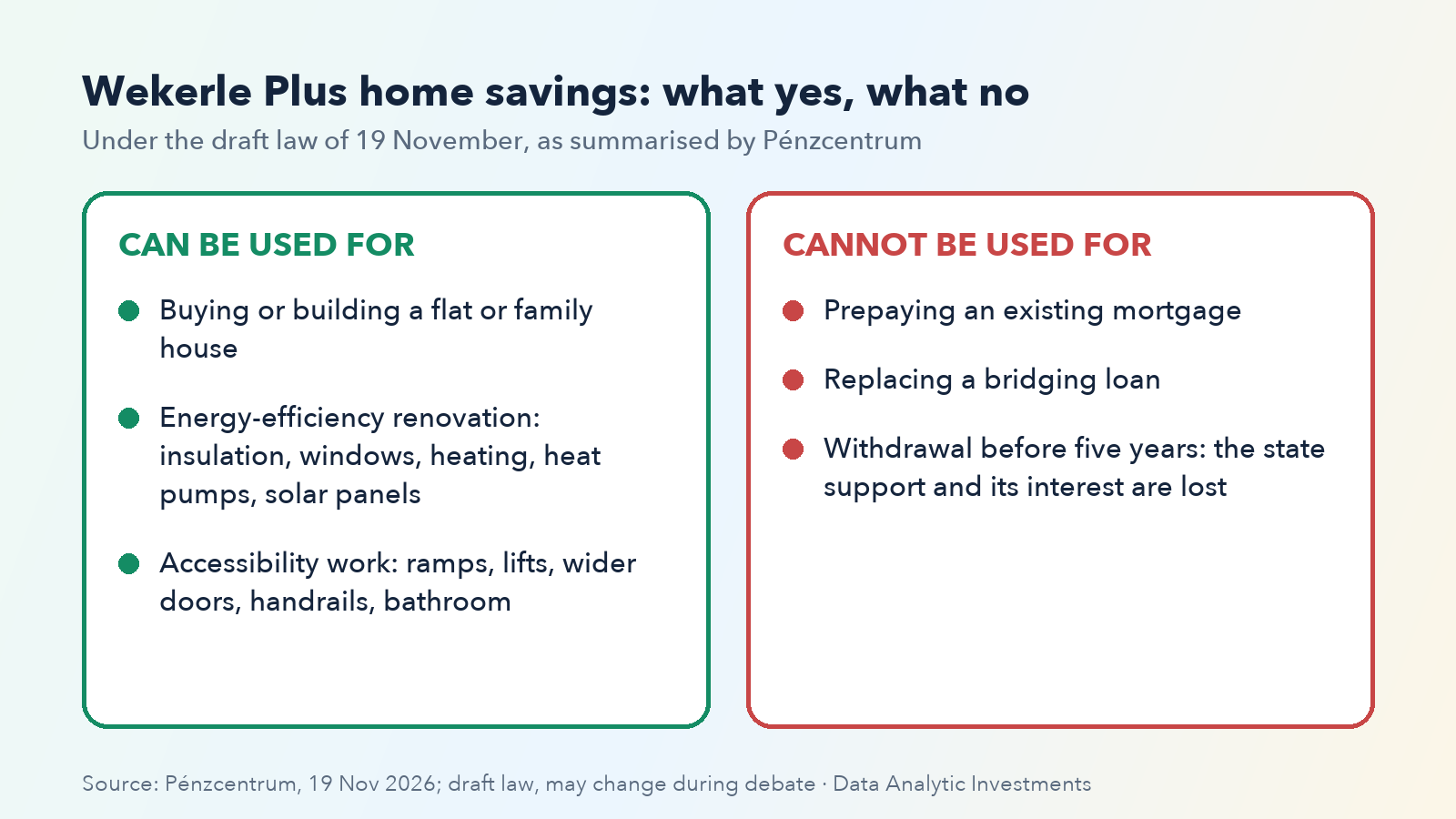
According to the source, the bill allows housing purposes in Hungary:
- buying or building a flat or family house;
- energy-efficiency renovation: insulation, window and door replacement, upgrading hot-water and heating systems, solar collectors, heat pumps, solar panels, smart-home systems;
- accessibility work: ramps, lifts, wider doors, removing thresholds, handrails, bathroom conversion.
The money can be used by the saver, the named beneficiary or a close relative. According to the source, the bill does not define "close relative" in detail.
What it cannot be used for
The bill rules out two uses:
- prepaying an existing mortgage — according to the source, one of the most popular uses of earlier home-savings schemes;
- replacing a bridge loan.
Anyone withdrawing before five years loses the state subsidy and the interest earned on it; the provider deducts these and pays them back to the central budget. If the housing-purpose condition is not met, the subsidy and the benefit of the at-least-3% interest may also be lost. After at least five years, a linked housing loan can be taken, if the full contract amount goes to a housing purpose.
A worked example, for illustration
The example cited by the source assumes HUF 100,000 a month, 3% interest and no costs: after ten years about HUF 16 million builds up — 12 million of own payments, 1.8 million of state subsidy and about 2.19 million of interest. This article's check: 100,000 × 12 × 10 = 12 million; 5 × 120,000 + 5 × 240,000 = 1.8 million forints. HUF 100,000 a month exactly uses up the annual subsidy cap. The source stresses that the example is not a guaranteed outcome.
What banks are doing
According to Economx's round-up of 19 November (in Hungarian), the statutory rate cap on the subsidised loan leaves banks little room, so competition shifts to market loans taken alongside it and to other discounts. Credits are smaller than at the launch of the earlier CSOK Plus and Otthon Start schemes, and often tied to insurance or salary transfers. The source's examples: MBH credits up to HUF 480,000 for two applicants; Erste HUF 80,000 in total with home and payment-protection insurance; CIB up to HUF 100,000 for new clients; OTP gives first-time buyers under 45 a 1 percentage-point discount on a market mortgage. Another source earlier reported an MBH credit of 380,000 — the conditions are set by each bank's own published terms. This is a list, not a comparative recommendation.
What the central bank expects
According to THT on 20 November, the Hungarian central bank (MNB) estimates that the stricter conditions could cut new subsidised mortgage contracts by at least 34%. The estimate applies only to new subsidised contracts, not to total loan stock or the number of transactions. According to the source, household loan stock grew 21.8% year on year by the end of Q3 (V4 average 8.6%, EU 3.4%), and under Otthon Start, from September 2025 to October 2026, 66,000 contracts were signed, worth about HUF 2,300 billion.
5 things many people don't know
- The home-savings rules are still in a bill. According to the source, they may change in debate.
- Prepayment is left out. It was one of the commonest uses of earlier schemes.
- The subsidy doubles from year six. From 10% to 20%, the cap from 120,000 to 240,000.
- Smart-home systems and solar panels count as housing purposes. As part of energy-efficiency renovation.
- The 34% is not about prices. It is about the number of new subsidised contracts.
Summary
- Start: 1 January 2027, 5–10-year contracts.
- Subsidy: 10%, then 20%; at least 3% interest for the first 10 years.
- Excluded: prepaying an existing loan and bridge loans.
- Banks: competition has moved to market loans and smaller credits.
- MNB: at least 34% fewer new subsidised contracts expected.
Related reading: Wekerle Plus announcement in numbers · Blog archive.
Educational content. Not financial, mortgage, property or investment advice, and not a market forecast. This article describes a bill and public press sources; the final rules are set by the law as enacted, and bank conditions by the banks' published terms. Data Analytic Investments is not affiliated with the banks, the MNB or the portals cited.
Continue on DAI
Explore Topics
Written by
Data Analytic Investments
Content creator and writer sharing insights and stories.