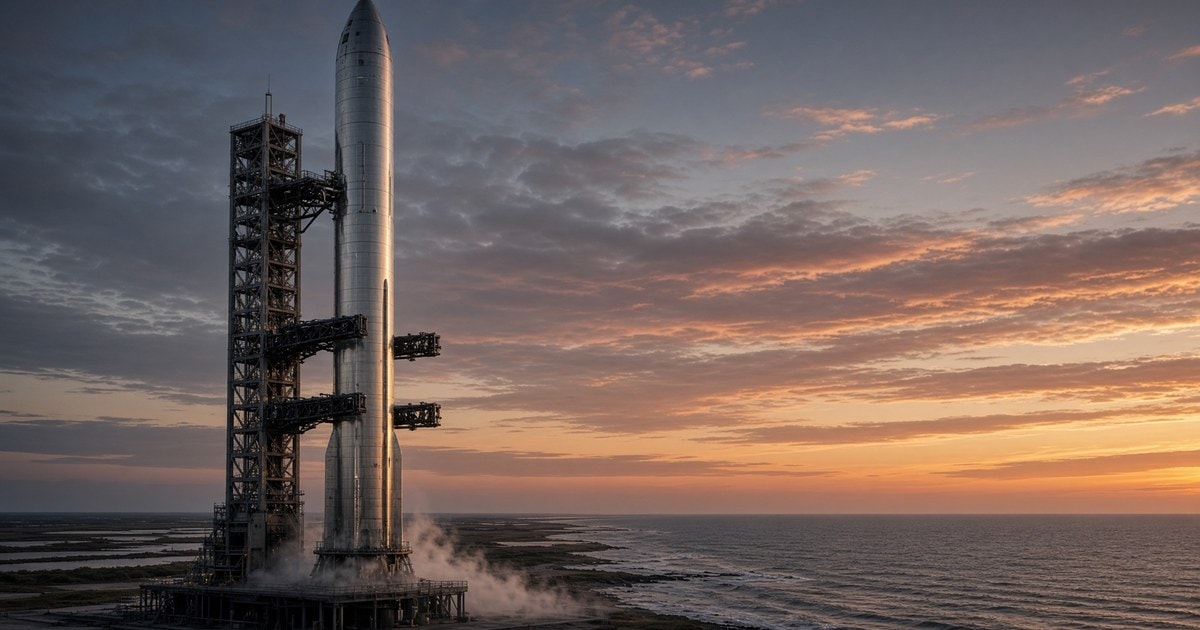
SpaceX in autumn 2026: Starship, Starlink and the launch market
On 28 September 2026 Starship reached orbit for the first time. Here is where SpaceX stands in October 2026: Starship, Falcon 9, Starlink, the Moon lander timeline, the FAA and the competitors, in plain words.
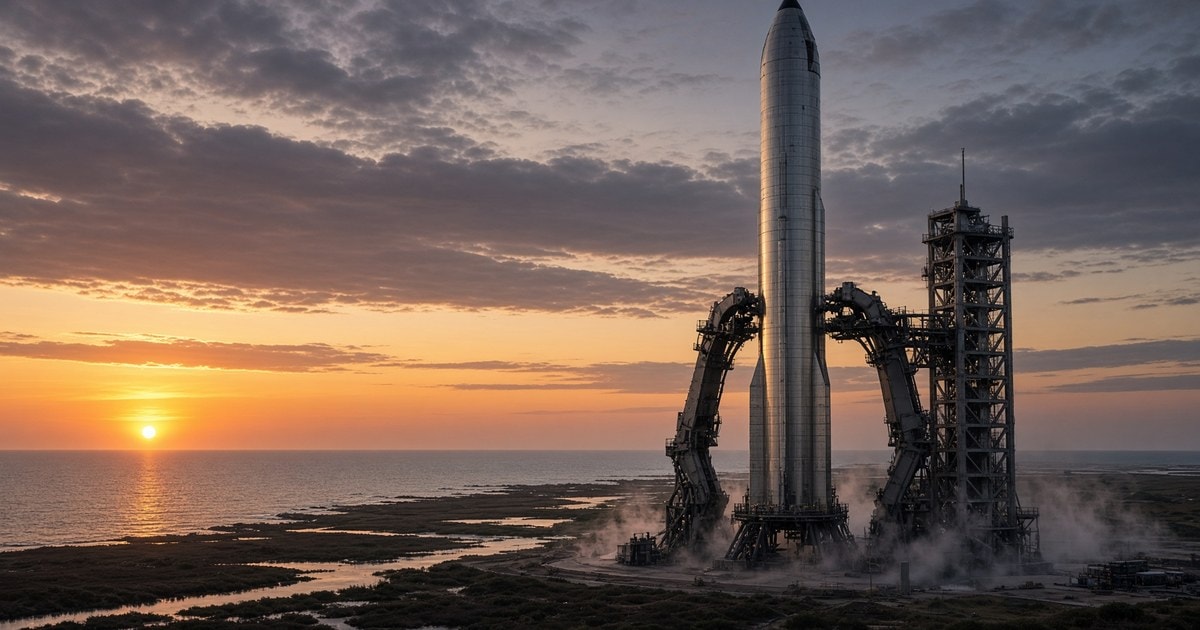
On 28 September 2026 something happened that the Starship programme had never done before: the ship reached orbit. All 13 earlier flights were suborbital, meaning they went up to space but did not circle the Earth. This article sums up where SpaceX stands in October 2026 in space technology and the launch market. Group-level finances are covered in a separate article.
Starship: from test flights to orbit
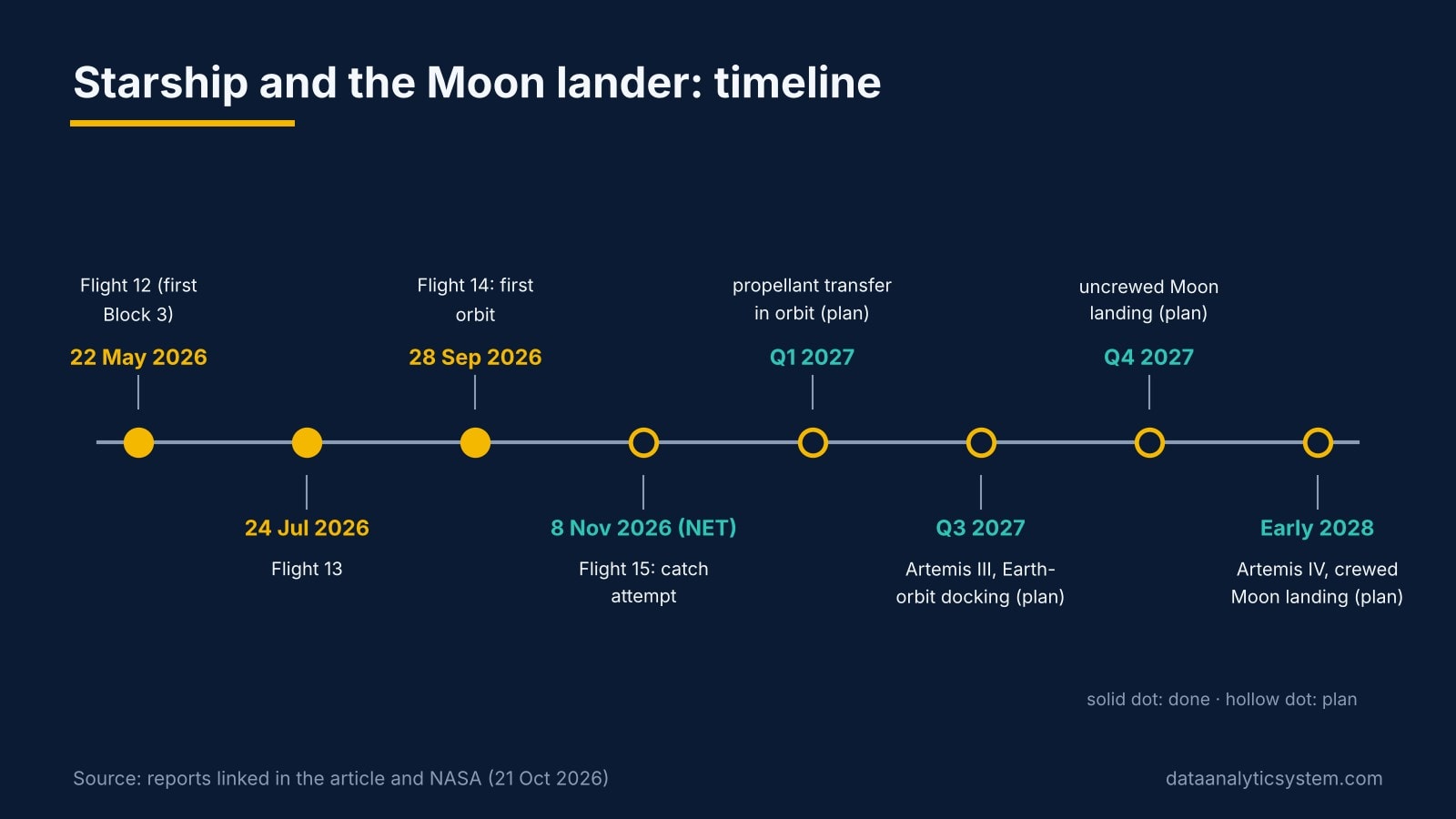
In 2026 SpaceX moved to the third version of Starship, called Block 3 (or V3). The list of Starship launches shows the first Block 3 flight (Flight 12) on 22 May 2026 and Flight 13 on 24 July. Both ships reached their target splashdown zones, but both boosters were lost in the Gulf of Mexico.
Flight 14 flew on 28 September. According to GPB / NPR, one of the ship's six engines shut down during ascent. The ship released 26 Starlink V3 satellites, then came down early, after about three hours instead of the planned ten. The booster did not return to the tower; it made a planned splashdown in the Gulf. Elon Musk later called the engine shutdown a software glitch in that one engine's computer. This is the company's explanation, not an independent finding.
What comes next (plans, not facts yet):
- Flight 15: no earlier than 8 November, per NASASpaceflight. SpaceX wants to catch both the booster and, for the first time, the ship with the tower's "chopsticks" (two mechanical arms).
- Flight 16: targeted for December, possibly the first Starship launch from Florida (pad 39A).
- NASASpaceflight expects only about five Starship launches in 2026.
| Flight | Date | Main result |
|---|---|---|
| 12 | 22 May 2026 | First Block 3 flight; ship hit its landing zone, booster lost |
| 13 | 24 Jul 2026 | Ship hit its landing zone, booster lost |
| 14 | 28 Sep 2026 | First orbit, 26 Starlink V3 satellites, shortened mission |
| 15 | NET 8 Nov 2026 | Planned catch of booster and ship |
Sources: Wikipedia, GPB, NASASpaceflight.
Refuelling in orbit and the Moon lander
To land astronauts on the Moon, the Starship lander (HLS, Human Landing System) needs to be refuelled in orbit by tanker ships. According to the NASA timeline reported by Starlust on 21 October 2026:
- Q1 2027: propellant transfer demonstration in orbit.
- Q3 2027: Artemis III. This is no longer a Moon landing. Four astronauts fly Orion to low Earth orbit and dock with test versions of the landers.
- Q4 2027: uncrewed Starship landing on the Moon.
- Early 2028: Artemis IV, the first crewed Moon landing since Apollo. NASA picks the lander after Artemis III.
Falcon 9: the workhorse of the world
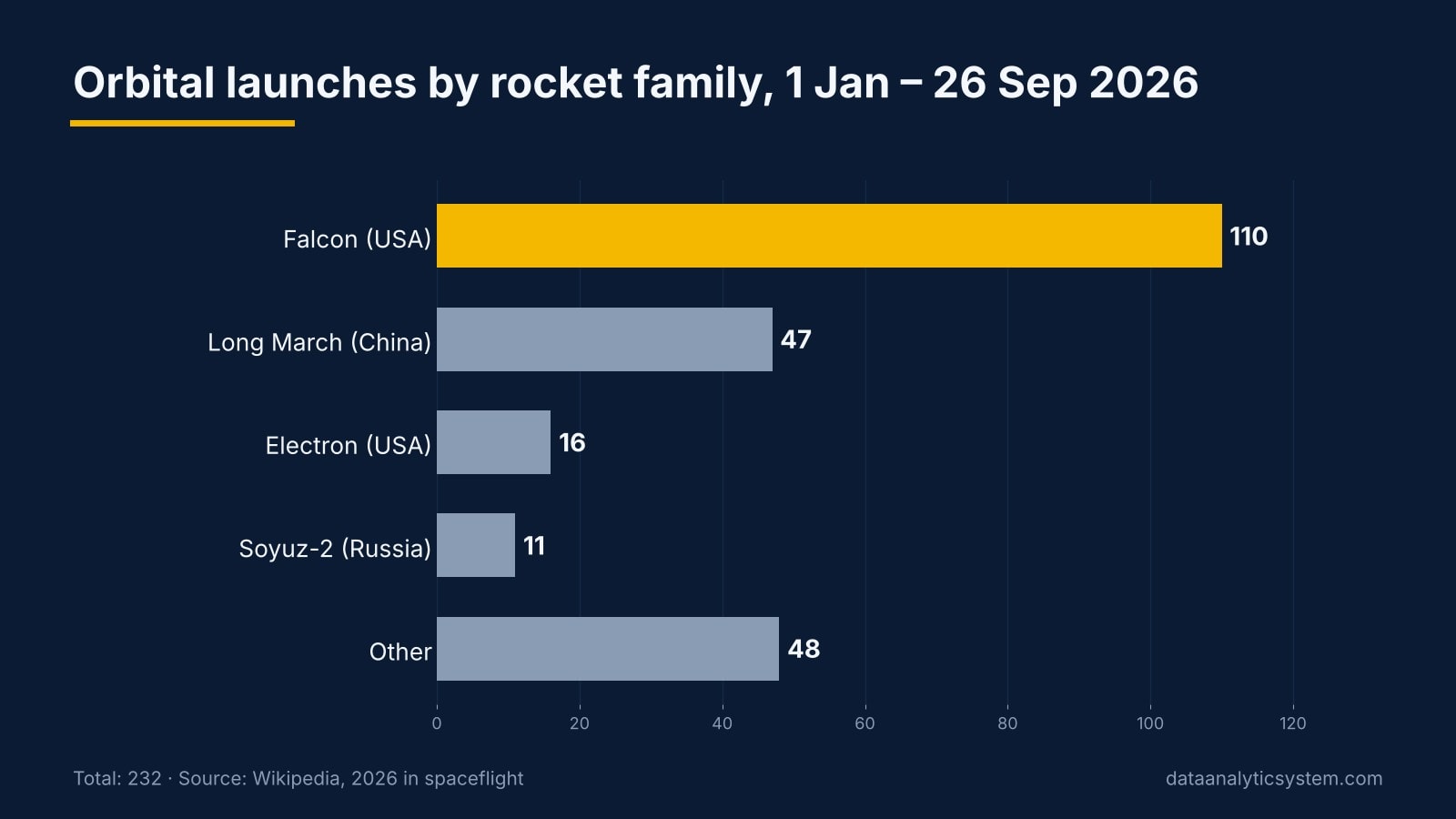
While Starship is still testing, Falcon 9 does the daily work. By 26 September 2026 the Falcon family had flown 110 times in 2026, without a failure. The whole world made 232 orbital launches in the same period. So Falcon flew about 47% of all orbital launches on Earth. The United States as a whole made 136 launches, China 70.
In the third quarter SpaceX reported 35 launches: 12 for customers and 23 for itself, mostly Starlink. One booster, B1067, has flown 37 times.
Reusable rockets, in plain words
A rocket is like an airliner that used to be thrown away after every flight. The first stage, the big lower part, is the most expensive piece. Falcon 9 lands its first stage on a ship or on land, then flies it again. You pay for the hardware once and spread the cost over many flights. Fuel is cheap by comparison.
The public list price of a Falcon 9 launch is $74 million. An independent researcher, Brian Basson, estimates the real cost of one launch at about $13.7 million, and refurbishing a booster between flights at about $300,000. These are outside estimates, not SpaceX figures. Starship aims to reuse both stages, which would push the cost down further, if it works.
Starlink: the main business
Starlink is the satellite internet service. SpaceX's own quarterly report, quoted by Spaceflight Now, says:
| Item (end of Q3 2026) | Value |
|---|---|
| Satellites in orbit | more than 11,100 |
| Consumer subscribers | 13.6 million (pulse2) |
| Markets served | 174 |
| Average monthly revenue per consumer | $69 |
| Connectivity revenue, Q3 | $5.25 billion |
These are company-reported figures from SEC filings, not independently audited counts.
Direct-to-cell means a normal phone talks straight to a satellite when there is no mobile tower nearby. SpaceX bought spectrum (radio frequencies) for this from EchoStar in a deal worth about $17 billion, announced in September 2025. On 21 October 2026 the US regulator FCC approved a further, smaller spectrum purchase.
Hungary: Starlink home internet has been available in Hungary since May 2022. On 2 March 2026 Deutsche Telekom, including Magyar Telekom, announced a partnership with Starlink for satellite-to-phone coverage from 2028 in several European markets. Hungary is "probably" among them, but this is not confirmed.

Money, the stock market and the FAA
SpaceX listed on Nasdaq under the ticker SPCX on 12 June 2026. It raised a reported $75 billion at $135 per share, the largest IPO on record. In Q3 2026 the company reported total revenue of $14.6 billion. The space segment (launches and related work) brought $1.77 billion. Most of the growth came from the AI segment, which the separate group article discusses.
The FAA, the US aviation regulator, licenses every launch. Today Starbase in Texas may host up to 25 Starship launches a year. A new environmental review could allow far more, up to 456, but it is only at an early stage and nothing is approved.
The competitors
- Blue Origin, New Glenn: In April 2026 the third flight put its satellite into the wrong orbit. On 28 May a rocket exploded during a ground test and badly damaged its only launch pad. Blue Origin says it aims to fly again before the end of 2026; whether it will was not known when this article was written.
- Rocket Lab, Neutron: The first launch slipped to 2027 after air pockets were found in a tank dome.
- China: On 19 August 2026 LandSpace's Zhuque-3 landed its first stage on land, a first for China. A Long March 10B stage was recovered at sea with a net on 10 July.
5 things many people don't know
- Starship's first 13 flights never orbited the Earth. Flight 14 on 28 September 2026 was the first orbital attempt in the programme's history.
- Artemis III will not land on the Moon. Under the current NASA plan it is a docking test in Earth orbit; the landing moved to Artemis IV, early 2028.
- SpaceX is its own biggest customer. Of 35 launches in Q3 2026, 23 were internal, mostly Starlink.
- One Starship flight equals about ten Falcon 9 Starlink flights in capacity. SpaceX says the 26 V3 satellites added about 26 Tbps. This is a company claim.
- Refurbishing a used booster may cost less than half a percent of the list price. An independent estimate puts it at about $300,000 against a $74 million sticker price.
Summary
In autumn 2026 SpaceX leads the launch market by a wide margin: Falcon 9 flies almost every second orbital rocket. Starship has reached orbit, but the big tests are still ahead: catching the ship, refuelling in orbit and landing on the Moon. Most competitors lost time in 2026.
Educational content. Not investment advice. Data Analytic Investments is not affiliated with SpaceX, Starlink, NASA, Blue Origin, Rocket Lab, LandSpace, EchoStar or Deutsche Telekom / Magyar Telekom; brand names are used for identification only. Images labelled "AI illustration" are not photographs.
Continue on DAI
Explore Topics
Written by
Data Analytic Investments
Content creator and writer sharing insights and stories.