EU funds in Hungary's 2027 budget bill: HUF 2,126 billion in revenue, HUF 963.5 billion in contributions – what the net balance, co-financing and operational programme envelopes mean
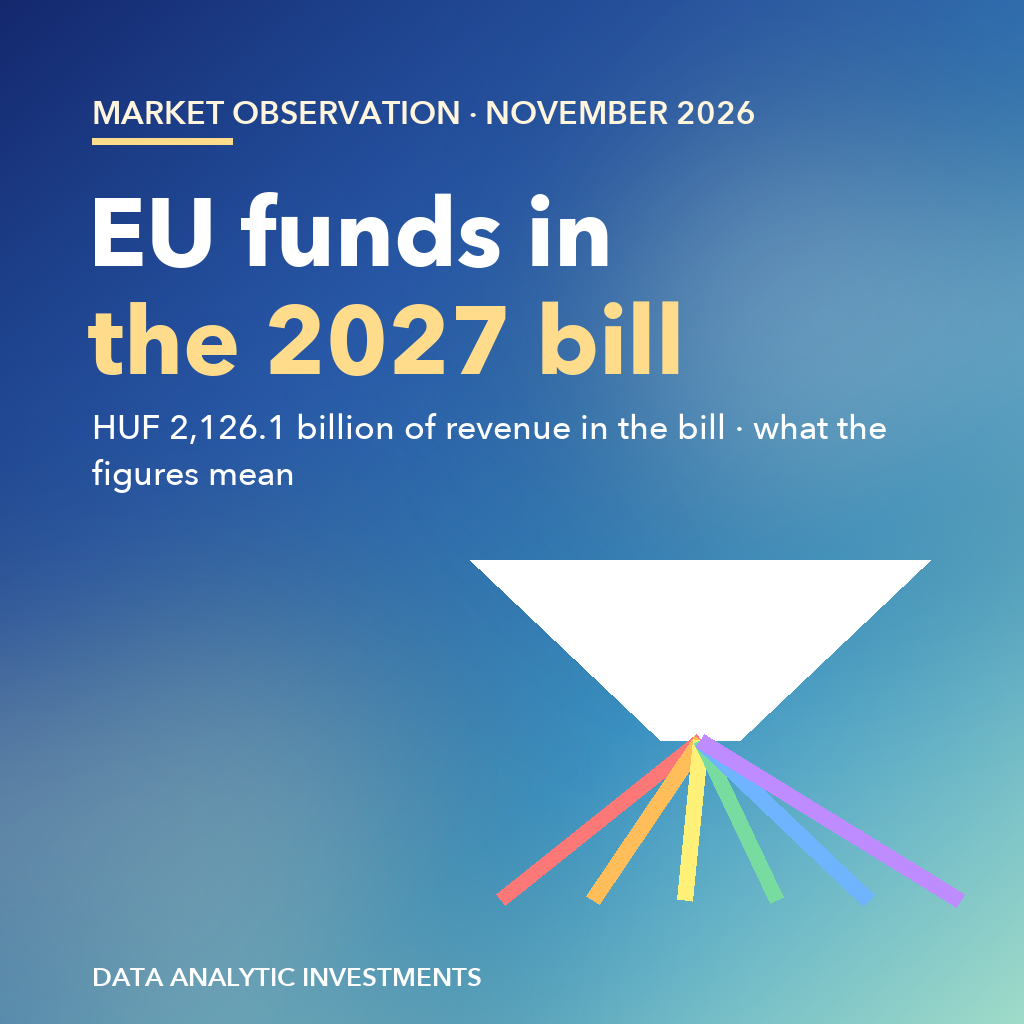
HUF 2,126.1 billion in revenue, 963.5 billion in contributions, a net balance of 1,162.6 billion, and six operational programmes paying out next year. What the EU items in the budget bill show, and what they do not – with sources, without forecasts.
The EU chapter of a budget bill contains many figures that look similar at first glance but measure different things: revenue, contributions, payments and investment. Portfolio's analysis of 21 November (in Hungarian) went through the EU items in Hungary's 2027 budget bill, submitted to parliament. This article summarises the figures and explains what each means. It is not grant advice or an economic forecast.
| Fact sheet | |
|---|---|
| Source | Portfolio, 21 November 2026, based on the 2027 budget bill |
| Expected EU revenue in 2027 | HUF 2,126.1 billion |
| Of which into the central budget | HUF 1,523 billion |
| Direct agricultural support (outside the budget) | HUF 505.8 billion |
| Refund for customs collection | HUF 97.3 billion |
| Hungary's contribution to the EU budget | HUF 963.5 billion |
| Net balance | +HUF 1,162.6 billion |
| EU-funded investment spending | 687.8 (2026, expected) → HUF 1,615.6 billion (2027) |
Source: Portfolio, 21 Nov (in Hungarian).
The revenue side
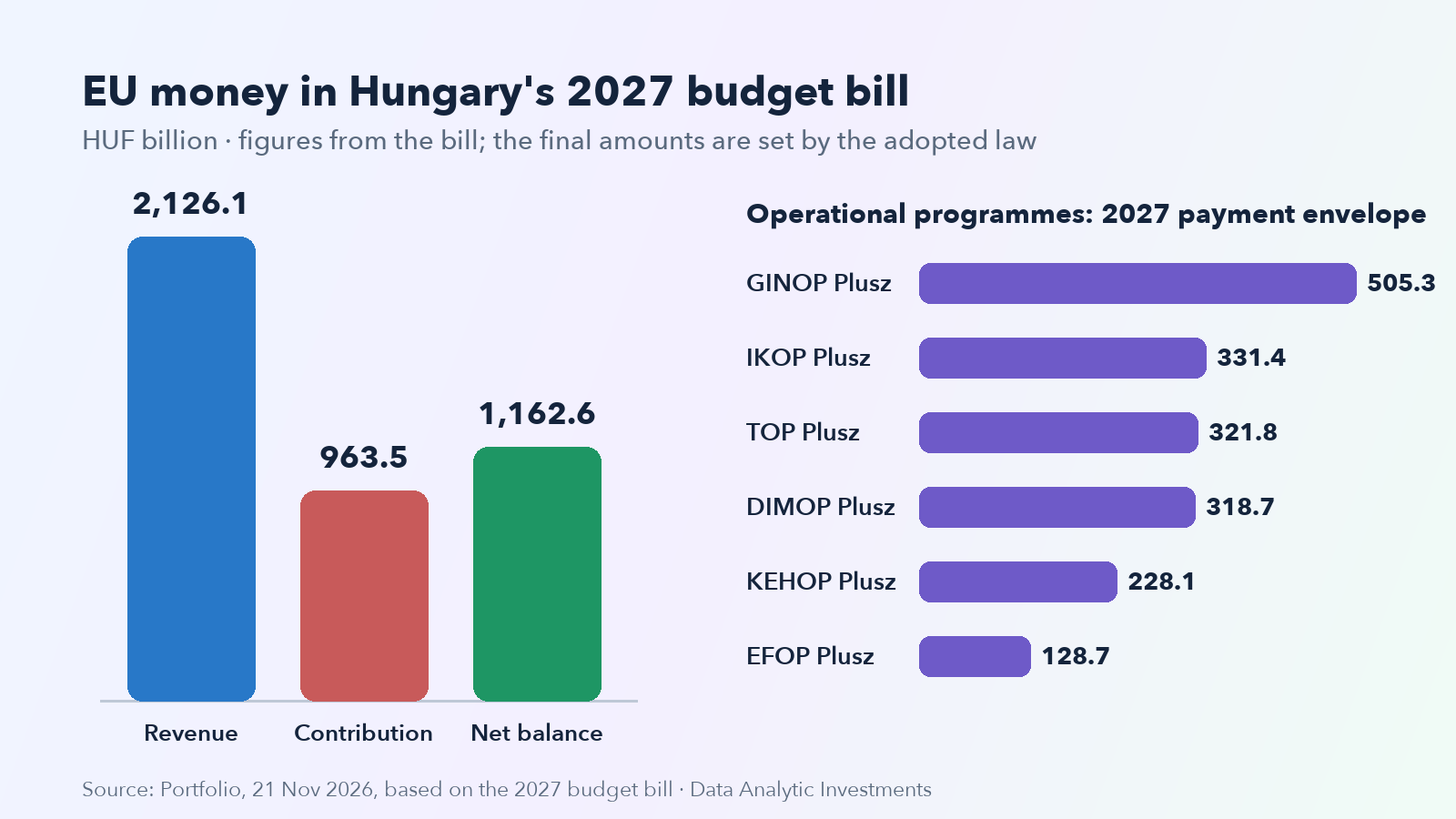
According to the source, Hungary expects HUF 2,126.1 billion in revenue from the EU budget in 2027. It has three parts:
- HUF 1,523 billion into the central budget, mainly from EU development programmes released this year;
- HUF 505.8 billion in direct agricultural and agricultural-market support, accounted for outside the budget;
- HUF 97.3 billion in refunds, due because Hungary collects customs duties at the EU's external borders on the Union's behalf.
This article's check: 1,523 + 505.8 + 97.3 = 2,126.1 billion forints — the parts add up to the stated total.
Net balance: revenue minus contributions
Every member state also pays into the EU budget. According to the source, Hungary's contribution would rise to HUF 963.5 billion, so HUF 1,162.6 billion more would come in than the country pays. This article's calculation: 2,126.1 − 963.5 = 1,162.6. The net balance shows how much more money comes in than goes out — not how much is actually spent in a given year.
The payment side: why the figures are larger here
According to the source, larger sums move on the domestic payment side: the HUF 2,695.8 billion planned for EU programmes also includes Hungarian co-financing. Co-financing means that the member state covers part of an EU project's cost from its own resources.
In addition, a contractor or applicant may receive its money before the European Commission reimburses the Hungarian state for its share. That is why payments and revenue do not fall in the same year: for the 2021–2027 operational programmes, the government expects HUF 1,268.1 billion to come in and HUF 1,864.8 billion to be paid out in 2027. According to the source, the latter is 79 percent more than the HUF 1,042 billion expected this year. This article's check: 1,864.8 / 1,042 ≈ 1.79.
Investment: EU and domestic funding
According to the source, EU-funded investment spending would rise from the HUF 687.8 billion expected for 2026 to HUF 1,615.6 billion. Of the increase of almost HUF 928 billion, 270.8 billion would go to the transport programme and 172 billion to the environment and energy-efficiency programme. At the same time, the government plans about HUF 442 billion less for purely domestically funded central investment. This article's calculation: 1,615.6 − 687.8 = 927.8 billion.
The programmes' payment envelopes for 2027
| Programme | Area | Planned payments in 2027 |
|---|---|---|
| GINOP Plusz | economic development, innovation | HUF 505.3 billion |
| IKOP Plusz | transport | HUF 331.4 billion |
| TOP Plusz | local and regional development | HUF 321.8 billion |
| DIMOP Plusz | digital development | HUF 318.7 billion |
| KEHOP Plusz | environment, energy efficiency | HUF 228.1 billion |
| EFOP Plusz | education, health, social affairs | HUF 128.7 billion |
Source: Portfolio, 21 Nov (in Hungarian).
Note: according to the source, these annual amounts also pay winners of earlier calls. For a new applicant, what counts is the envelope and deadline of the published call, not the programme's annual total.
As an example, the source mentions the GINOP Plusz-2.1.3-24 call for micro and small businesses outside Budapest: HUF 30–100 million in non-repayable support per project; the window from 1 December 2026 to 2 February 2027 has HUF 20 billion, and a further HUF 10 billion is available between 2 April and 4 May. The exact conditions are set by the official call.
5 things many people don't know
- Revenue and payments are two separate figures. Payments include Hungarian co-financing.
- Pre-financing shifts the years. An applicant can be paid before the Commission reimburses the state — according to the source.
- Part of agricultural support runs outside the budget. HUF 505.8 billion in 2027.
- Customs collection also earns a refund. HUF 97.3 billion.
- A programme's annual envelope is not the applicants' envelope. Earlier winners are paid from it too.
Summary
- EU revenue in 2027: HUF 2,126.1 billion, according to the bill.
- Contributions: 963.5 billion; net balance +1,162.6 billion.
- Operational programmes: 1,864.8 billion paid out, 1,268.1 billion coming in.
- Investment: 1,615.6 billion from EU funds; about 442 billion less from domestic funds.
- These are figures from a bill; the final amounts are set by the law as adopted.
Related reading: Blog archive.
Educational content. Not investment or grant advice, and not an economic forecast. This article describes a public press source and the figures of a submitted budget bill that has not yet been adopted. Data Analytic Investments is not affiliated with the government, the European Commission or the portal cited.
Continue on DAI
Explore Topics
Written by
Data Analytic Investments
Content creator and writer sharing insights and stories.