Deloitte Property Index 2026: Hungarian home prices up more than 10%, Budapest at €4,291 per square metre – what the European comparison shows
Prices rose in 19 of 22 countries, by 14.4% in Romania. Hungary ranks 12th for new-home prices but last for new homes per thousand residents. What an asking price measures and what it doesn't – with sources, without advice.

Deloitte has published its Property Index, a comparison of European housing markets, for the fifteenth time. According to Pénzcentrum's summary of 28 October and Piac&Profit's article of 29 October (both in Hungarian), the 2025 data show Hungarian home prices again rising more than 10%, while new-home construction stayed at the lowest level in the European comparison. This article goes through the figures and explains what they measure. It is not advice.
| Fact sheet | |
|---|---|
| Report | Deloitte Property Index 2026 (15th edition) |
| Coverage | 25 countries, 22 with comparable national prices; 71 cities |
| Price change in 2025 | prices rose in 19 of 22 countries |
| Hungary | annual price growth above 10% |
| New-home asking price | €3,438/m² nationally (12th), Budapest €4,291/m² |
| Budapest rent | €14.1/m² a month |
| Construction 2025 | about 12,000 homes, 1.26 per 1,000 residents (the lowest) |
Sources: Pénzcentrum, 28 Oct, Piac&Profit, 29 Oct (in Hungarian).

Where homes got most expensive
According to Piac&Profit, home prices rose in 2025 in 19 of the 22 countries with comparable national data. The biggest increases were in Romania (14.4%), Croatia (14.3%) and Slovakia (12.5%). In Hungary, annual growth was again above 10%; both sources attribute part of this to the Otthon Start subsidised-loan programme launched in the second half of 2025. Neither summary gives an exact Hungarian percentage or a European average, so this article does not either.
What a square metre of a new home costs
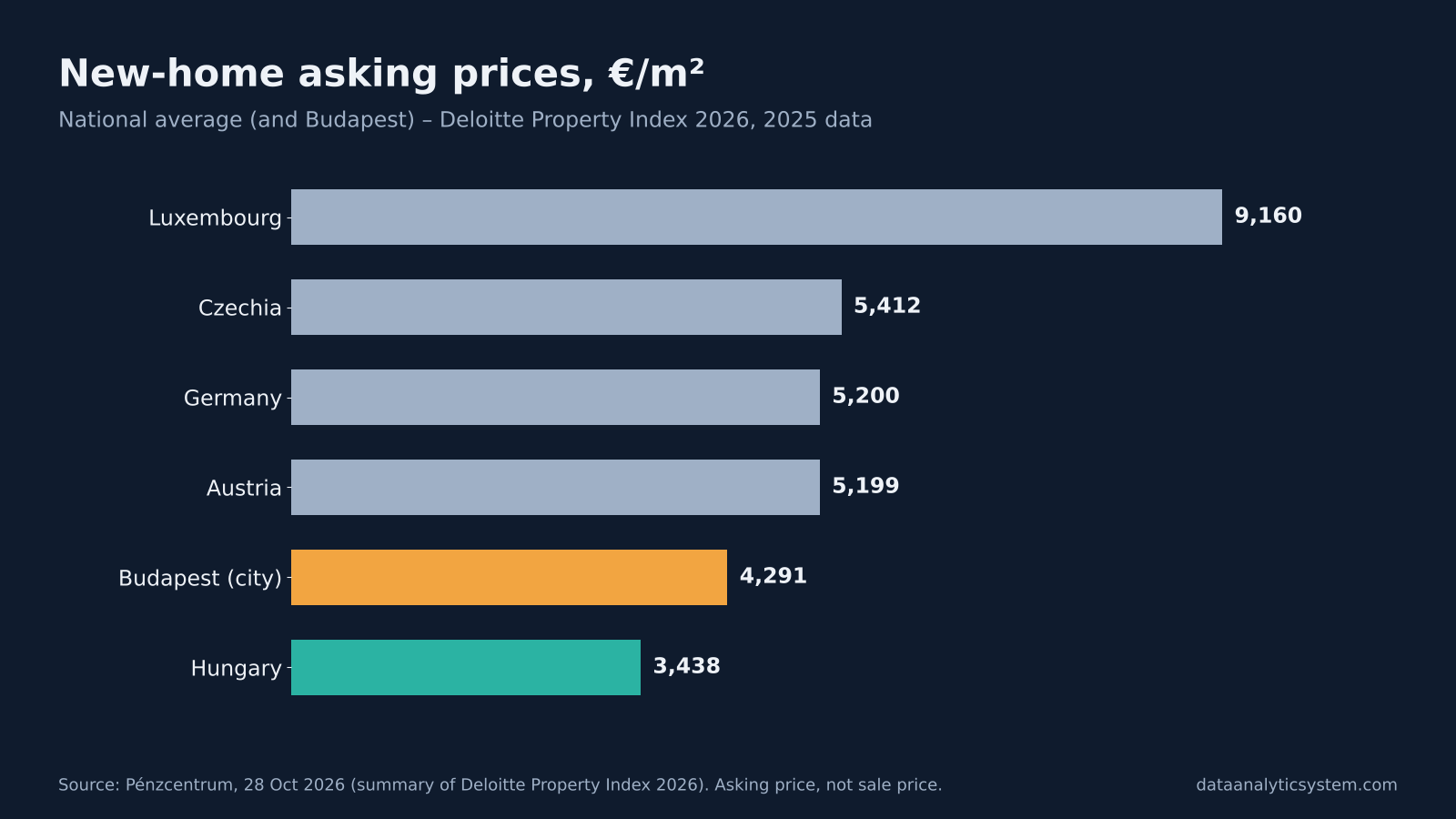
According to Pénzcentrum, national average asking prices for new homes are:
| Country | €/m² | Rank |
|---|---|---|
| Luxembourg | 9,160 | 1st |
| Czechia | 5,412 | 2nd |
| Germany | 5,200 | 3rd |
| Austria | 5,199 | 4th |
| Hungary | 3,438 | 12th of 22 |
Among cities, Munich (€11,200/m²), Luxembourg City (10,567) and Amsterdam (8,650) lead. At €4,291/m², Budapest is roughly level with Warsaw, Bratislava, Athens, Rome, Milan and Antwerp; Prague, Brno and Ostrava are more expensive. According to the source, Budapest is about 25% above the national average (this article's check: 4,291 / 3,438 ≈ 1.25).
What an "asking price" means
An asking price is the price at which a home is advertised, not the price actually paid. Bargaining, listings that stay unsold and market mood can make the two differ. A comparison based on asking prices therefore shows what sellers ask, not what homes change hands for.
Rents
The average monthly rent per square metre is highest in Luxembourg City (€45.4), followed by Paris (31.2), Barcelona (30.9) and Dublin (30.8). At €14.1, Budapest is not the most expensive even in its region: according to Pénzcentrum, rents are higher in Prague, Warsaw, Bratislava, Kraków, Wrocław and Gdańsk.
Construction and permits
According to the source, about 12,000 new homes were completed in Hungary in 2025, or 1.26 per 1,000 residents: the lowest construction intensity of the countries studied. Meanwhile, building permits for new homes rose 37% to more than 28,000 — the largest increase in the sample, yet still only enough for the bottom third of the European ranking. A permit is not a finished home: the path from approval to moving in typically takes years.
Affordability
According to Pénzcentrum, the report finds that in nearly half of the cities more than ten years of average gross earnings are needed to buy a "standard home". The summary gives neither Hungary's figure nor an exact definition of the standard home; both can be checked in the full report. A new element is the taxation of privately owned residential property in 21 countries.
5 things many people don't know
- An asking price is not a sale price. Deloitte's per-square-metre figures for new homes are advertised prices.
- Hungary had the fastest growth in permits. The 37% rise is the largest in the sample.
- Yet it builds the fewest homes per resident. There were 1.26 new homes per 1,000 people.
- Budapest rents are not an outlier in the region. Renting costs more in six Central European cities.
- Not all 25 countries are in the price ranking. According to Piac&Profit, comparable data existed for 22.
Summary
- Prices rose in 19 of 22 countries in 2025; in Hungary by more than 10%.
- New homes: €3,438/m² nationally, €4,291/m² in Budapest.
- Renting in Budapest: €14.1/m² a month.
- Construction: 1.26 homes per 1,000 residents, the lowest; permits +37%.
- The exact Hungarian percentage and affordability figure are in the full report.
Related reading: KSH house price index, Q2 2026 · Blog archive.
Educational content. Not financial or property-buying advice, and not a price forecast. This article describes press summaries of an international report. Data Analytic Investments is not affiliated with Deloitte or the portals cited. Images labelled "AI illustration" are not photographs.
Continue on DAI
Explore Topics
Written by
Data Analytic Investments
Content creator and writer sharing insights and stories.