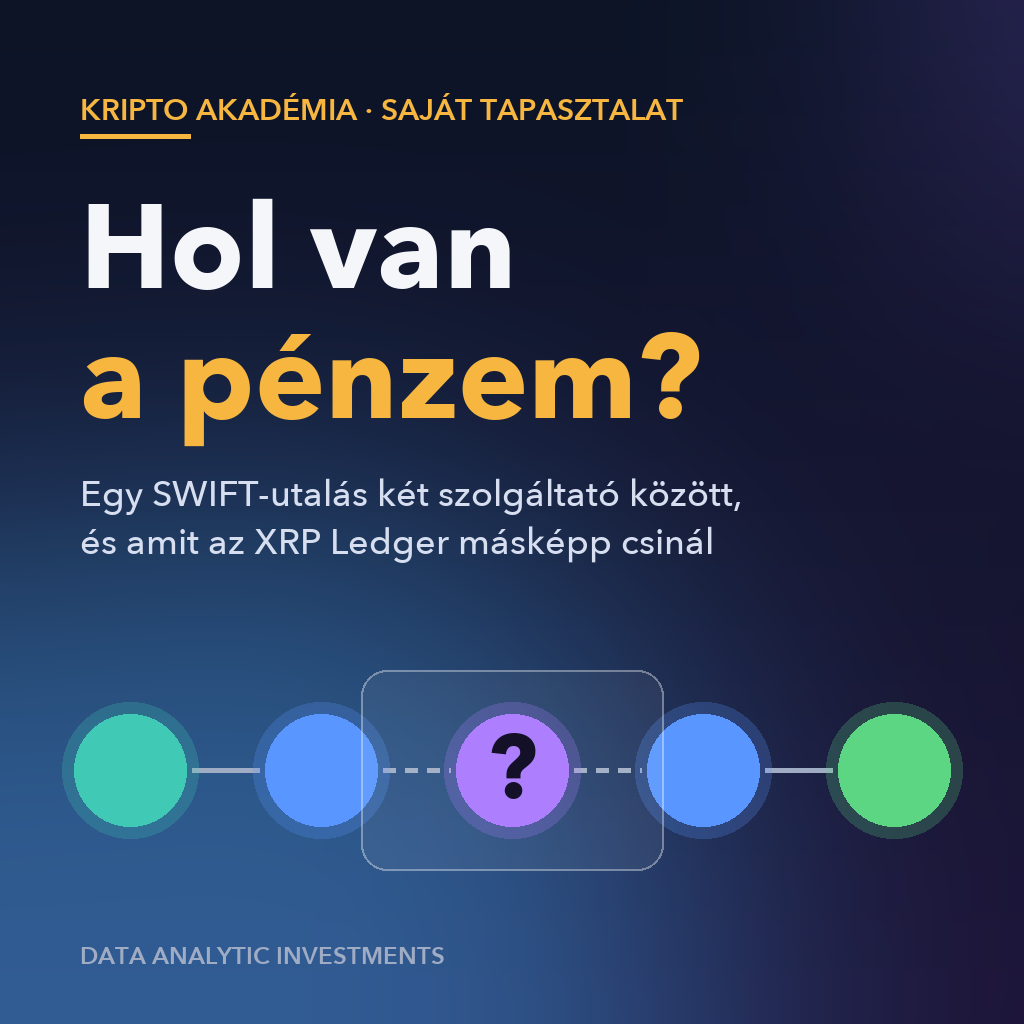
Where is my money? A SWIFT transfer between two providers, and what the XRP Ledger does differently
The sender says it has gone. The bank says nothing has arrived. The customer ends up writing to two providers while the money sits with a third. What is going on in the SWIFT chain, and how does the XRP Ledger compare?
Early on a Monday we sent euros from an EU crypto platform to our own bank account in Hungary. Within minutes the platform marked the withdrawal "Complete". Two business days later the bank replied in writing that, based on the details provided, it could see no such amount coming in. It suggested asking the sending side, or ordering a SWIFT copy for a fee.
The sending side's support team said everything was fine on their end. SWIFT transfers take one to five business days, they said, and the tracking reference would not be released before that window closed.
So the customer writes to two providers while the money sits with a third, somewhere in between. This article walks through what happens in that gap, the common causes, what to ask for, and how a system that settles in seconds, every day of the week, compares.
Fact sheet
| Our case (November 2026) | |
|---|---|
| Direction | EU crypto platform → Hungarian bank account, EUR |
| Channel | the platform's banking partner, SWIFT |
| Status on the sending side | "Complete", minutes after initiation |
| Receiving bank, business day 2 | "we cannot see such an amount coming in" |
| Sending side's stated window | 1–5 business days |
| Tracking reference (UETR) | not released before the window ends |
| SWIFT's own figure | nearly 60% of gpi payments credited within 30 minutes, almost 100% within 24 hours (Swift) |
Why "complete" means different things at each end
On the sending side, "complete" means the money has left the account and a payment message has gone out. It does not mean the money has arrived.
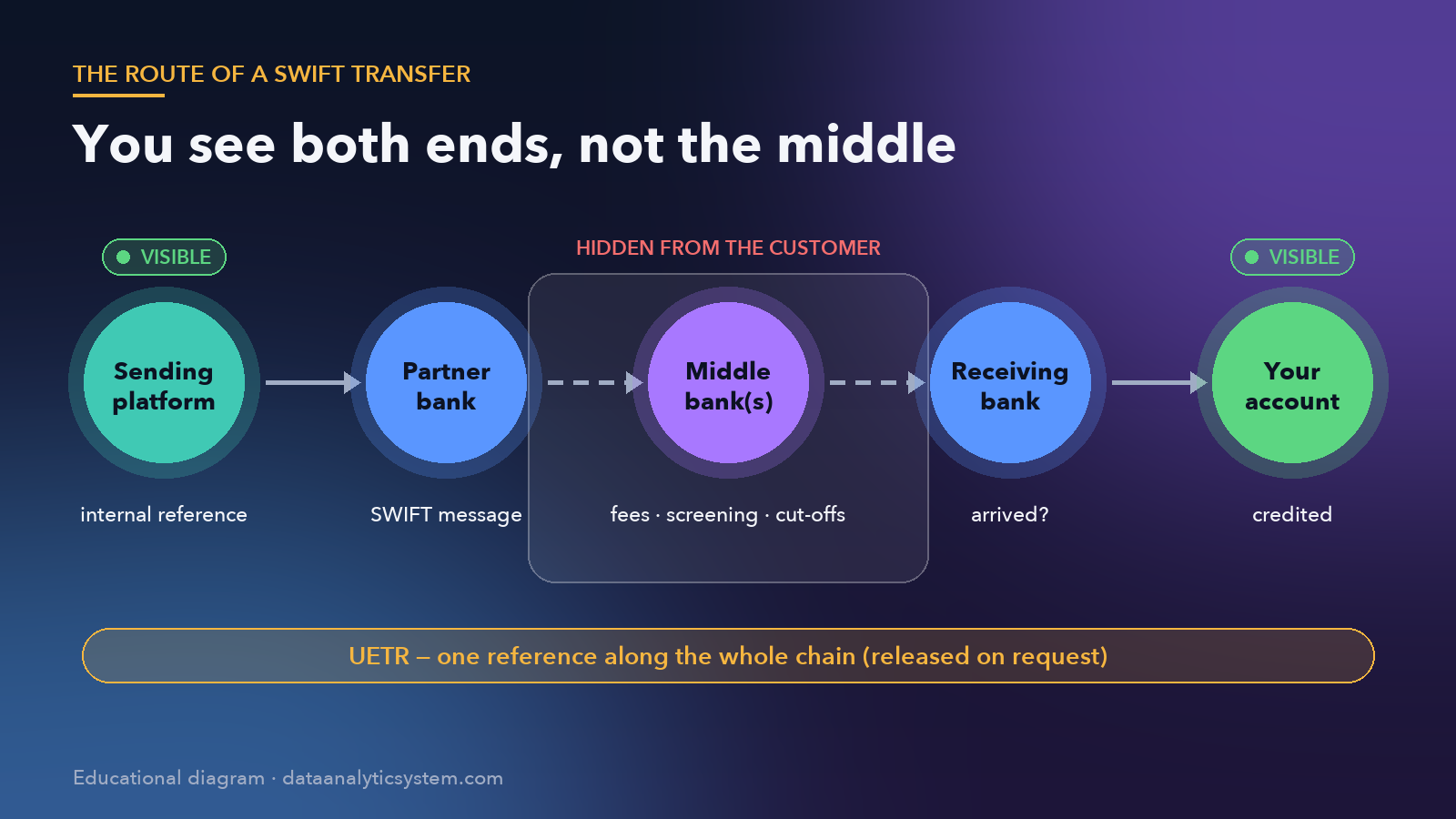
A cross-border euro transfer rarely goes straight from bank A to bank B. The sending provider hands it to a partner bank. If that bank has no direct relationship with the receiving bank, the payment passes through one or more correspondent banks. Each link works to its own hours, its own checks and its own cut-off times. The customer can see both ends of the chain, but not the middle.
The platform's reference number is an internal ID. It is not visible on the interbank network, so the receiving bank cannot search with it. What the bank needs is the UETR, the 36-character reference that follows the payment end to end, or a copy of the MT103 message (now the ISO 20022 pacs.008).
What makes a payment "circle"
Common causes, any one of which can add days:
- Compliance screening. Anti-money-laundering and sanctions checks at any intermediary. The payment stops while questions travel back up the chain.
- Data mismatch. If the name, IBAN or address does not match exactly, the payment may go to manual processing or be returned.
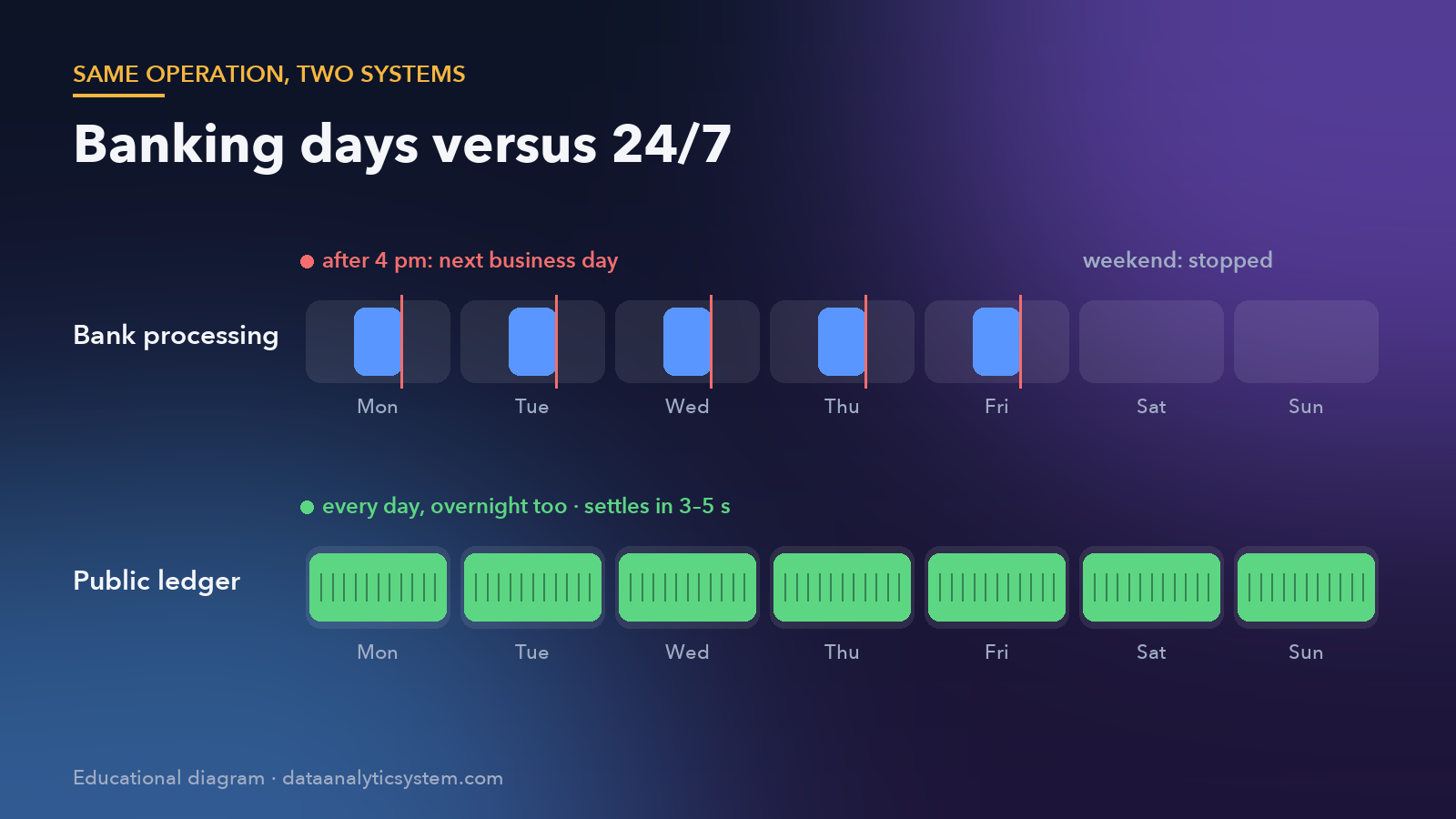
- Cut-off times. A payment sent in the afternoon moves on the next bank's next business day. Weekends and public holidays do not count.
- Intermediary fees and conversion. A correspondent may deduct its fee, and any currency conversion along the way is another step.
- Network migration. SWIFT has moved cross-border payments to the ISO 20022 message format. Mandatory structured postal addresses were scheduled for November 2026 (Swift). An industry summary from July 2026 reports that this step is being deferred, with a new timeline expected by December 2026 (Mambu). Around changes like this, banks screen more tightly, and badly formatted messages get handled by hand.
None of this is visible from outside. That is what the UETR is for: it lets you look up where the payment is in the chain.
What to ask for, and from whom
| From | What | Why |
|---|---|---|
| Sending provider | UETR, MT103/pacs.008 copy, actual send date, intermediary bank | tracing starts here |
| Receiving bank | written confirmation that nothing has arrived | lets you ask the sender to investigate |
| Both | a written complaint if answers stay vague | complaints have deadlines |
Under the EU Payment Services Directive, the payer's provider must, on request, make immediate efforts to trace the payment and tell the payer the outcome, free of charge (PSD2, Article 89). Under Hungarian law, once the amount reaches the receiving bank it must be credited without delay (Act LXXXV of 2009).
In our experience, joining the two ends falls to the customer. Ask the sender for the reference in writing. Ask the bank to confirm in writing that nothing has arrived. Keep both, with dates.
Currency exchange: 24/7 in one country, "next business day" in another
The same banking group can handle the same operation very differently in two countries. KBC, the Belgian parent of Hungary's K&H Bank, tells retail customers they can exchange euros on a foreign currency account "24/7 at real-time rates" (KBC).
Our own experience in Hungary is that an exchange placed after 4 pm is executed on the next business day. The exact cut-off is always set out in the bank's current terms.
That is not a technical limit, since the Belgian example shows the group can do it. It is an operating choice, left over from a time when banks worked in end-of-day batches.
What the XRP Ledger does differently
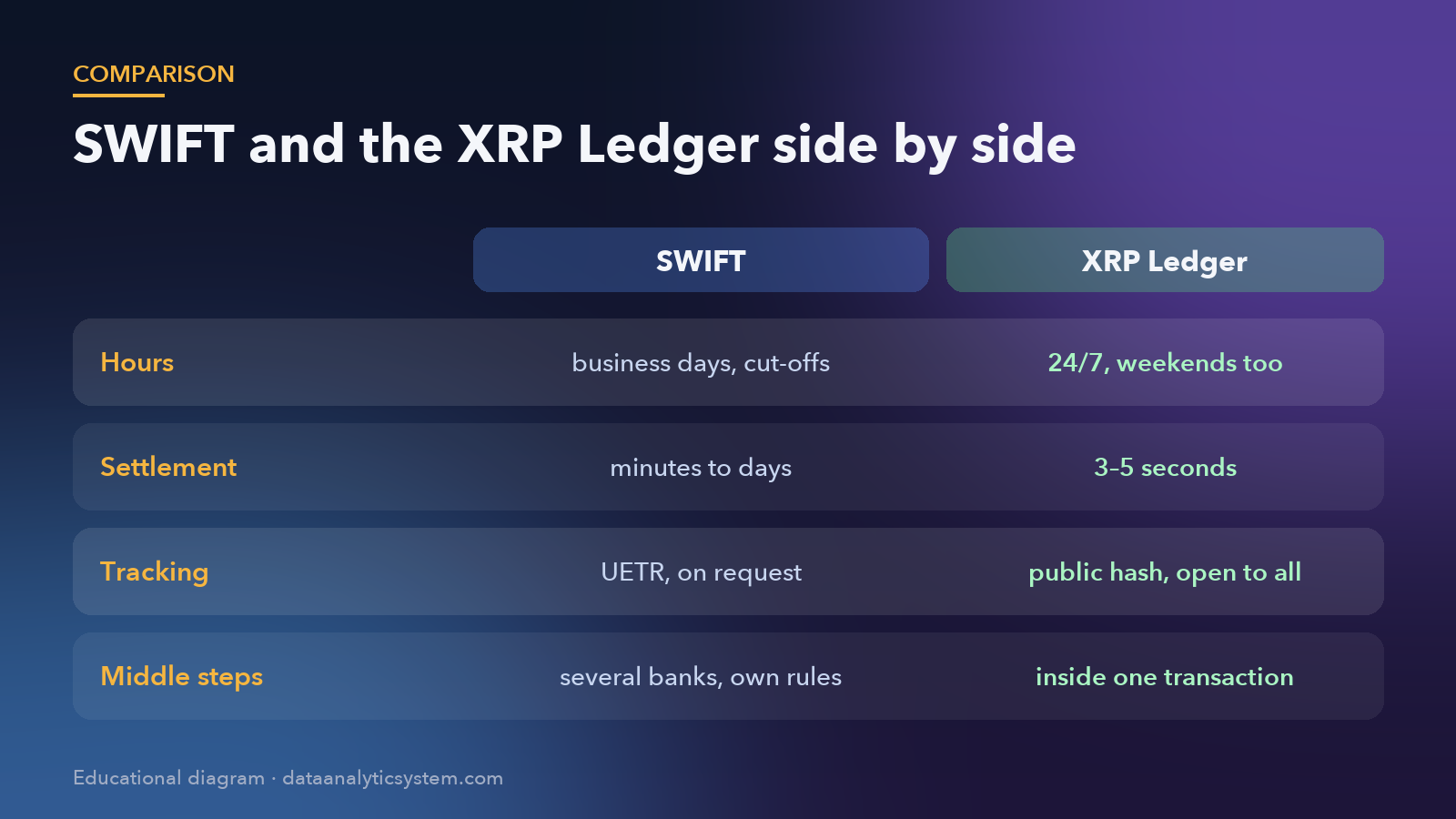
The XRP Ledger is a public ledger. Transactions settle in 3–5 seconds (XRPL.org), including at weekends and on holidays. Three differences matter in a case like ours:
- No opening hours. No cut-off, no "next business day".
- One reference everyone can see. Every transaction has a single public hash. Sender, receiver and anyone else see the same state: settled or not. Nobody has to request it.
- The middle of the chain is visible. If the transaction includes a currency conversion, that happens on the ledger too, in the same transaction.
We use the XRP Ledger in our apps for timestamping. A fingerprint of a document or a song goes onto the ledger, and anyone can check it in the Proof verifier. It is the same principle as point 2: one public reference that nobody has to request.
What this does not mean
- It does not mean SWIFT is a bad system. Most payments arrive within hours, and the gpi figures show them getting faster.
- It does not mean value sent on the XRP Ledger turns into euros in a bank account by itself. That needs a regulated provider at each end, and identity and compliance rules still apply there.
- This article is not financial advice and does not promote any provider or asset. It describes a real situation, and what the technology now makes possible.
Our case is still open. The sending side's window ends on 23 November. If the money has not arrived by then, the next steps are requesting the UETR and the message copy, then a written complaint.
Sources
- Swift: Swift GPI (product page, accessed 18 November 2026) – https://www.swift.com/products/swift-gpi
- Swift: ISO 20022 milestone: November 2026, unstructured addresses to be removed – https://www.swift.com/news-events/news/iso-20022-milestone-november-2026-unstructured-addresses-be-removed
- Mambu: CBPR+ is live – what ISO 20022 means in practice (updated 27 July 2026) – https://mambu.com/en/insights/articles/cbpr-is-live-what-iso-20022-means-in-practice
- KBC: Foreign currency account (accessed 18 November 2026) – https://www.kbc.be/retail/en/payments/foreign-currency-account.html
- Directive (EU) 2015/2366 (PSD2), Article 89 – https://eur-lex.europa.eu/legal-content/EN/TXT/?uri=CELEX:32015L2366
- Act LXXXV of 2009 on payment services (Hungary) – https://net.jogtar.hu/jogszabaly?docid=a0900085.tv
- XRPL.org: home page ("Transactions settle in 3-5 seconds") – https://xrpl.org/
Related on dataanalyticsystem.com
Continue on DAI
Explore Topics
Written by
Data Analytic Investments
Content creator and writer sharing insights and stories.
Related tools & research
This article is a companion piece to the book.
RIPPLE — the book
An Unofficial Documentary Study of Ripple and the XRP Ledger
22 chapters · every claim with a named source · numbered first edition · $29