
Újpest FC: from a gymnastics club to the purple-and-white golden age (1885–2026)
It began as a gymnastics club in 1885, reached twenty league titles and won seven championships in a row between 1969 and 1975. The history of Újpest, with sources.
Újpest is today Budapest's 4th district, but until 1950 it was a town in its own right, with its own factories, schools and sports club. The history of the purple-and-white club is also the history of that town: a gymnastics society founded by a teacher became one of the most successful football clubs in Hungary. This article pulls together what public sources document about Újpest's 141 years, and flags where the sources disagree.
1885–1900: a gymnastics club in Újpest
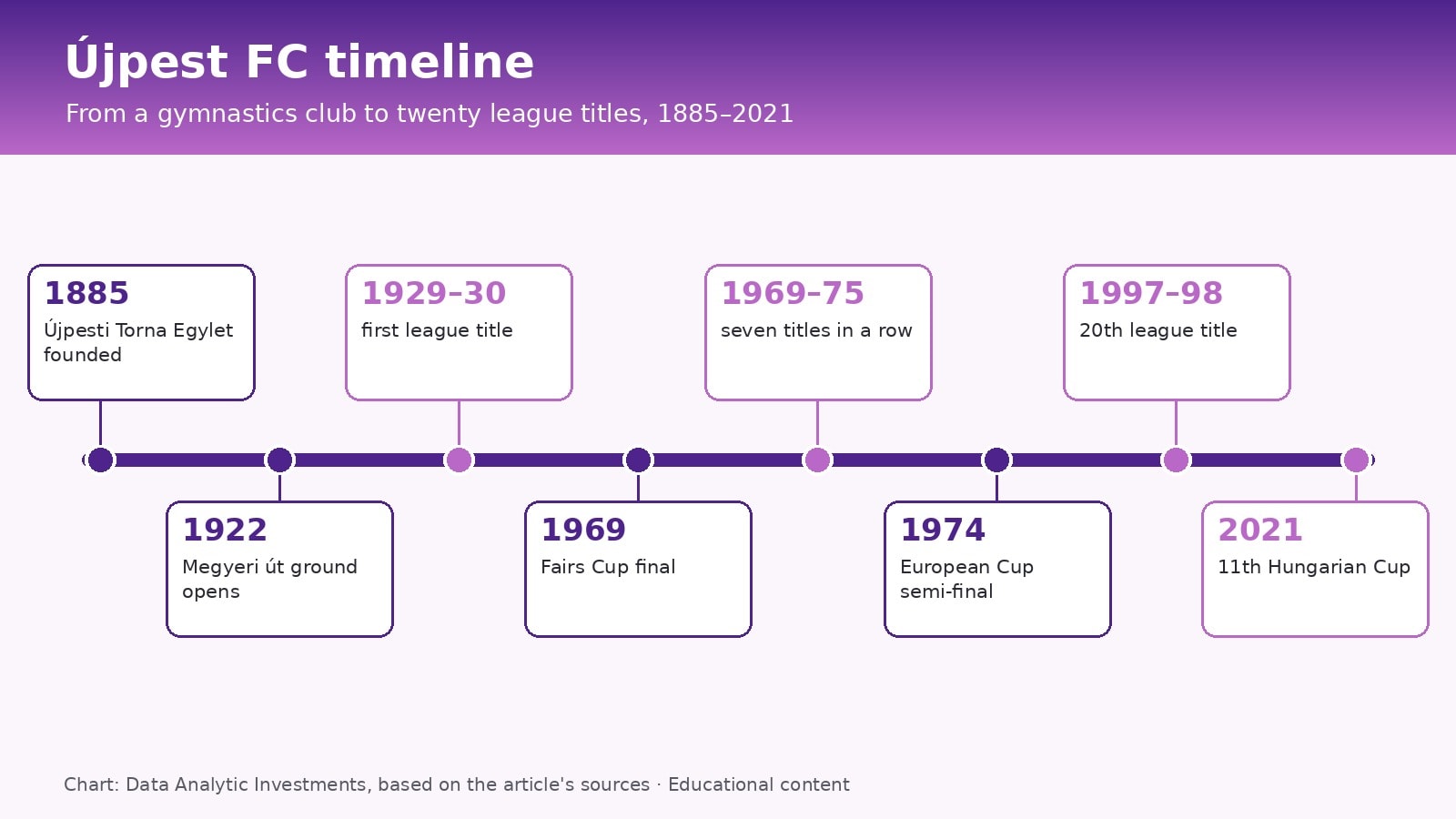
The club was founded on 16 June 1885 in Újpest by a teacher, János Goll, as Újpesti Torna Egylet (UTE). At first it was a general athletics and gymnastics society, with the motto "Soundness, Strength, Harmony" [2]. Football came later. A football club called Újpesti FC was formed in 1899, played its first official match on 29 April 1900 (1–1), and merged with the gymnastics club in 1901 [2][3]. The same year the team entered the second division of the league [2].
So the two founding dates do not contradict each other; they describe two different events. The society dates from 1885, the football team from around 1899–1901.
1922–1939: a ground of its own, first titles, the Mitropa Cup
In 1922 the club built the Megyeri út stadium. It opened on 17 September 1922 [1], and the club has played on the same site ever since [3]. Professional football was introduced in Hungary in 1926, and the team took the name Újpest FC [2].
The first league title came in 1929–30 [1]. In the same era the club won the Mitropa Cup, then the most prestigious competition for Central European clubs, twice: in 1929 and in 1939 [2].
1945–1960: Szusza the goalscorer and the Dózsa years
The greatest Újpest figure of the post-war years is Ferenc Szusza. According to the club history summary he scored 393 goals in 463 matches [2], and the stadium has carried his name since 2003: Szusza Ferenc Stadion [3].
In 1950 politics stepped in. The communist government assigned the club to the interior ministry, and the team carried on as Budapesti Dózsa. After the 1956 revolution the name became Újpesti Dózsa [2], and it stayed that way until the end of communism.
1969–1975: seven league titles in a row
Újpest's brightest decade began at the end of the 1960s. From the 1969 season to 1974–75 the team won every championship [2]. Because of a calendar change the run includes one shortened, spring-only season (spring 1970), so the seven titles are: 1969, spring 1970, 1970–71, 1971–72, 1972–73, 1973–74, 1974–75 [5].
Supporters still know the forward line by heart. Ferenc Bene was the league's top scorer five times [2]. László Fazekas won three scoring titles (1975–76, 1977–78, 1979–80) and, with 36 goals in 1979–80, a European Silver Boot [5]. In midfield, János Göröcs, "Titi", ran the game [6]. László Fazekas died in spring 2026, aged 78 [5].
This was also the club's best period in European competition:
| Year | Competition | Result |
|---|---|---|
| 1969 | Inter-Cities Fairs Cup | final, lost to Newcastle United 0–3, 2–3 |
| 1974 | European Cup | semi-final, lost to Bayern Munich 1–1, 0–3 |
Sources: [1][2]
1975–1998: more titles and the last championship
More titles followed after the run: László Fazekas's career record lists 1977–78 and 1978–79 as championship seasons too [5]. After the fall of communism the club took back the name Újpesti TE, then in 1998 it became Újpest FC again [2].
The twentieth and most recent league title came in 1997–98 [2][3]. The two stars on the club crest stand for those twenty titles [3].
1998–2026: cups, Super Cups, a new owner
No league title has followed since, but Újpest has kept winning cups. It won the Hungarian Super Cup in 1992, 2002 and 2014 [1]. It won the Hungarian Cup in 2014 against DVTK and in 2018 against Puskás Akadémia, both times on penalties [2]. In the final on 3 May 2021 it beat Fehérvár 1–0 after extra time, with Kastrati scoring in the 101st minute. It was the club's eleventh Hungarian Cup [4].
For many years the club was owned by the Belgian businessman Roderick Duchâtelet. In 2024 the energy group MOL bought 100 per cent of the shares [1][2].
5 things many people don't know
- The club is older than its football team. The society dates from 1885; the football team from around 1899–1901 [2][3].
- Its founder was a teacher. János Goll started it as a gymnastics society with the motto "Soundness, Strength, Harmony" [2].
- The team has played on the same site since 1922. Today's Szusza Ferenc Stadion stands where the old Megyeri út ground was [3].
- One of the seven titles in a row was a spring-only season. The shortened 1970 championship counts in the run [5].
- English Wikipedia gives two different capacities. The infobox says 12,670; the text says 13,501 [1].
What we do not know from these sources
- The sources disagree on the number of Hungarian Cups: English Wikipedia says 11 in one place and 9 in another [1]. The report on the 2021 final confirms 11 [4].
- None of the sources we could reach lists every championship season between 1929–30 and 1997–98 in full. Several sources agree on the total of 20 [1][3].
- We do not report the 2025–26 standings, because at the time of writing (October 2026) we found no completed, verifiable source.
From the Hungarian clubs series
This is part six of the series. Earlier parts covered Ferencváros football and water polo, Szolnoki Olajbányász, ice hockey in Székesfehérvár and handball in Veszprém. The next part is about the Győri ETO women's handball team.
Sources
- Wikipedia: Újpest FC — https://en.wikipedia.org/wiki/%C3%9Ajpest_FC (accessed 20 Oct 2026)
- Wikipedia: History of Újpest FC — https://en.wikipedia.org/wiki/History_of_%C3%9Ajpest_FC (accessed 20 Oct 2026)
- footballhistory.org: Újpest — https://footballhistory.org/club/ujpest.html (accessed 20 Oct 2026)
- Goal.com (Hungarian): Hungarian Cup: Újpest beat Fehérvár after extra time, 3 May 2021 — https://www.goal.com/hu/h%C3%ADrek/magyar-kupa-az-ujpest-hosszabbitasban-legyozte-a-fehervart/nbf804k4076t10v02gdjnx1k9
- Infostart (Hungarian): One of the best Hungarian footballers of all time has died, 6 May 2026 — https://infostart.hu/sport/2026/05/06/elhunyt-minden-idok-egyik-legjobb-magyar-labdarugoja
- Infostart (Hungarian): Titi is gone, and what he left behind, 24 Feb 2020 — https://infostart.hu/sport/2020/02/24/elment-titi-es-mi-mindent-hagyott-itt
A klubnevet azonosításra használjuk; az oldal nem hivatalos, a klubbal nincs kapcsolatunk. Oktatási tartalom.