
Hungary’s railway in one page: 43-year-old trains, a 10-year plan, and what the EU actually pays for
The Hungarian rail fleet averages 43 years, 41% of the network is electrified, and 81% of passenger trains ran on time in 2025. A new 3,550 billion HUF plan promises to halve fleet age by 2035. Here is the record — with sources — and the two things every country that caught up had in common.
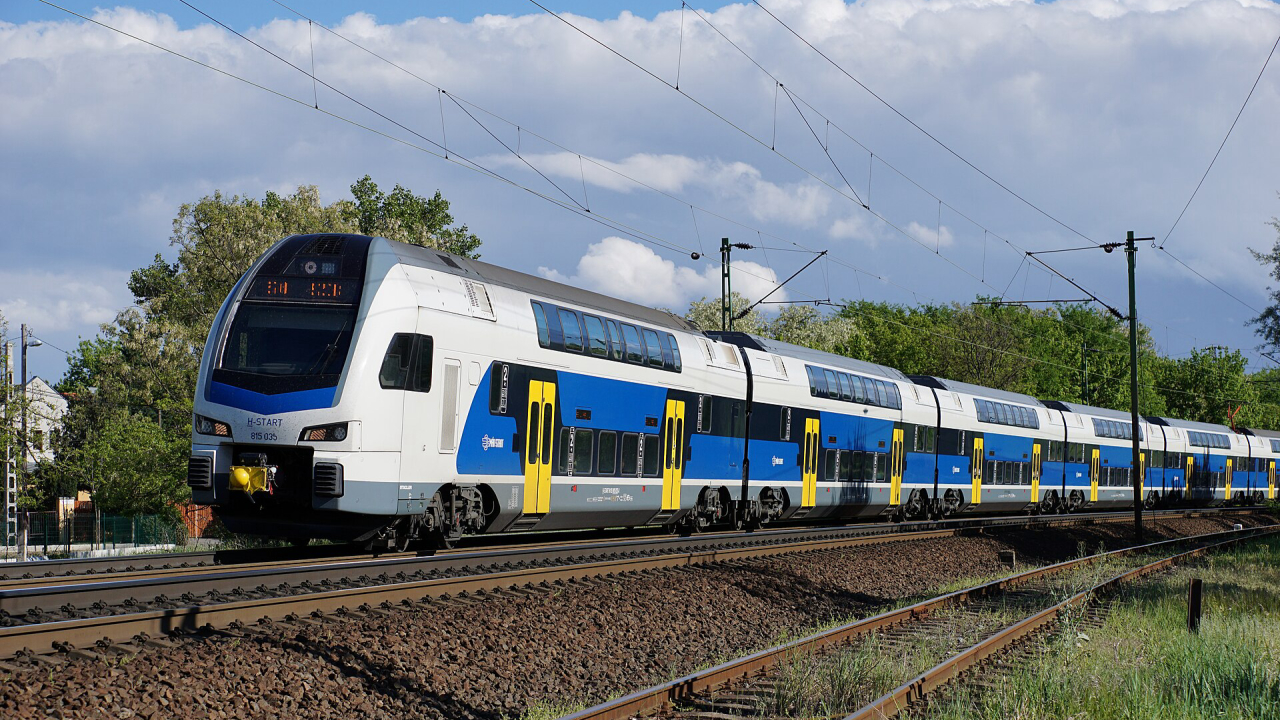
The numbers, from the operator. Hungary’s state railway manages 6,980 line-km, of which 2,864 km — about 41% — is electrified (MÁV, statistics updated 11 Sept 2025). Passenger punctuality in 2025 was 81.35%, up from 78.47%; the operator paid out 735 million HUF in delay compensation (MÁV, 18 Jan 2026). The fleet averages 43 years; a third of seats have no air conditioning (government plan document, July 2026). And one number nobody expected: Hungary posted the largest rail passenger growth in the EU in 2024, +60%, after a flat-rate county and national pass was introduced (Eurostat, 31 Oct 2025).
The plan. In July 2026 the government announced the Baross Gábor Railway Development Plan: 3,550 billion HUF over ten years, with three measurable promises — halve the fleet’s average age, reach a 100 km/h station-to-station average on main lines, and bring zero-emission service to 50% (kormany.hu). Most line items carry a 2030 date; a business daily’s reading is that most construction starts rather than finishes by then (Világgazdaság, 25 Aug 2026). Both readings are on record.
The money. A political agreement on 29 May 2026 unlocked roughly €16 billion of frozen EU funds; by 31 August the government said all legislative conditions were met, with payment due by year-end. We found no source confirming an actual disbursement as of 7 September. “Unlocked” and “received” are different words.
The benchmark. Swiss SBB: 94.1% punctuality in 2025. Austrian ÖBB: 94.1%. German DB long-distance: 60.1% — worse than Hungary — and DB says fixing its network will take “about ten more years” on a record €22bn annual budget. Spain built 4,000 km of high-speed rail in thirty years. Japan’s Tokaido Shinkansen averages 1.4 minutes of delay per train. China passed 50,000 km of high-speed line in December 2025.
What AI already does on rails — elsewhere. Deutsche Bahn runs AI dispatching live in three S-Bahn control centres and has used machine-learning delay forecasts since 2018; Italy’s RFI inspects bridges with 55 drones and an AI platform. We found no documented AI deployment at Hungarian rail operators. Not “none exists” — “none is on record”.
The two things the catch-up countries had in common: money that arrived, not money that was announced; and a public, dated status report that anyone could check. Hungary has neither yet. The full sourced research, with the tables, is on our Research page.
Sources: MÁV, kormany.hu, Eurostat, SBB, DB, ÖBB, Adif, JR Central, SCIO, Railway Gazette, Telex, 444, HVG, Világgazdaság — all read 7 Sept 2026. Educational content. Not investment advice.
Continue on DAI
Explore Topics
Written by
DAI Research Desk
Content creator and writer sharing insights and stories.