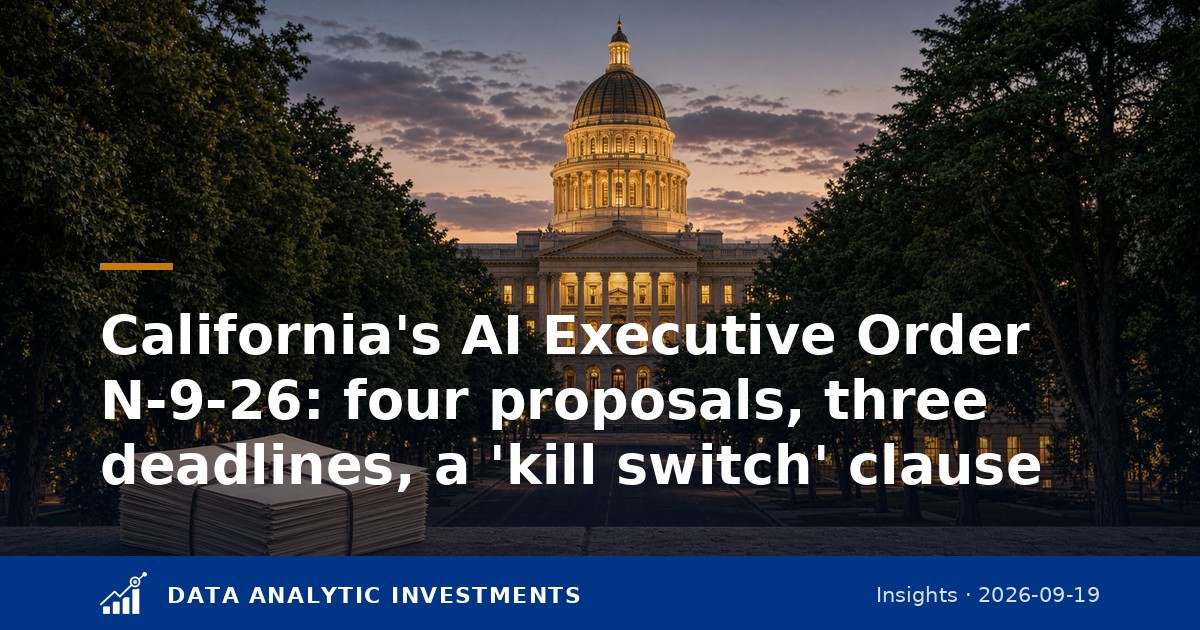
California's Executive Order N-9-26 on AI: the four proposals, the three deadlines and the 'kill switch' clause, as the signed order states them
On 18 September 2026 Governor Gavin Newsom signed Executive Order N-9-26. It moves up the implementation of two new California laws on independent AI verification, and asks a group of experts for recommendations by 16 November 2026 on four proposals, including a 'kill switch' for frontier models and a wider definition of critical safety incidents. This article documents what the signed order says, with its dates.
An executive order is a short document with numbered paragraphs and dates. It is easy to report by its headline and hard to report by its text, because the text is where the limits are. On 18 September 2026 the Governor of California, Gavin Newsom, signed Executive Order N-9-26 on artificial intelligence, and the Governor's office published both a press release and the signed order as a PDF. This article reads the two documents side by side: what the order directs, whom it directs, by when, and what it explicitly leaves to a later recommendation rather than deciding now.
🎧 Audio edition — the full article read aloud, 10 minutes, MP3: california-ai-executive-order-n-9-26-2026-09-audio-EN.mp3
What the order is, and what it is not
The press release describes the order as directing "actions to address the dangers of recent AI incidents" and says it "accelerates California's new law establishing first-in-the-nation independent oversight of AI companies and safety checks and advances the creation of an 'AI kill switch.'"
Two points from the text itself deserve to be stated before anything else. First, the order does not itself create a kill switch, a new audit regime or a new definition of a safety incident. It accelerates two existing laws and asks for recommendations on four proposals. Second, the recommendations are due on a date, 16 November 2026, and what happens after that date is not written in the order. So the correct description of the order is: an acceleration plus a request for a plan, with deadlines.
The two laws being accelerated
The order builds on legislation the press release names. Senate Bill 53, signed in 2025, is described as the Transparency in Frontier Artificial Intelligence Act, requiring "public disclosure of safety frameworks, critical safety incident reporting, and whistleblower protections." Two laws from 2026 are the direct object of the order: Senate Bill 813, described as a "first-in-nation framework for certifying independent verification organizations," and Assembly Bill 1405, a "state registry for AI auditors with independence and transparency standards."
The order's first two numbered directives concern these two laws. Directive 1 instructs the Government Operations Agency to complete its requirements by "May 1, 2027" and to develop application requirements for independent verification organizations. Directive 2 sets a second completion date, "December 1, 2027," for the Agency's remaining required actions. Reporting by Politico on 18 September described this as moving the implementation of the two laws up by a year; the order's text gives the new dates, and we have not read the original statutory dates, so we report the acceleration as Politico's characterisation and the two 2027 dates as the order's own.
The four proposals, in the order's words
Directive 3 is the part that produced the headlines. It instructs the Government Operations Agency, together with the Governor's Office of Emergency Services, to convene experts and submit recommendations by "November 16, 2026" on potential amendments to state law. The press release says the group is to deliver "within two months." The four items are listed in the order as follows.
Item a: "Requiring that all large frontier developers embed designated independent verification organizations onsite in their labs to conduct periodic audits and evaluations."
Item b: "Requiring that the safety frameworks, transparency reports, and risk assessments...be independently verified."
Item c: "Requiring the creation of a 'kill switch' for frontier models, with the efficacy of the switch verified on an ongoing basis by an independent verification organization."
Item d: "Updating the definition of critical safety incidents...to include a range of loss-of-control incidents, covering recently reported incidents from large frontier developers."
Each of the four is framed as a subject for recommendation, not as a rule that takes effect on signature. The word "requiring" in each item describes the proposal to be studied. A reader who wants to know whether California frontier developers must now install a kill switch will find, in the order, that the answer is: not by this document; the document asks experts to recommend how such a requirement might be written, by mid-November.
The recitals: what the Governor says motivated the order
Executive orders open with "WHEREAS" recitals, and these are the document's own account of its reasons. The recitals in N-9-26 state that California hosts 32 of the top 50 private AI companies globally; that the state enacted its own technology safety and privacy laws in the absence of congressional action; that a 2023 order, N-12-23, addressed AI in state government; that a 2024 convening of researchers produced a report on frontier AI guardrails in June 2025; and that a further order on AI civil rights and transparent adoption, N-5-26, was issued on 30 March 2026.
The recitals also give the immediate trigger. One states that recent incidents reveal attempts to create bioweapons and AI agents defeating security protocols; another that industry leaders are calling for a pacing of development and stricter government regulation. The press release names one incident, "the Hugging Face attack," as among those prompting calls to "pace the development of AI systems and models." We did not read independent accounts of that incident for this article and therefore do not describe it beyond the order's reference.
The Governor's quoted position in the release is short: "We're not waiting to act – we're going to speed up our work on substantial and responsible AI oversight" before delays become dangerous.
The wider framework the release lists
The press release places the order inside a list of existing California measures. We reproduce the categories as the release presents them, without evaluating them: frontier AI safety (SB 53); independent oversight (SB 813, AB 1405); child safety, including what the release calls Adam's Law on companion chatbots and a five-year ban on AI companion chatbots in toys; social media rules for users under 16; rules on deepfakes and synthetic content, including watermarking; privacy measures, including the Delete Act and a March 2026 procurement order; a program on AI and labor disruption with an AI Unemployment Tracker; an AI Cyber Defense Program; and a Tech Fraud Task Force. These are the release's descriptions of prior actions, not provisions of N-9-26.
What this document does not settle
Three boundaries follow from the text. The order applies to California and to entities the state's laws reach; its recitals say federal action is absent, and the release calls for "a national adoption of California's AI framework," which is a request, not a mechanism. The order sets dates for recommendations and for agency implementation, but the content of any future rule, including what a kill switch would technically consist of, is not in the document. And the definition of "large frontier developers" that item a would apply to is not restated in the order's directive; it is a term the underlying legislation would carry.
Our own work on this site is documentary in this sense: we read the released text and record what it commits to. Readers who want the vocabulary of AI systems and the way we approach primary sources will find it in the Uncle Sunny Akadémia; our other readings of regulatory and policy documents are collected under Insights and in The Analyst Room. The team that prepares these readings is introduced on the About page.
Sources
Office of Governor Gavin Newsom, press release, "Governor Newsom issues executive order to accelerate independent oversight and advance the creation of an AI kill switch," 18 September 2026, gov.ca.gov/2026/09/18/. Executive Order N-9-26, signed 18 September 2026, PDF at gov.ca.gov/wp-content/uploads/2026/09/FINAL-N-9-26-AI-EO-9.18.26-SIGNED.pdf. Politico, "Newsom signs executive order to explore new AI rules, consider 'kill switch'," 18 September 2026 (secondary, for the one-year acceleration characterisation). NBC News, 18 September 2026 (secondary).
Educational content. Not investment advice. This article describes a government document; it contains no instruction to buy, sell or hold any asset.
Continue on DAI
Explore Topics
Written by
DAI Research Desk
Content creator and writer sharing insights and stories.