
One- to five-day settlement loans in a stablecoin: what the Arf–Ripple agreement on the XRP Ledger means, what PayFi is, and what still depends on the validator vote
About $10 billion in annual settlement volume, capital turning over roughly four times a month, repayment in one to five days. What the settlement gap is, why it needs financing, and what changes if the XRP Ledger's lending feature is activated – with sources, without prices.

On 22 October 2026 the Swiss firm Arf announced that, together with Ripple, it is bringing settlement liquidity to the XRP Ledger (XRPL): short-term loans in the RLUSD stablecoin for licensed cross-border payment companies. This article explains what problem such a loan solves, what the parties announced, and what still depends on the ledger's validators. It says nothing about price.
| Fact sheet | |
|---|---|
| Announcement | 22 October 2026 |
| Arf | Swiss-regulated financial institution, Zug, VQF member, since November 2022 |
| Clients | licensed cross-border payment, card and remittance companies |
| Asset | RLUSD (US-dollar stablecoin) |
| Repayment | typically 1–5 days |
| Settlement volume | about $10 billion a year |
| Capital turnover | about four times a month |
| Later | native XRPL lending protocol (XLS-65, XLS-66) |
Sources: Arf, 22 Oct, Sensei XRP Weekly, 25 Oct.

The problem: the settlement gap
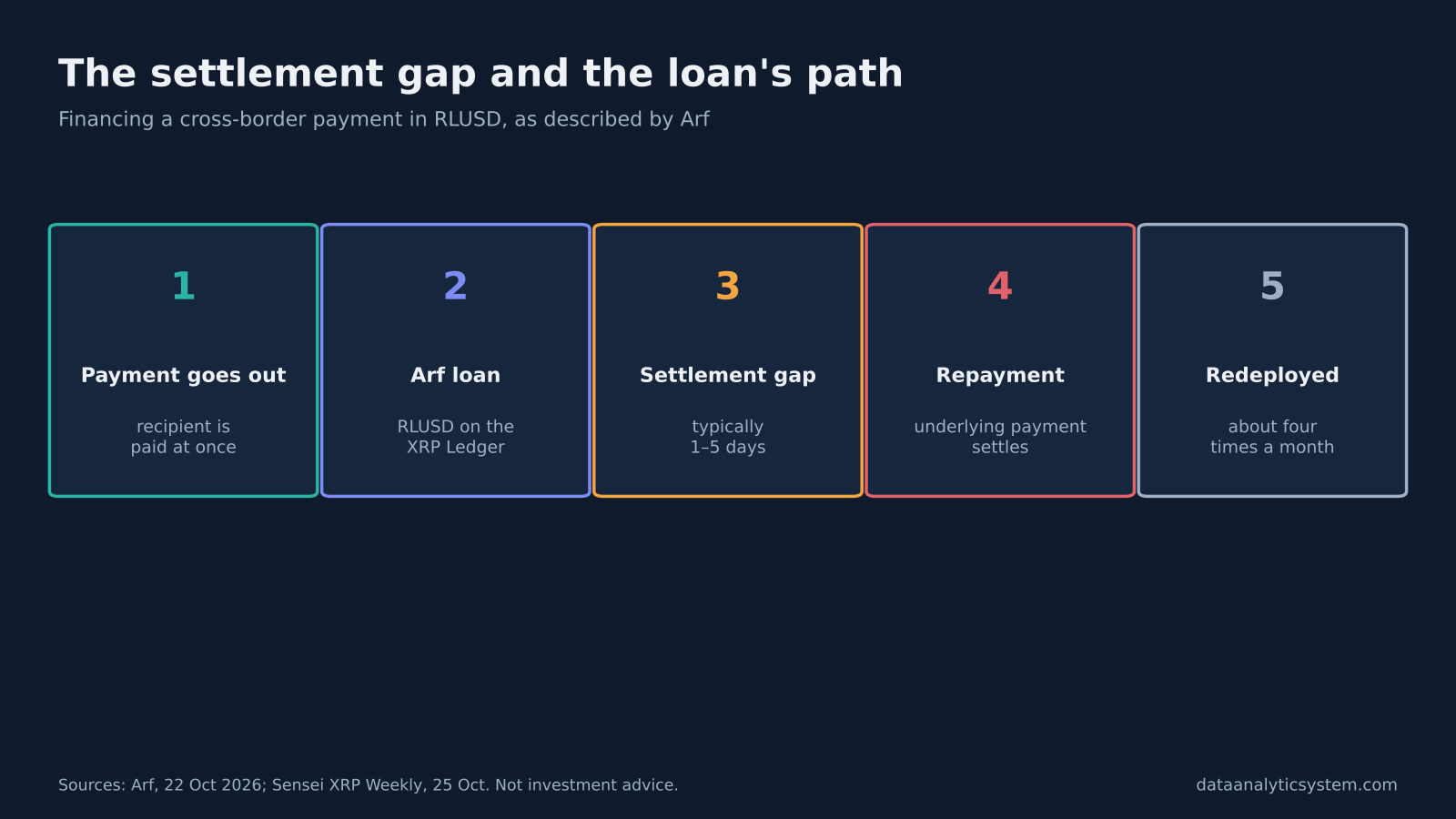
When a payment company sends money from one country to another, it often has to pay the recipient immediately, while the funds from the sending side arrive only days later. The time in between is called the settlement gap. The company has to bridge it with its own capital or with a loan.
Arf finances that gap. Ali Erhat Nalbant, Arf's chief executive, said in the announcement that payment companies need capital to keep money moving while they wait for funds to settle. Loans are typically repaid within one to five days, once the underlying payment settles, and the same capital can then be redeployed.
What PayFi is
PayFi (payment finance) is an umbrella term for short-term financing tied to payments. The traditional version has existed for a long time: banks and fintech firms bridge the settlement gap the same way. What is new is the mechanics: the loan is disbursed and repaid in a stablecoin, on a public ledger.
According to Arf, it handles about $10 billion in settlement volume a year, and its capital turns over about four times a month. By simple multiplication, this article gets about 48 deployments of the same capital in a year.
Two phases: now and later
The announcement separates two steps:
- Phase one: Arf provides RLUSD liquidity directly on the XRP Ledger. Lending decisions, underwriting and working-capital management stay off the ledger.
- Phase two: part of the activity could move to the XRPL's native lending protocol, using Single Asset Vaults and the Lending Protocol.
Phase two requires the relevant amendments (XLS-65, XLS-66) to be activated. According to Sensei's 25 October round-up, the lending amendment stands at 19 validator votes out of the 29 needed. The same source notes that a claim circulating that week about "RLUSD-backed loans going live" was inaccurate: no such lending product had launched.
The role of XRP
According to Arf's announcement, loans are disbursed and repaid in RLUSD. XRP pays the XRP Ledger's transaction fees and covers account reserve requirements. This follows from how the ledger works technically; the announcement infers additional demand from it but gives no quantity.
MiCA: what applies in Europe
Arf is a Swiss institution, and Switzerland is not a member of the European Union, so the EU's MiCA regulation does not apply to it directly. For EU providers the situation is different: according to ESMA, crypto-asset service providers authorised under MiCA may not offer services for stablecoins that do not comply with the regulation. More detail: ESMA: non-MiCA-compliant stablecoins. This article did not examine RLUSD's EU status.
Coming this week: Swell
Ripple's annual conference, Swell, takes place this week over three days in New York, with about 1,500 attendees. According to Sensei, it begins on 27 October, and on 29 October RippleX is scheduled to present a roadmap for lending and trading on the ledger. Whatever is said there will be an announcement, not a live feature.
5 things many people don't know
- The loan is about time, not crypto. Arf finances the days between payment and settlement.
- Decisions stay off the chain. Underwriting and working-capital decisions happen at Arf, offchain.
- No amount was disclosed. The parties did not publish how much will be lent under the agreement.
- Native lending depends on a vote. The lending amendment stands at 19 of 29 votes.
- Switzerland is not the EU. VQF is a Swiss self-regulatory organisation; MiCA applies to EU providers.
Summary
- Arf provides 1–5-day settlement loans in RLUSD to payment companies on the XRP Ledger.
- Stated figures: about $10 billion a year in volume, capital turning over about four times a month.
- The native lending protocol depends on the validator vote (19/29).
- This week: Swell in New York.
Related reading: XRPL fixCleanup3_4_0 moved to November · Franklin Templeton sgBENJI on the XRP Ledger · Blog archive.
Educational content. Not investment advice. This article describes public announcements and a press source and says nothing about price. Data Analytic Investments is not affiliated with Arf, Ripple Labs or the portals cited; names are used for identification only. Images labelled "AI illustration" are not photographs.
Continue on DAI
Explore Topics
Written by
Data Analytic Investments
Content creator and writer sharing insights and stories.
Related tools & research
This article is a companion piece to the book.
RIPPLE — the book
An Unofficial Documentary Study of Ripple and the XRP Ledger
22 chapters · every claim with a named source · numbered first edition · $29