Old Letters and Postcards: Digitise, Transcribe, Describe
Old family letters and postcards carry information that photographs alone cannot preserve. This article explains how to digitise, transcribe, and describe them for long-term preservation.
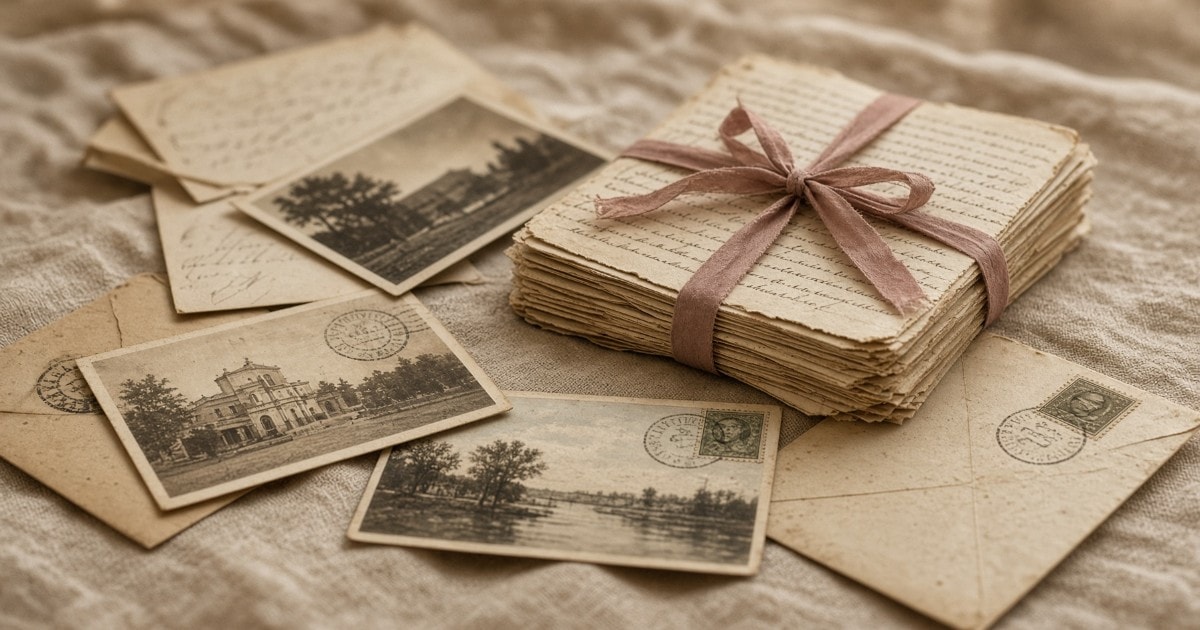
Old letters and postcards are among the most information-dense objects in a family archive. A single postcard can record a date, a location, a relationship, a handwriting style, and a moment in time. Preserving them well requires three steps: digitisation, transcription, and description.
Digitisation
Scan rather than photograph where possible. A flatbed scanner at 600 dpi produces a file that can be read at full size on screen and printed without loss. For fragile items, a document camera or a phone with a macro lens is a reasonable alternative.
Scan both sides. The back of a postcard often contains the address, the stamp, the postmark, and the message. The front has the image. Both are part of the record.
Save as TIFF for the archival master and JPEG for working copies. Name files systematically: sender-recipient-date or a sequential number with a corresponding log.
Transcription
Type out the full text of each letter or postcard. Transcription makes the content searchable and readable when the original handwriting is difficult. Preserve the original spelling, punctuation, and line breaks. Note illegible words with [illegible] rather than guessing.
For postcards with very short messages, transcription takes less than a minute. For multi-page letters, it takes longer but the result is a permanent, searchable record.
Description
Add a short description to each item: who wrote it, to whom, when, from where, and what it is about. If the date is not written on the item, estimate it from context — postmark, paper type, events mentioned — and note that it is an estimate.
Record the physical condition: torn, faded, water-damaged. Note any stamps, postmarks, or other markings that might be of interest to a philatelist or historian.
Storage
Store originals in acid-free sleeves or folders, away from light and humidity. The digital files are the working copies; the originals are the primary record.
This article is for information only.
Continue on DAI
Explore Topics
Written by
Data Analytic Investments
Content creator and writer sharing insights and stories.