Oil, Hormuz and Hungary's pumps: what is really happening, who has to do what, and which path is best for Hungary
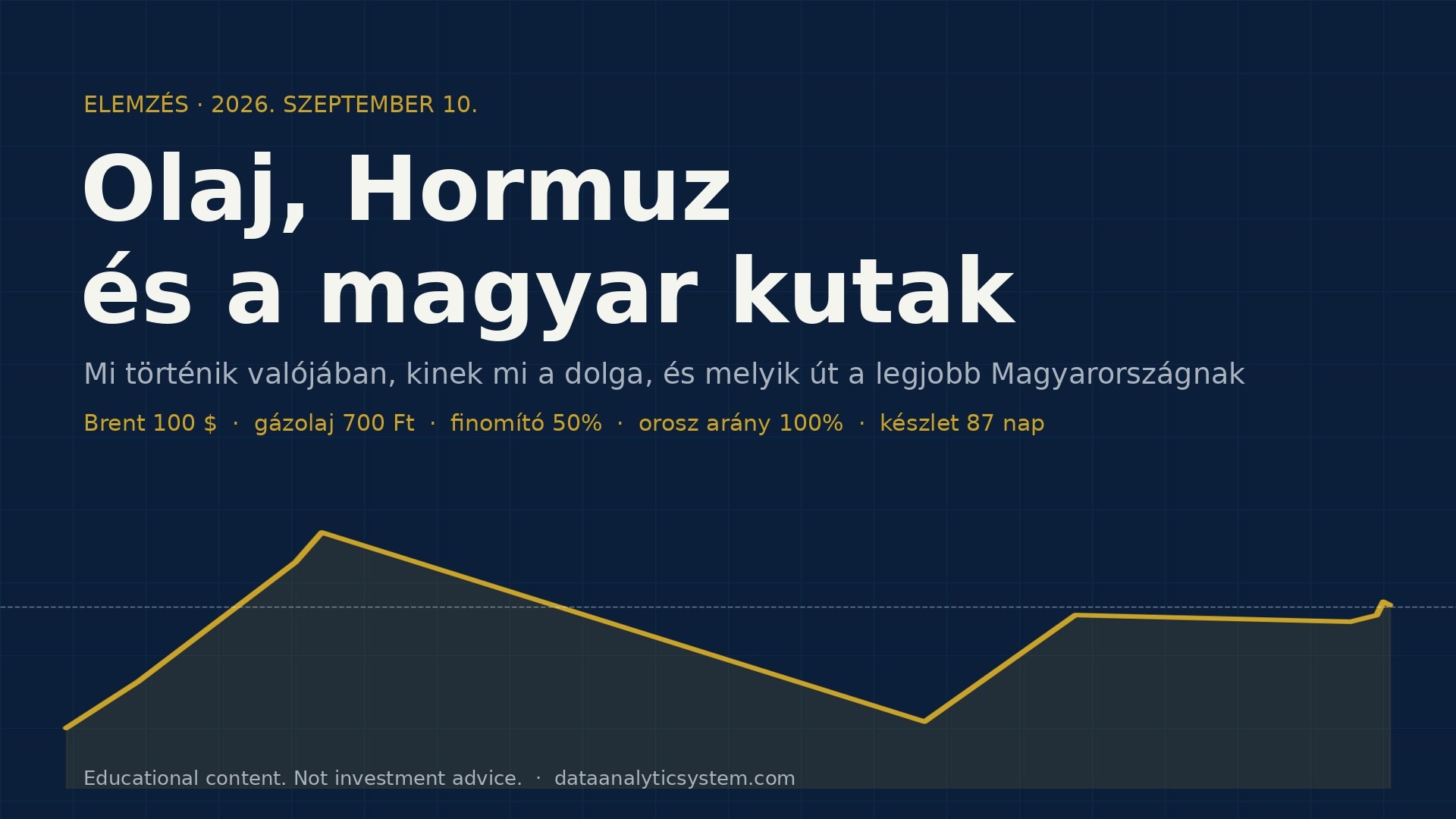
The Strait of Hormuz crisis is in its seventh month, Brent is back above $100, and diesel in Hungary costs 700 forints. The Százhalombatta refinery runs at half capacity, the Druzhba pipeline stood still for three months this year, and less is known about the Swiss company MET than people assume. A sourced situation report with every actor's position, a stated strategy — and what would prove it wrong.
This article was written on the morning of 10 September 2026 from three research notes drawing on 271 sources in total. Every figure carries its source and date. Where something could not be verified from a source, it is marked [UNVERIFIED]. The method is a situation report: measurement, change, options, one next step — and, at the end, what would prove the whole thing wrong.
🎧 Audio edition — the full article read aloud, 41 minutes, MP3: oil-hormuz-and-hungary-2026-audio-EN.mp3
Why now, and why at this length
There is a number every Hungarian driver learned on 9 September: the national average price of diesel passed 700 forints a litre — 700.5, according to holtankoljak.hu. Three days earlier the prime minister had told parliament it was 697, up 9 forints in a single day. On the same day, Brent crude closed above $100 for the first time in six weeks. Those three numbers are the end of one story that began on 28 February in the Persian Gulf, and in the middle of which Hungary found itself in a situation the prime minister described on 31 July as one the country had "never" been in.
This is not a news digest. It asks what exactly is happening, who is claiming what, how much of it is proven, who ought to be doing what — and, most importantly, which strategy serves Hungary best. At the end we say so plainly, and set beside it what would refute it.
1. The world: what is happening at the Strait of Hormuz
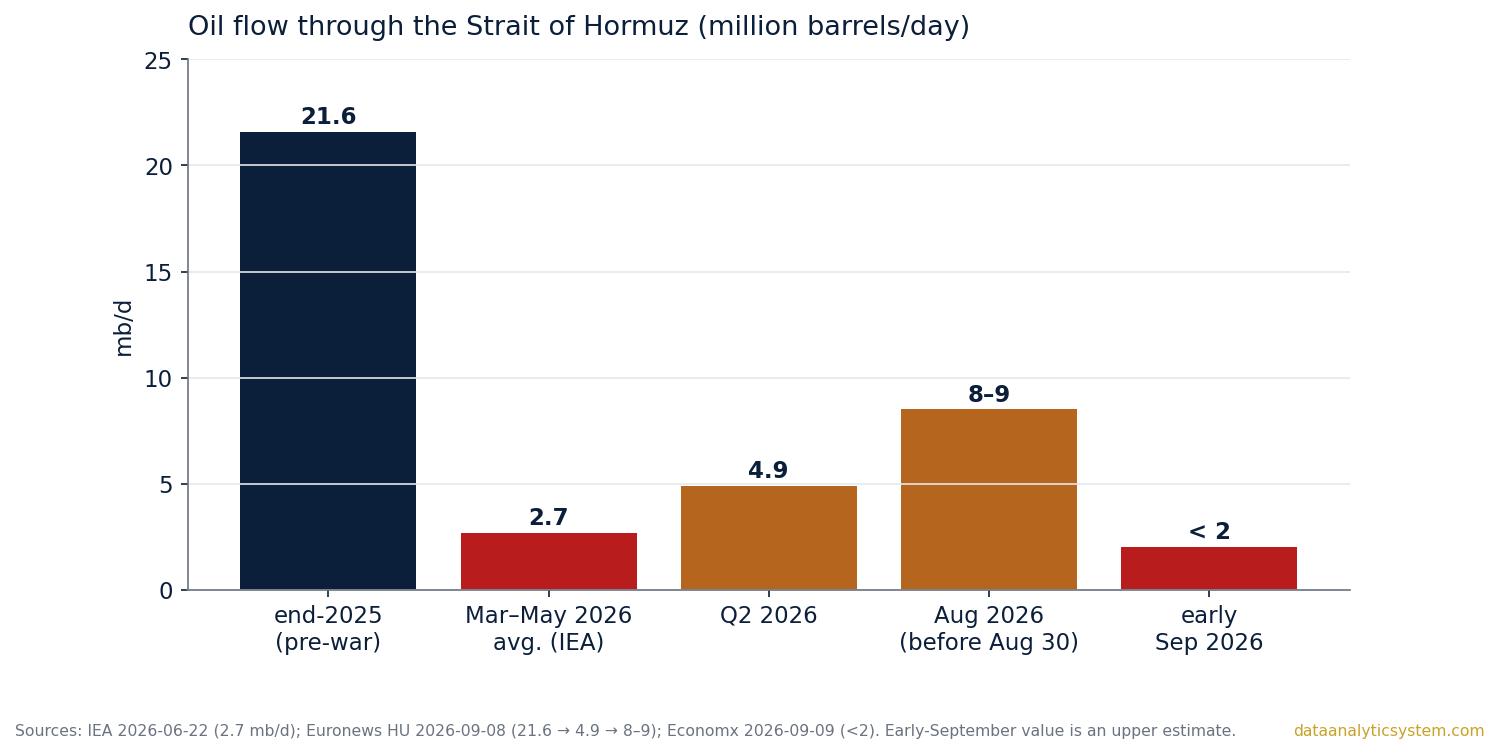
The Strait of Hormuz is the only sea exit from the Persian Gulf. Before the war, roughly 20 million barrels of oil a day and about a fifth of the world's LNG trade passed through it — a fifth of global oil flows on a single waterway.
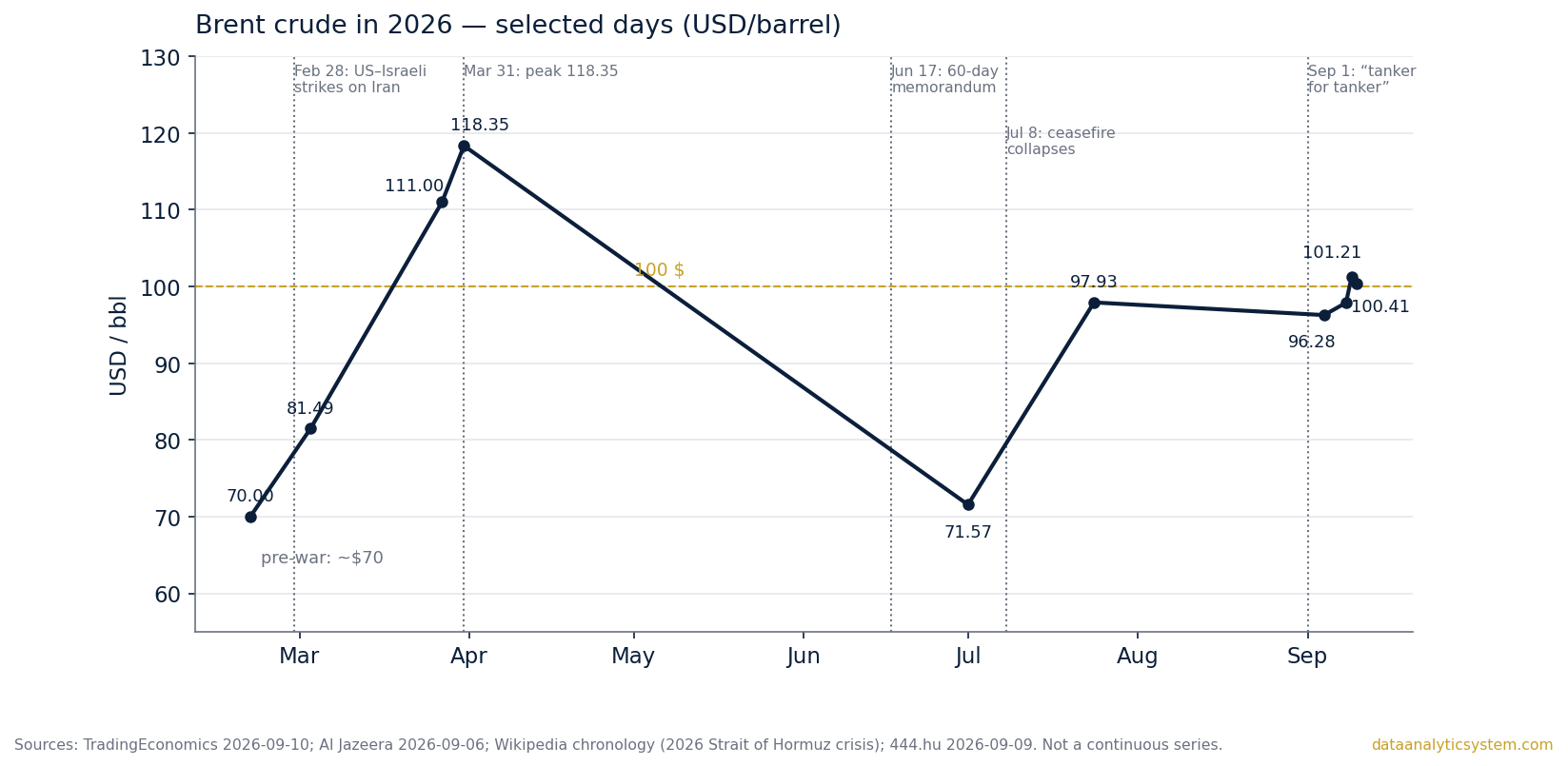
The timeline in brief, with sources. On 28 February the United States and Israel launched air strikes on Iran, and Iran closed the strait within hours (Al Jazeera, 6 September 2026). On 11 March the International Energy Agency (IEA) ordered a 400-million-barrel coordinated stock release, the largest in its history, and called the crisis "the largest supply disruption in the history of the world market". On 31 March Brent peaked at $118.35. A ceasefire followed on 8 April, and a US naval blockade of Iranian ports from 13 April. On 17 June Trump and President Pezeshkian signed a 60-day memorandum that collapsed within ten days; the truce broke down on 8 July, and on 12 July Iran's Revolutionary Guard declared the strait closed again. On 17 August the memorandum expired without agreement. From 1 September the United States announced a "tanker for tanker" policy: between 1 and 8 September it disabled or destroyed ten Iranian oil tankers, while Iran fired ballistic missiles at US warships and at bases in Jordan, Kuwait and Bahrain. On 9 September the Revolutionary Guard announced it had targeted two US vessels, eight tankers and ten "violating" ships (IRNA, NPR, Axios, GlobalSecurity — all September 2026).
Where things stand. There is no ceasefire, and the White House said on 27 August that there are no active negotiations. The two sides also describe reality differently. The US government says the strait is "fully open" and mine-free; Treasury Secretary Bessent spoke of 10–17 million barrels a day passing through, and Trump of "30 ships every night". Independent ship trackers — Kpler, Lloyd's List Intelligence, Windward — measure 5–14 vessels a day for the same dates, against 85–100 before the war. The two data series cannot be reconciled, and this article does not try: we report both and say where each comes from.
The market. Brent stood at $100.41 on the morning of 10 September, WTI at $96.61 (TradingEconomics). Before the war it was around $70; the low during the July truce was $71.57. The US Energy Information Administration's forecast of 9 September expects Brent around $90 in the second half of 2026 and $74 in 2027; Goldman Sachs gives an upper scenario of $120 and a lower one of $80. War-risk hull insurance, according to Marsh, costs 3–10 per cent of a vessel's value (0.25 per cent before the war) — $3–10 million for a single voyage of a $100 million tanker. OPEC+ raised output by 188,000 barrels a day from September and left October unchanged; in one analyst's words, "OPEC+ currently has very limited power over the physical oil market". The IEA's September market report is published tomorrow, 11 September; it will be the first new official figure.
The bypasses. Saudi Arabia has filled its East–West pipeline to 7 million barrels a day and exports about 5 million a day from Yanbu; the UAE's Habshan–Fujairah line carries 1.8 million, with a second line half built and promised for 2027; Iraq and Turkey signed a one-year, 750,000-barrel-a-day Kirkuk–Ceyhan agreement on 1 August, but actual flows are 150–180,000. Qatar has no bypass: force majeure on its LNG has been in place since 4 March and was extended to November. Together the bypasses replace only part of the loss — which is why the price never returned to $70 for long, even during the summer truce.
2. Where everyone stands — the world's actors
For each actor we set out what it says itself, and what the other side says about it. We do not judge.
United States. Its policy is "tanker for tanker", the naval blockade, and sanctions on every Iranian revenue stream. Defense Secretary Hegseth: "If Iran shoots at U.S. ships, we will destroy (and sink) their oil tankers. All they have to do is not shoot." Secretary of State Rubio: "for every time they do that or try to do that, they're going to lose tankers." Trump on 18 August: "We have total control of the strait." Iran calls the tanker strikes war crimes; China and Russia abstained on the Security Council's Resolution 2817 in March because it did not mention the US–Israeli strikes of 28 February.
Iran. Its position is that the strait is under the Revolutionary Guard's control and will open only when the United States "fully implements all of its commitments" — an end to the blockade, the terms of the memorandum, frozen funds. Parliament speaker Ghalibaf: Iranian forces are "in complete control of the strait and will not allow it to be opened". Since May an Iranian "Persian Gulf Strait Authority" has charged for passage; the US Treasury sanctioned it in July as an "extortion network". President Pezeshkian on 27 August: "Our foundation is understanding and resolving issues through interaction and negotiation, but at the same time, we will stand firmly against economic pressures."
The Gulf states. Saudi Arabia cut output by 20 per cent in March and is routing exports to the Red Sea; on 2 September, after one of its supertankers was hit, it called for "halting escalations". The UAE foreign ministry called the attacks on ADNOC vessels "acts of piracy by Iran's Revolutionary Guard Corps" and demands the strait's full reopening. Qatar is the clearest: opening the strait "unconditionally" is "a top priority", because "it's not acceptable at all to have this state of no war and no peace" — and it is trying to mediate together with China. Oman is the mediator whose own ports were hit by Iranian drones; in late August it spoke of a temporary Iran–Oman corridor, which is not registered with the IMO. Iraq's exports fell by 80 per cent at the start of the war. Kuwait lifted its force majeure in June, and with the July re-closure is in practice again forced to restrict exports [UNVERIFIED from a Kuwaiti source].
China, India, Japan, South Korea. China's crude imports fell 40 per cent between February and May; Foreign Minister Wang Yi said "the freedom and safety of international navigation through the strait should also be ensured", yet China abstained at the Security Council, and the Shanghai Cooperation Organisation "expressed solidarity with the Iranian government" in July. India, which imports more than 80 per cent of its oil through the strait, sent warships in March (Operation "Urja Suraksha"), created its own insurance pool, and refuses to pay Iranian fees; eleven Indian nationals have died in the conflict. Japan depends on the Middle East for 94 per cent of its crude and decided on 26 August to support Hormuz-bypass pipelines. South Korea is coordinating with France on a maritime security mission, but "no decision has been made".
European Union, Germany, France, United Kingdom. Von der Leyen in April: the closure is "greatly damaging", the EU's fossil import bill rose by €22 billion in 44 days, "not a single molecule of energy in addition". The British–French-led mine-clearing mission is "strictly defensive" in principle and would start only after a "sustainable ceasefire"; whether it had actually started by 10 September we could not establish [UNVERIFIED]. Germany ties participation to a Bundestag mandate and to the end of hostilities. The E3 statement of July condemns "Iran's reckless attacks" and urges the resumption of the ceasefire and of negotiations. Only about 7 per cent of the EU's crude imports came from the Gulf in 2025 — but the price is global, and Europe's main vulnerability is LNG.
Russia. Spokeswoman Zakharova "regretted" the escalation in July and offered "the necessary assistance" under the June memorandum; presidential envoy Titov on 7 September: the crisis "could end just as quickly as it began". The other side's reading: Chatham House's April headline called the Iran war "an economic gift for Putin"; in early September Russia banned diesel exports (Origo, 8 September) while it has itself been importing diesel for weeks (444, 9 September).
Turkey, the IEA, OPEC, the UN, the insurers. Erdoğan urges diplomacy, and Turkey opened the Kirkuk–Ceyhan overland bypass for Iraq. Birol, the head of the IEA, in April: "We are facing the biggest energy security threat in history", and "the cure is opening up the Strait of Hormuz". OPEC's secretary general says its "policies are not aimed at directing or determining oil price trends". UN Secretary-General Guterres was "deeply concerned" on 9 September and asked for "utmost restraint". The Lloyd's insurance market said the essential thing back in March: "The reason ships are not moving is not through a lack of insurance; it is a question of the risk to crew and vessel safety being assessed by the ship masters and owners as too high." According to the IMO's secretary general, around 400 ships and 6,000 seafarers were stranded in the region at the end of August, and 19 seafarers had died.
3. Hungary: how large is the exposure, really
Hungary's oil import dependency is 83.5 per cent, and the domestic price is tied to Brent — as the analyst Attila Holoda put it in March, "everyone benchmarks oil to Brent". This section measures what the actual Hungarian risk is.
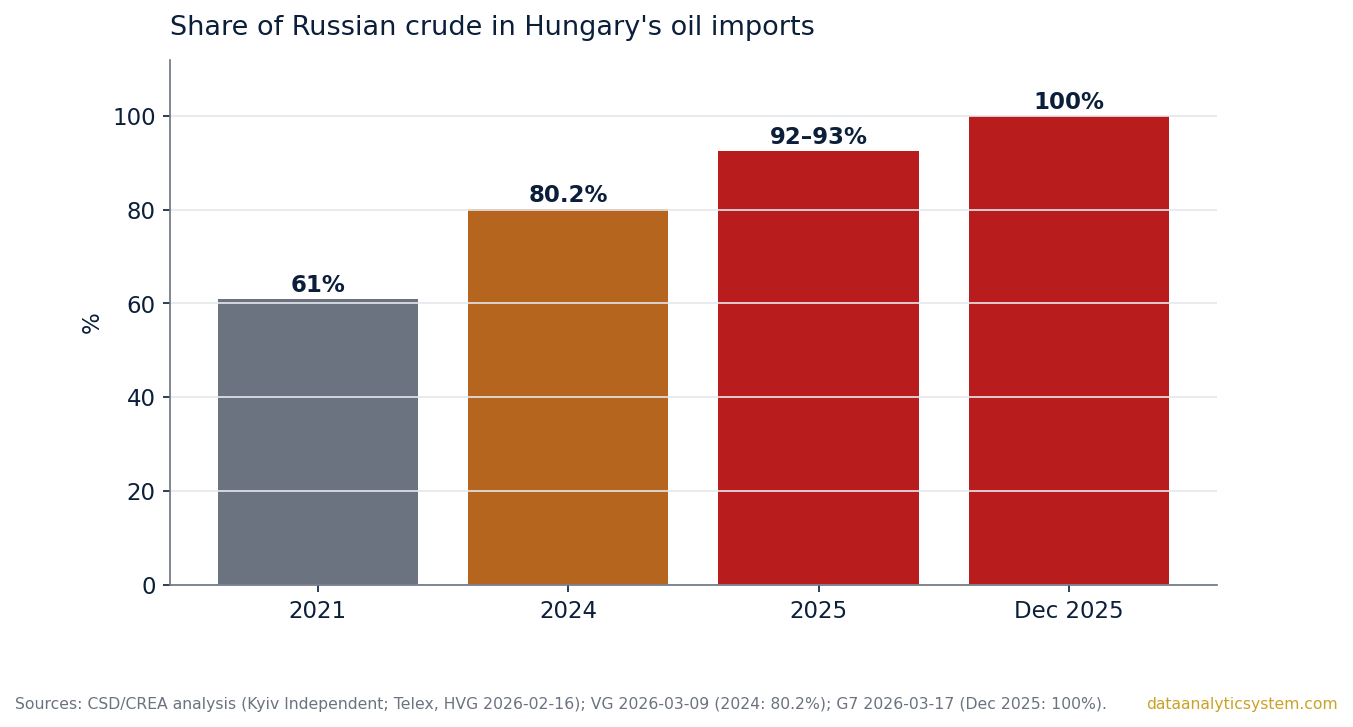
The Russian share. Russian oil accounted for 61 per cent of Hungary's crude imports in 2021, 80.2 per cent in 2024, 92–93 per cent in 2025 and 100 per cent in December 2025 (CSD/CREA analysis; VG, Telex, HVG, G7). István Kapitány, minister for economy and energy, put it this way at his committee hearing on 11 May: "It was not a successful outcome that the share of Russian oil went from 65 per cent to 90 per cent between 2022 and 2025." The previous government read it differently: Péter Szijjártó argued in April that diversification would "cut Hungary off from cheap Russian energy"; MOL realised an average price advantage of €47.3 million a month on Russian oil in 2025 (CSD/CREA), a figure MOL disputes.
The Druzhba pipeline in 2026. The southern branch supplying the Hungarian and Slovak refineries carried nothing from 27 January to 22 April — almost three months. Ukraine cited a Russian drone strike on the Brody station; the Hungarian government of the day cited political blackmail; Zelensky said on 5 March that he "would not repair the pipeline", and announced on 21 April that it had been repaired. Oil reached Hungary in the early hours of 23 April, releasing the €90 billion EU loan to Ukraine that Hungary had been blocking until then. In May flows were 165,000 barrels a day against 200–235,000 before the stoppage. The pipeline's legal future is uncertain too: the EU promises a full ban on Russian oil by the end of 2027 (Commissioner Jørgensen: "as soon as possible and no later than by the end of 2027"), the Commission's proposal was postponed because of the war, and there is no new date [UNVERIFIED]; the Ukrainian transit contract runs to 2030, but Ukraine's leadership says that with an EU ban transit could be stopped "within eight months". Hungary's exemption from the US sanctions on Rosneft and Lukoil was for one year according to the White House, so it lapses around November 2026; we found no official source on its fate under the Tisza government [UNVERIFIED].
The Adria pipeline. This is the dispute in which both sides are confident and neither has proof. Croatia's JANAF claims an annual capacity of 11–15 million tonnes; MOL says "we have never brought up more than 2 million tonnes a year" — Zsolt Hernádi said so on 19 February, and added on 31 July that "they still do not know the Adria pipeline's capacity". The two companies agreed on 25 February to a ten-month test with independent observers, which started on 11 March and will report in early 2027; the 40,000-tonne-a-day peak test can only come in the autumn, after the Százhalombatta distillation unit restarts. MOL has complained to the European Commission that JANAF's tariff raises the suspicion of "abuse of a monopoly position"; Croatia, for its part, has said it will not let Russian oil through: "help does not mean Russian oil" (Minister Šušnjar). A 2.05-million-tonne contract is in force for 2026. The Bruegel think tank says seaborne supply is "fully feasible… driven by commercial interests and not hard technical constraints"; MOL says "any other oil only goes down with soda water, with significant financial compromises".
The refinery. The AV3 distillation unit of the Danube Refinery at Százhalombatta has been down since a fire in October 2025, and the refinery runs at about 50 per cent. The repair costs 20 billion forints and the lost profit $500 million (Infostart, 31 July). Even so, MOL's second quarter was exceptional: a refining margin of $20.8 a barrel, clean EBITDA of $1,297 million and net profit of $786 million — because global margins jumped on the crisis, while throughput fell 20 per cent in the first half.
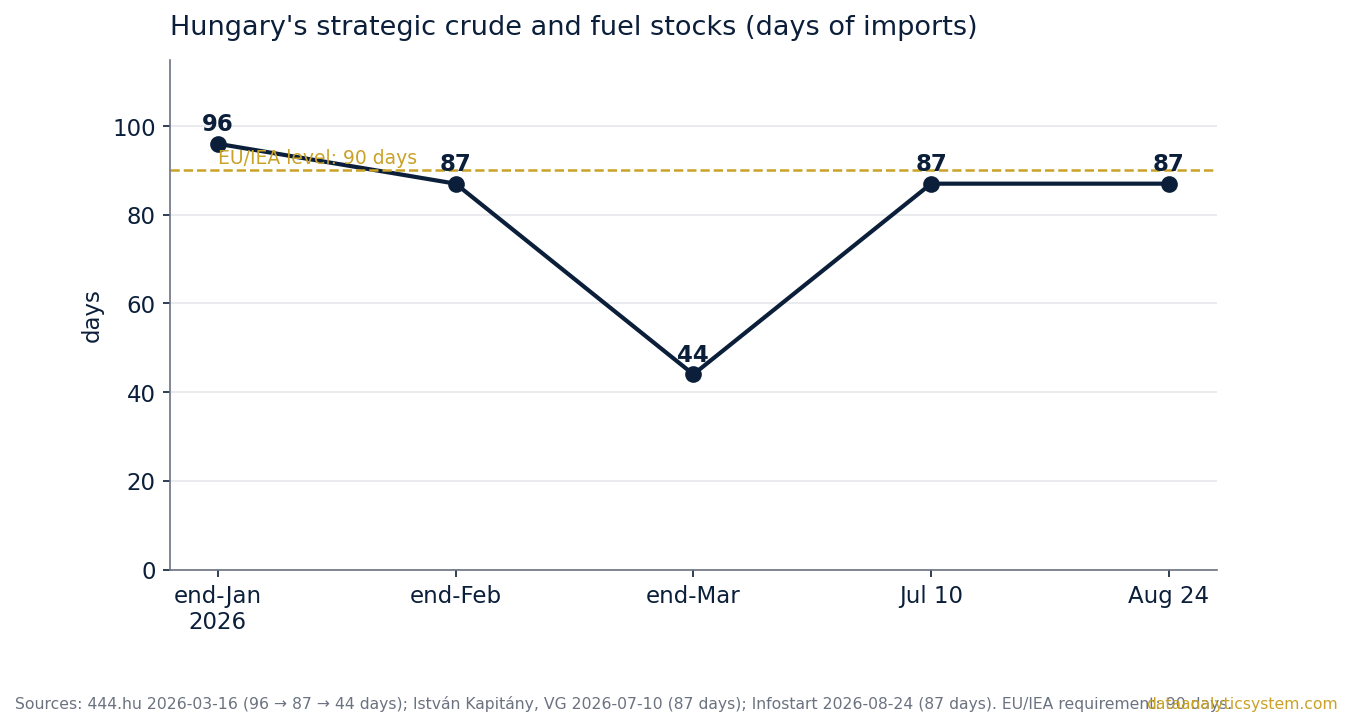
The stocks. Strategic crude and fuel stocks equalled 96 days of imports at the end of January, 87 at the end of February, and — after the February release of 250,000 tonnes and the Druzhba stoppage — 44 at the end of March. István Kapitány reported 87 days on 10 July and said the released volume had been "fully replenished"; Infostart also wrote 87 days on 24 August, 3 days short of the 90-day EU level. Hungary contributed 6.1 million barrels to the IEA's March action. On 16 July Fidesz claimed that only 24 days of diesel and 14 days of petrol were available; the government and MOL say supply is secure. The two claims do not measure the same thing — one is the strategic stock, the other probably commercial product inventory — and we could verify neither against the stockholding agency's own data, because the MSZKSZ website could not be read due to a certificate error [UNVERIFIED].
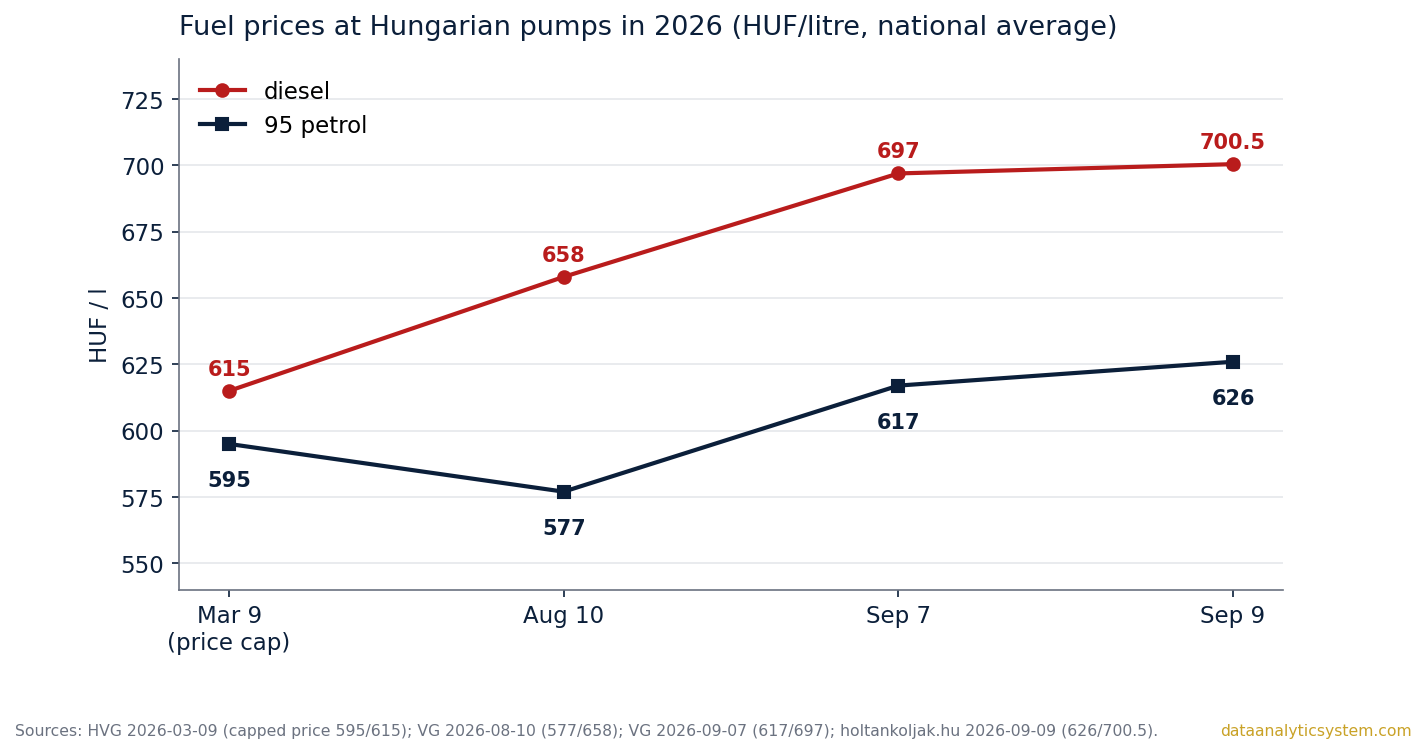
Prices and the price cap. The capped price (595 forints for petrol, 615 for diesel) was the previous government's measure of 9 March, together with an excise cut and an export ban. Parliament removed it on 23 June by 130 votes to 36 with 5 abstentions — by then, Kapitány said, "fuel at the pumps was already 10–15 forints cheaper than the protected price"; János Bencsik (Fidesz) said it was premature, because "passage through the Strait of Hormuz is currently not assured". In hindsight both sentences proved true: in June the price really was below the cap, and after the re-closure on 8 July it really did run away. On 7 September the prime minister told parliament that a 100-forint price gap "would consume at least 50 billion forints of public money", and promised targeted support for commuters and farmers instead of a cap; on 9 September he added: "if the protected price were introduced now, shortages would develop within one or two weeks". Fidesz demands the restoration of the 595/615 cap. MOL's executives were summoned to the cabinet meeting of 9 September; it ended at 21:25 without a decision being announced (VG, 10 September).
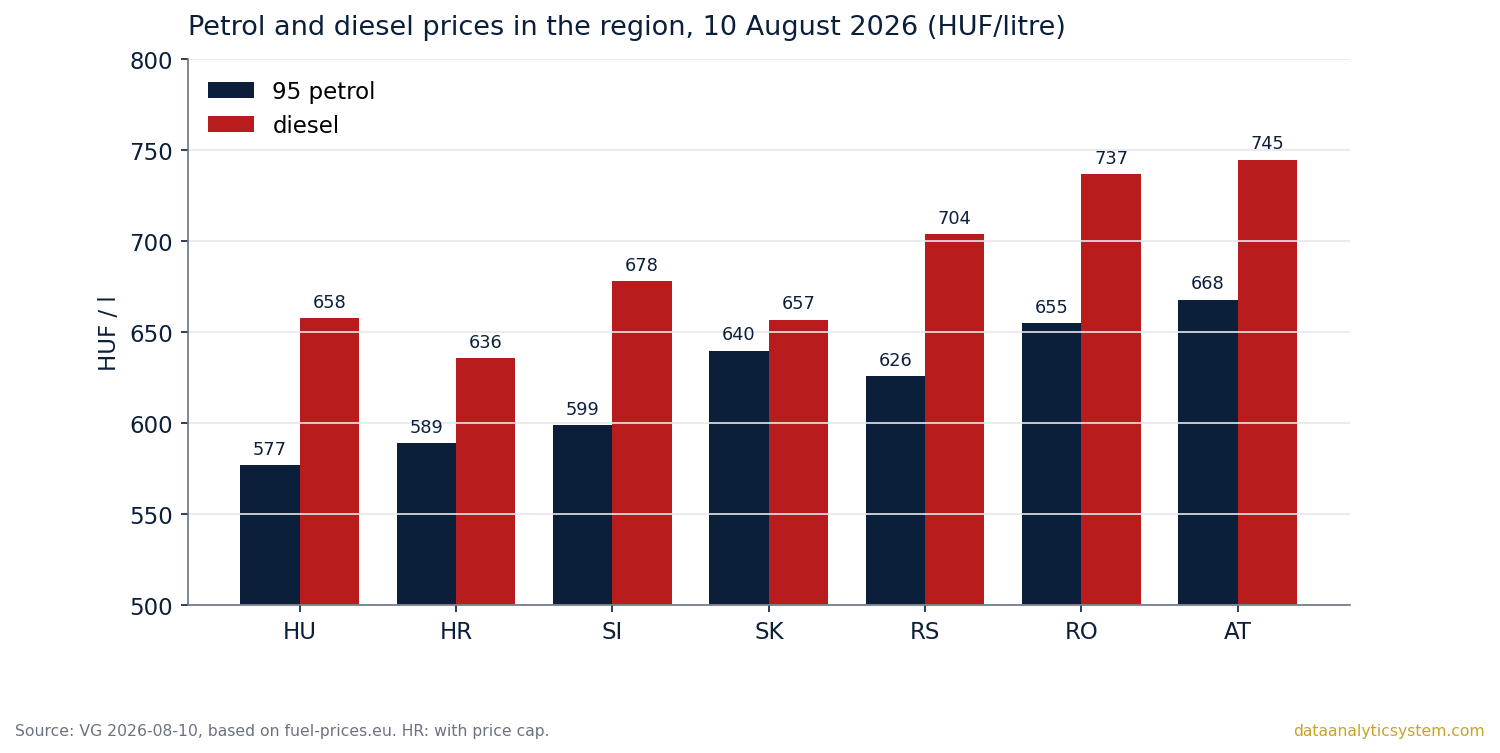
In regional comparison, on 10 August the Hungarian price was in the lower third: petrol 577, diesel 658 forints, against Austria's 668/745, Romania's 655/737 and Serbia's 626/704 (VG, fuel-prices.eu). The 27 per cent VAT, however, is the highest: Attila Holoda calculates that with 19–20 per cent tax the price could be 550–570 forints.
4. The press conference of 31 July — what was said, and who said it
The Százhalombatta press conference of 31 July was covered by on-site reports (Telex, Origo, Portfolio, Economx, Infostart, ATV, all 31 July): at 11 a.m. that day Prime Minister Péter Magyar and Zsolt Hernádi, MOL's chairman and CEO, spoke, alongside government spokeswoman Vanda Szondi; István Kapitány held a briefing at Paks at 3 p.m. the same day.
What was said, with sources: — Péter Magyar: the refinery "is expected to restart at full capacity around 20 September"; Hernádi: the full-capacity test run starts on 22 September. — Hernádi: "There is enough fuel in Hungary, supply is secure" — and, in the same breath: "diesel is in short supply, there is less of it available." For August, Hungarian diesel demand is 356 million litres, of which the Danube Refinery supplies 230 million and Bratislava 95 million. With the loss of Russian diesel exports, "10–13 per cent is missing from the world market". — Hernádi: 87 days of strategic reserves, "no need to touch them"; "We live in mad, extraordinary times, and that demands sacrifices from all of us"; to industrial executives: "don't look at their pockets". — Hernádi on MOL preparing to move off Russian oil, "but he asked for the government's help in this, and said they still do not know the capacity of the Adria pipeline" (Telex). — Péter Magyar: "Fuel prices at Hungarian filling stations are well below the average of the neighbouring countries" and "If prices ran away, we will intervene"; he called on the Croatians to speed up the Adria tests. — And the sentence that became the day's headline: "Hungary has never been in as difficult an energy situation as it is now."
The reactions: the Fidesz parliamentary group leader that evening asked about the Paks load-shedding scenario, not the refinery; the Association of Independent Filling Stations spoke of shortages; MOL issued no separate statement [UNVERIFIED].
5. MET: who owns the Swiss company, and what does it have to do with Hungarian oil
MET Group's name comes up in every Hungarian energy debate, so three things need to be clarified: what the company is, whose it is, and what it has to do with oil.
What MET is. MET Holding AG is a company registered in Baar, Switzerland (UID CHE-135.897.834, registered on 11 December 2012), founded by MOL in 2007 as a gas trader. Today it is a natural gas and LNG trader, an electricity trader and producer, and a renewables and storage group in 23–24 countries with more than 1,400 staff. Its consolidated revenue in 2025 was €28.6 billion, on 241 billion cubic metres of gas — many times the size of the Hungarian gas market. The company does not publish a consolidated net profit; what is official is the holding's own PwC-audited 2025 statutory accounts: a profit of €241.4 million, dividends of €300 million in 2024 and €75 million in 2025 [consolidated profit UNVERIFIED].
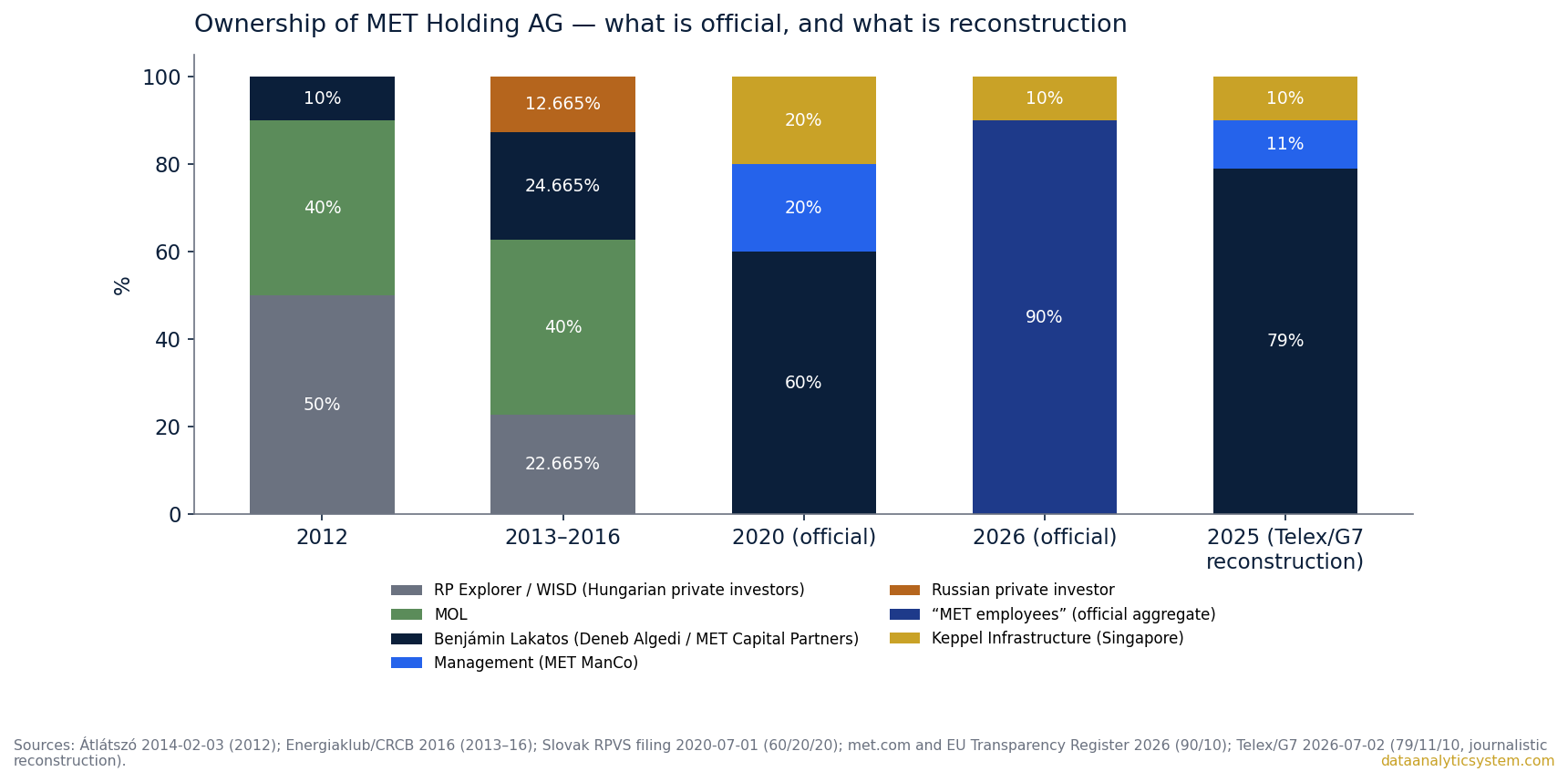
Whose it is. Here the official and the reconstructed must be kept sharply apart. According to the company's own statement and the entry in the EU Transparency Register updated on 28 April 2026, MET is "owned 90% by MET employees and 10% by Keppel Infrastructure", a subsidiary of Singapore's Keppel group, whose largest indirect shareholder is the Singaporean state. There is no official 2026 breakdown by name. The last official, named structure is the one recorded in Slovakia's public-sector partner register on 1 July 2020: MET Capital Partners AG 60 per cent, MET ManCo AG (management) 20, Keppel 20; according to that filing, MET Capital Partners AG is controlled by Benjámin Lakatos. In November 2022 Keppel sold 10 per cent back to Lakatos for €31.86 million. On 2 July 2026 Telex and G7 reconstructed from foreign regulatory filings that Lakatos holds 79 per cent, management 11 and Keppel 10 — a journalistic reconstruction, not a company register, and one that, by the article's own account, found no evidence of a hidden political background. MOL sold its 40 per cent stake in May 2018; we found no new investor entering between 2023 and 2026.
The disputed history. Between 2011 and 2015 Hungarian legislation gave MVM's trading arm near-exclusive access to cheap gas arriving via the Austrian–Hungarian pipeline, which MVM Partner passed on to MET; the EU opened infringement proceedings in 2015, and the rules were repealed. In 2016 Energiaklub and the Corruption Research Center Budapest wrote that the case showed "traits of government failure, rent-seeking and also a manifestation of the kleptocratic state"; Direkt36 called it in 2018 "one of the most controversial state-related deals in the last 8 years". MET's answer has been unchanged since 2014: it concluded its contracts "on market terms" and operates "in accordance with the laws in force, on a competitive basis"; Lakatos in 2025: MET is a Swiss private company with no government ties. The company's board chairman of 13 years, Csaba Lantos, became energy minister in November 2022 and resigned from MET's board. This April Zurich's Tages-Anzeiger reported that MET had been forced to hand over the Tigáz gas network "under duress, below value" to Lőrinc Mészáros's group, at a loss of more than a hundred million francs; MET "did not wish to comment".
What it has to do with oil — and with today's crisis. The precise answer: directly, little. MET does not ship crude to Hungary, and its public results announcements do not mention oil trading [the extent of actual oil activity UNVERIFIED]. Its Hungarian assets are the gas trader MET Magyarország Zrt. (2025 revenue 182.8 billion forints), 74.92 per cent of the Dunamenti power plant at Százhalombatta, a 40-megawatt battery and solar parks. Where MET was an actor in Hungary's energy supply this year, it was in electricity: the Dunamenti G3 unit shut down on 29 July with a seal failure, at the same time as the Paks outage, restarted on 1 August — the prime minister "thanked those who took part in the repair" — and at the ministry's request postponed its warranty maintenance during the summer peak. We found no investigation, contract termination or loss of role for MET on the part of the Tisza government; the extraordinary government inquiry of 3 September concerns Paks and MVM [no result found, which is not the same as no event — UNVERIFIED].
Is it right that things are as they are? This article cannot answer that with a yes or a no, because the answer depends on what one values — but it can say what is missing for anyone to answer responsibly. Three things are missing. The first is an official, named ownership breakdown: a company that runs a power plant and a gas trader in Hungary, and whose gas volumes are fifteen times the domestic market, could disclose more than the "90 per cent employees" aggregate. The second is a consolidated profit figure: Swiss law does not require it, so it is not public, and so everything that appears in the Hungarian press about MET's profits remains an estimate. The third is a written account of the relationship between the state and the company — not because any government is under suspicion, but because an energy company whose chairman became a minister, and whose assets were taken over by a group close to another government, naturally invites suspicion in both directions. What is measurable today: MET is significant in the Hungarian gas and electricity markets and a bystander in the oil crisis; its ownership is known at the official level and not in detail; and its disputes have typically been settled not by courts but by the press.
6. Who has to do what — actor by actor
Here we do not say who erred, but what each actor would have to do actively, in today's situation, to make Hungary's supply safer and cheaper.
The government has three tasks, all measurable. First: a single public stock data sheet, weekly, signed by the stockholding agency — in days, by product — so that the "87 days" versus "24 days" argument is settled in a table, not in parliament. Second: the precise rule and duration of the targeted diesel support, because on the morning of 10 September the cabinet meeting had ended without a decision, and uncertainty is itself a cost. Third: a public timetable for the Adria test and a political framework signed with the Croatian government, so that in early 2027 it is not the case that nobody yet knows the pipeline's capacity.
MOL's task is to prove its own claims: if processing non-Russian oil means "significant financial compromises", quantify it per barrel; if the Adria cannot deliver more than 2 million tonnes, let the independent observers measure that in the peak test; and keep the 20–22 September refinery deadline, because it is the only event that can move Hungarian diesel prices down in the short term.
Croatia and JANAF's task is to turn the 11–15-million-tonne claim into a contractual guarantee, tariff included — MOL's competition complaint exists precisely because neither capacity nor price is fixed today.
The European Union must name the date: the proposal to ban Russian oil was postponed in March, and until there is a regulation, neither MOL, nor the government, nor Ukraine can plan.
Companies and consumers — told on 31 July to "multiply by two" their consumption-cut pledges — should do that in response to price signals, not to requests: the best energy policy in a crisis is one in which the price says what is worth doing.
7. Hungary can be most effective by following this strategy
The strategy in one sentence: "options, not decoupling" — but the options have to be bought, not merely mentioned.
This is not our idea; the minister said it on 11 May: "we do not want to decouple from anything; we want to get options". The trouble is that on 10 September not one of those options is measured: the Adria's capacity is unknown, the refinery is at half capacity, Druzhba has already stood still for three months once, and the Russian share is 100 per cent. What is most effective, therefore, is the following five steps, in this order:
1. The refinery before anything else. 20–22 September: AV3 at full capacity. This is the one step that reduces diesel import needs within weeks, and that depends on no one but MOL. Measure: the Danube Refinery's daily throughput on 30 September.
2. Prove the Adria's capacity instead of arguing about it. The 40,000-tonne-a-day peak test in the first half of the autumn, with independent observers and a public result. If the pipeline delivers 8 million tonnes to Százhalombatta, Hungary has a second source; if not, that needs to be known before 2027. Measure: the test protocol.
3. Stocks above 90 days, and in public. 87 days is 3 days below the requirement in a year in which Druzhba stood still three times longer than anyone planned. Measure: the stockholding agency's weekly release.
4. Targeted, time-limited diesel support instead of a price cap — and saying the VAT question out loud. The government says a cap would bring shortages within one or two weeks; the spring experience partly bears this out, because in March the protected price had to be accompanied by an export ban and a stock release. Targeted support, however, only works if it has a rule and an expiry. The 27 per cent VAT is the region's highest; by Attila Holoda's calculation the price could be 550–570 forints at 19–20 per cent — a budget decision to be stated, not circumvented.
5. Reduce the Russian share by the end of 2027 at the pace of capacity, not of the calendar. Not because Russian oil is politically awkward, but because 100 per cent from a single source — any source — is not energy policy but a bet. The right pace is the one the measurement in step 2 gives.
The healthy situation, if this and that happens: the refinery at full capacity, the Adria proven to deliver at least 6–8 million tonnes, stocks above 90 days, the Russian share around 50–60 per cent with two real sources, support targeted and time-limited, VAT at the regional level. In that situation another Druzhba stoppage or another Hormuz week is a problem for the price, not for the country — and that is the difference.
How this proposal was produced: as a situation report (HELYZETKÉP). Measurement (sections 1–5), change (since the July re-closure), options (section 6), one next step (the refinery). To argue against the proposal, then, one needs an argument, not a fact — the facts come from the sources above, and any of them can be refuted if someone shows better.
8. What would prove it wrong
Every situation report must say what observation would overturn it. Here there are three.
If the IEA's report tomorrow, 11 September, shows that Hormuz flows have moved durably above 10 million barrels a day — that is, if the US government's figures are right and the ship trackers are wrong — then Brent falls below $90 and steps 3–5 of the strategy above are downgraded from urgent to important.
If the Adria's autumn peak test stays below 2–3 million tonnes, then MOL was right, and steps 2 and 5 must be rewritten: what Hungary lacks then is not a second pipeline but a second refining technology, and that is a decade-long investment.
If the refinery restart of 20–22 September slips, diesel prices will not move down before November, and the targeted support becomes a winter measure rather than a temporary one — in which case the budget debate in step 4 cannot be avoided.
9. What this article does not know
We have not seen the stockholding agency's own data. We do not know Druzhba's actual flows from June to September, MOL's 2026 Russian-versus-seaborne sourcing ratio, this year's Brent–Urals differential, the new date for the EU's oil-ban proposal, or the official 2026 status of the US exemption. We do not know MET's consolidated profit or the official, named 2026 ownership figures. The IEA's September report appears tomorrow; if any of the above changes, the article will be updated, with the date.
If you found this useful
If it was useful, share it — with taste: with someone it actually concerns, someone who drives a diesel, runs a company, or simply wants to understand why diesel costs 700 forints. One share to the right person is worth more than a hundred at random. Thank you.
Sources (selection; the full list of 271 items is in the desk's research notes): IEA — Oil Market Report, 12 August 2026, and the statements of 11 March and 22 June 2026; EIA Short-Term Energy Outlook, 9 September 2026; TradingEconomics, 10 September 2026; Al Jazeera, 2, 3, 6, 7 and 8 September 2026; Axios, 2 September 2026; NPR, 5 and 8 September 2026; RFE/RL, Al-Monitor, GlobalSecurity, 9 September 2026; US Treasury, 29 July 2026; OPEC, 2 August 2026; gov.uk E3 statement, 12 July 2026; Euronews, 31 August and 10 September 2026; The National (Marsh), 17 July 2026; Lloyd's Market Association, 23 March 2026; Telex, Origo, Portfolio, Economx, Infostart, ATV, Totalcar, 31 July 2026; Index, 13 and 21 April, 23 June 2026; VG, 11 May, 10 July, 10 August, 7 and 10 September 2026; 444.hu, 16 March and 9 September 2026; HVG, 9 March, 22 April, 23 June 2026; holtankoljak.hu, 9 September 2026; Reuters via Portfolio, 3 June 2026; MOL H1 2026 report, 7 August 2026; MOL–JANAF statements, 25 February 2026, CEEnergyNews 7 August 2026; Decree 4/2026 (II.19.) EM, njt.jog.gov.hu; Moneyhouse (MET Holding AG), the PwC-audited 2025 statutory accounts of MET Holding AG (Bundestag Lobbyregister), met.com, lobbyfacts.eu (28 April 2026), Slovak RPVS filing (1 July 2020), SGX announcement (5 December 2019), Keppel statement (16 November 2022), MOL Annual Report 2018, Telex/G7 2 July 2026, Telex 16 April 2026, Energiaklub/CRCB 2016, Direkt36 2018, Átlátszó 2014, Index 2014. All accessed on 10 September 2026.
Educational content. Not investment advice. This article takes no side between parties; for every actor we report both its own claims and those of its opponents.
Continue on DAI
Explore Topics
Written by
DAI Research Desk
Content creator and writer sharing insights and stories.