
The world in 2027, before The Economist weighs in: what the official forecasts say — and how often they have changed this year
The Economist's 'The World Ahead 2027' is not out yet; its launch event is dated 3 December 2026. So here is the record as it stands in mid-September: the 2027 growth and inflation projections of the IMF, the OECD, the World Bank, the ECB, the Fed, the European Commission and the Hungarian central bank; the regulatory dates already fixed for 2027; the energy and AI numbers behind them; and four cases where a 2026 forecast was revised within months. Sourced, dated, and written so that you can hold it up against the magazine's edition when it arrives.
Every November The Economist publishes a volume called The World Ahead, and every November a great many people read it as if it were a schedule. It is not, and its editors have never claimed it is; it is a set of informed expectations, written by people who know that expectations get revised. The 2027 edition does not exist yet: as of 13 September 2026 no publication date is announced, and the magazine's own launch event, "WorldNow: The World Ahead 2027", is scheduled for 3 December 2026. A preview piece on 4 September named four of its ten expected themes — artificial intelligence and computing, geopolitics and social unrest, climate and energy, and a set of global milestones such as India's census — and nothing more is confirmed.
That gap is an opportunity. This article assembles what the official forecasters — the institutions whose numbers governments and companies actually plan against — say about 2027 right now, with the date on every figure. It also records how often those same institutions changed their 2026 numbers during 2026, because that is the part of forecasting that rarely makes it into a year-ahead special. When the magazine's edition arrives, you will be able to read it against this page.
Growth in 2027: seven institutions, one range
The International Monetary Fund's July 2026 update of the World Economic Outlook puts global growth at 3.0 percent for 2026 and 3.4 percent for 2027. The OECD's June 2026 Economic Outlook gives 2.8 percent for 2026 and 3.1 percent for 2027 in its baseline — and, unusually, publishes an explicit downside: if the Middle East conflict that disrupted energy supply in 2026 lasts to the end of 2027, the OECD's "prolonged disruption" scenario drops global growth to 2.1 percent in 2026 and 1.8 percent in 2027. The World Bank's June 2026 Global Economic Prospects, whose headline figures run lower than the IMF's, gives 2.5 percent for 2026 and 2.8 percent for 2027.
For Europe the numbers are smaller. The European Commission's Spring 2026 forecast (21 May 2026) has the EU growing 1.1 percent in 2026 and 1.4 percent in 2027, the euro area 0.9 and 1.2 percent. The European Central Bank's staff projections of 10 September 2026 — the most recent official numbers in this article — put euro-area real growth at 0.9 percent in 2026, 1.4 percent in 2027 and 1.5 percent in 2028. For the United States, the Federal Reserve's Summary of Economic Projections of 17 June 2026 gives a median real growth figure of 2.3 percent for 2027; the next set of projections will be published after the meeting of 16–17 September, so that number is already the oldest on this page. For Hungary, the Magyar Nemzeti Bank's March 2026 Inflation Report projects 3.0 percent growth in 2027.
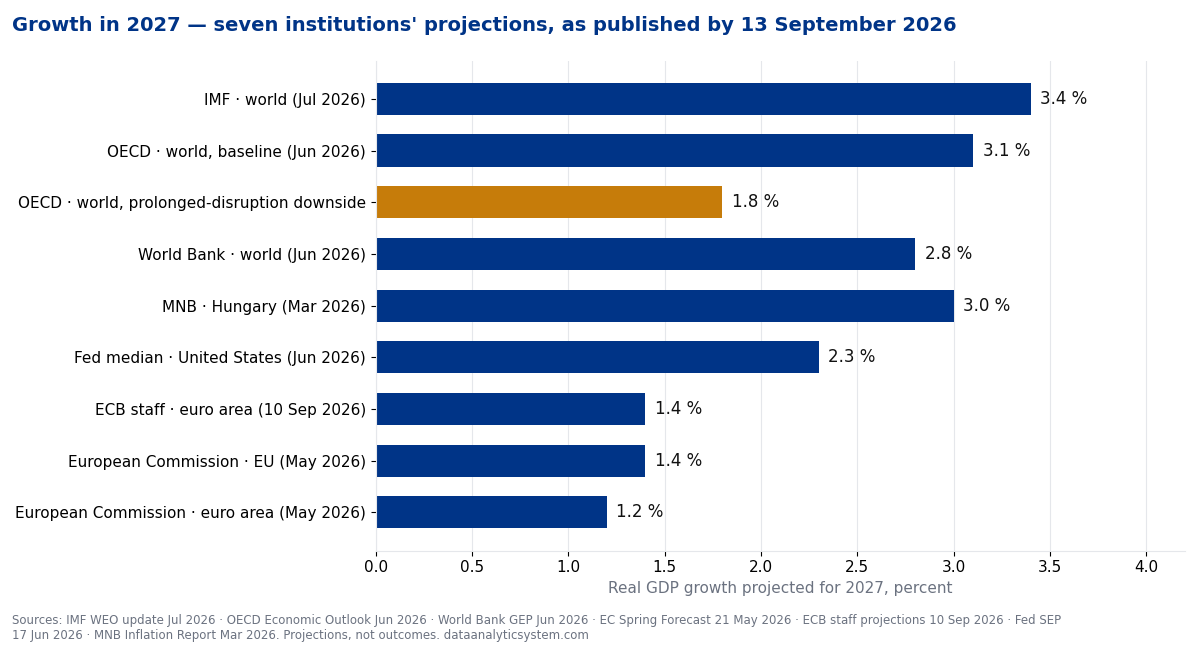
Put side by side, the seven institutions place 2027 global growth between 2.8 and 3.4 percent in their baselines, with the OECD's downside as the one published number below two percent. The spread between the IMF and the World Bank is largely a matter of method — the two institutions aggregate national economies with different weights — rather than a disagreement about the world.
Inflation and interest rates in 2027
The ECB's September projections put euro-area inflation (HICP) at 3.0 percent in 2026, 2.5 percent in 2027 and 2.1 percent in 2028. The Commission's Spring forecast has euro-area inflation at 3.0 percent in 2026 and 2.3 percent in 2027, and EU-wide inflation at 3.1 and 2.4 percent. The Fed's June median for PCE inflation in 2027 is 2.3 percent, and its median expectation for the federal funds rate at the end of 2027 is 3.6 percent. The MNB's March report projects average Hungarian inflation of 3.7 percent in 2027.
The common thread is that every one of these institutions expects 2027 inflation to be lower than 2026 inflation, and every one of them expects it to remain above the two percent that the ECB and the Fed define as their objective. That is a statement about the direction of travel, not a promise about the destination — and the next section shows why the distinction matters.
What changed in 2026: four revisions, one cause
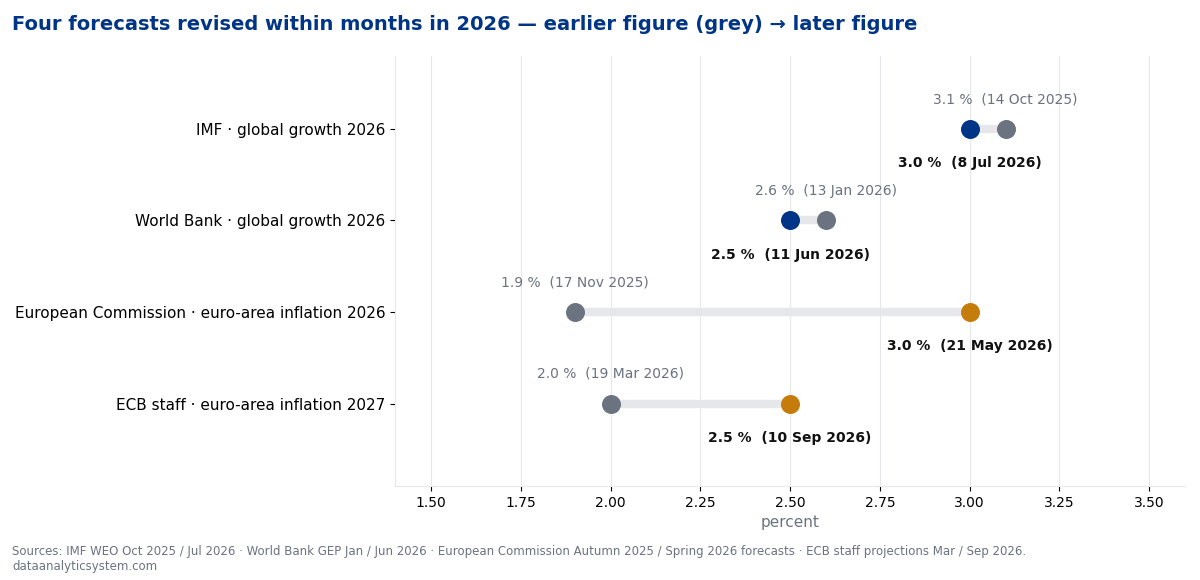
Forecasts are dated for a reason. Between the autumn of 2025 and the summer of 2026, the following official numbers for the year 2026 were revised, by the same institutions, using the same methods:
| Institution | Earlier figure (date) | Later figure (date) | What it measures |
|---|---|---|---|
| IMF | 3.1% (14 Oct 2025) | 3.0% (8 Jul 2026) | global growth, 2026 |
| World Bank | 2.6% (13 Jan 2026) | 2.5% (11 Jun 2026) | global growth, 2026 |
| European Commission | 1.9% (17 Nov 2025) | 3.0% (21 May 2026) | euro-area inflation, 2026 |
| ECB staff | 2.0% (19 Mar 2026) | 2.5% (10 Sep 2026) | euro-area inflation, 2027 |
The growth revisions are small; the inflation revisions are not. The Commission's own explanation, in its Spring 2026 document, is that the Middle East conflict "materially changed this picture", delivering what it calls one of the most significant global energy supply disruptions in recent history. The ECB's 2027 inflation figure moved up by half a percentage point in six months for the same reason. None of this means the models were wrong in any technical sense. It means that a single, well-documented external shock rewrote the official 2027 path within a few months — and that whatever The World Ahead 2027 says in November will carry the same property.
What is already fixed for 2027
Some of 2027 is not a forecast at all. It is on a legal calendar.
Stablecoins in the United States. The GENIUS Act, signed on 18 July 2025, takes effect on 18 January 2027 — eighteen months after signature — unless the implementing regulations come into force earlier. The OCC's Bulletin 2026-3 and the Federal Register notice of 2 March 2026 set out the implementation. Our profile of the Wall Street Blockchain Alliance, published today, records what one industry association asked the OCC and the FDIC to change in those rules.
Crypto-assets in the European Union. The MiCA transitional period ended on 1 July 2026 in every member state, according to ESMA's statement of 17 April 2026: service providers without authorisation had to wind down by then. 2027 is therefore the first full calendar year in which the EU crypto-asset market operates entirely under MiCA. (Data Analytic Investments is not a crypto-asset service provider; we publish educational and market information under Article 3 of the same regulation.)
Artificial intelligence in the European Union. Under the EU AI Act's official implementation timeline, every member state must have at least one AI regulatory sandbox operating by 2 August 2027, and the rules for high-risk systems listed in Annex III apply from 2 December 2027.
Cryptography. The US National Security Agency's CNSA 2.0 policy requires new national-security-system procurements from 1 January 2027 to support the quantum-resistant algorithms ML-KEM-1024 and ML-DSA-87; we confirmed the date through a secondary source and have not read the primary NSA document, so we mark it as such. NIST's draft transition document (IR 8547, November 2024, not yet final) would deprecate RSA and elliptic-curve cryptography after 2030 and disallow them after 2035; the UK's National Cyber Security Centre roadmap of March 2025 sets 2028–2031 for high-priority migration and 2031–2035 for completion.
Money. The ECB said on 30 October 2025 that a digital-euro "pilot exercise and initial transactions could take place as of mid-2027", provided EU legislators adopt the regulation during 2026, with a first actual issuance no earlier than 2029.
Politics. France elects a president in the spring of 2027 — the first round is expected on 18 April, a second on 2 May, because the current term expires on 13 May. We have this date only from a secondary source and mark it accordingly.
The energy and computing numbers underneath
Two sets of figures sit underneath almost every 2027 forecast above. The first is electricity. The International Energy Agency's Energy and AI report puts data-centre consumption at about 415 terawatt-hours in 2024, roughly 1.5 percent of global electricity, and projects around 945 TWh by 2030 — slightly more, in the IEA's comparison, than Japan's entire consumption today. Its Electricity 2026 report expects global electricity demand to grow 3.6 percent a year between 2026 and 2030, and attributes about half of the expected US demand growth to data centres.
The second is emissions. The IEA's Global Energy Review 2026 records energy-related CO₂ emissions of about 38.4 billion tonnes in 2025, up 0.4 percent on 2024 — the slowest growth since 2021 — against global GDP growth of about 3.1 percent in the same year. Whether 2025 turns out to have been the peak is exactly the kind of question a year-ahead volume will speculate about; the record so far shows growth in emissions falling well behind growth in output.
One year on: what The World Ahead 2026 said
For the sake of the comparison this article exists to enable, here is what the 2026 edition led with when it was published on 10 November 2025, as summarised in the publisher's own release: rich countries "living beyond their means" and a growing risk of a bond-market crisis; slower global growth because of tariffs; the question of whether AI infrastructure spending was masking underlying weakness in the US economy; the view that global emissions had probably peaked while 1.5 degrees was out of reach; and a choice of geopolitical frames between a new cold war and spheres of influence.
Set against the 2026 record above, the theme that actually moved the official numbers most — an energy supply shock from a Middle East conflict — was not among the five headline themes. That is not a criticism of the editors; it is the nature of the exercise, and it is the reason we date everything.
What this article does not say
It does not predict growth, inflation, interest rates or any market outcome for 2027; every number above belongs to the institution named beside it, with its publication date. It does not say which forecast is right. It does not describe what The World Ahead 2027 will contain beyond the four themes reported in a preview on 4 September 2026, and it does not quote from an edition that has not been published. It does not name a French election date from a primary government source, because we did not find one, and it does not cite the NSA's own document for the CNSA 2.0 date, because we did not open it. Where the source sheet behind this article says "not verified", so does this article.
Why this is on a data-analytics blog
Our readers use the Market Observation pages for live, sourced market data, and the same discipline applies to a year-ahead outlook: a number without a date and an author is not information. The way to read a forecast — who published it, when, what changed since, what is a legal date rather than an expectation — is the method the Uncle Sunny Academy teaches, and it is how the team introduced on our About page works every day. When The Economist's edition appears in November, we will do the comparison in a second article.
Sources
All retrieved 13 September 2026.
- The Economist / PR Newswire, "The Economist launches The World Ahead 2026", 10 November 2025 — the 2026 edition's headline themes.
- Eventbrite, "The World Ahead 2027 — WorldNow", event dated 3 December 2026; Boomers Daily, "The World Ahead 2027 — The Economist magazine", 4 September 2026 (preview of four themes; secondary).
- IMF, World Economic Outlook, October 2025 (14 Oct 2025) and July 2026 Update (8 Jul 2026).
- OECD, Economic Outlook, Volume 2026 Issue 1 (3 Jun 2026).
- World Bank, Global Economic Prospects, January 2026 (13 Jan 2026) and June 2026 (11 Jun 2026) press releases.
- ECB, staff macroeconomic projections, March 2026 (19 Mar 2026) and September 2026 (10 Sep 2026).
- Federal Reserve, Summary of Economic Projections, 17 June 2026 (PDF).
- Magyar Nemzeti Bank, Inflation Report, March 2026 (PDF).
- European Commission, Autumn 2025 Economic Forecast (17 Nov 2025) and Spring 2026 Economic Forecast (21 May 2026).
- EU AI Act Service Desk, implementation timeline — 2 August 2027 and 2 December 2027.
- OCC Bulletin 2026-3 and Federal Register, 2 March 2026 — GENIUS Act implementation, effective date 18 January 2027.
- ESMA, Statement on the end of transitional periods under MiCA, 17 April 2026 (PDF).
- ECB press release, 30 October 2025 — digital euro timeline.
- NIST IR 8547 (initial public draft, November 2024); UK NCSC, PQC migration roadmap, 20 March 2025; postquantum.com on CNSA 2.0 (secondary).
- IEA, Energy and AI (executive summary); Electricity 2026 (executive summary); Global Energy Review 2026 (CO₂ emissions).
- Wikipedia, "2027 French presidential election" (secondary; dates not confirmed from a primary source).
Educational content. Not investment advice.
Continue on DAI
Explore Topics
Written by
DAI Research Desk
Content creator and writer sharing insights and stories.