Public Key, Private Key and Address: What Is the Difference
A private key, a public key, and an address are three distinct things in a crypto wallet. This article explains what each is, how they relate, and why the distinction matters.
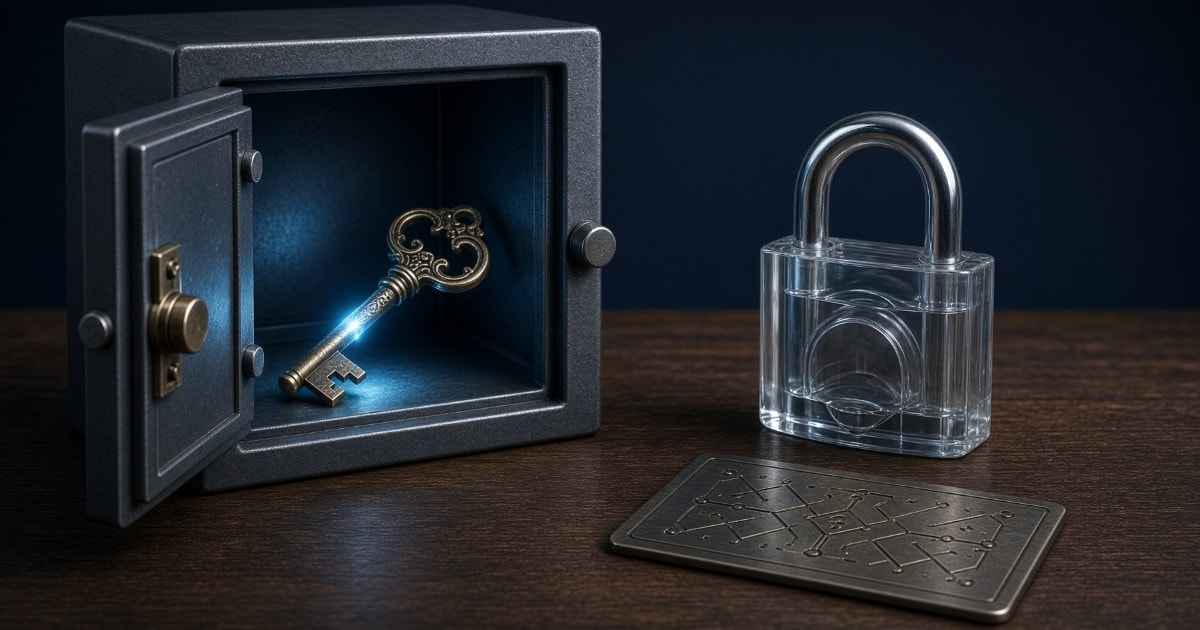
When you use a crypto wallet, three concepts appear repeatedly: private key, public key, and address. They are related but distinct, and confusing them leads to mistakes — including irreversible ones.
Private key
A private key is a randomly generated number, typically 256 bits long. It is the root of your ownership. Whoever holds the private key controls the funds associated with it. There is no recovery mechanism: if you lose the private key and have no backup, the funds are inaccessible permanently.
The private key must never be shared. It is used to sign transactions, proving that you authorised a transfer without revealing the key itself.
Public key
The public key is derived from the private key using elliptic curve cryptography. The derivation is one-way: you can compute the public key from the private key, but not the reverse.
The public key is used to verify signatures. When you sign a transaction with your private key, anyone can verify the signature using your public key — confirming that the transaction was authorised by the private key holder — without learning the private key.
Address
An address is derived from the public key, typically by hashing it and encoding the result. On the XRP Ledger, an address looks like rHb9CJAWyB4rj91VRWn96DkukG4bwdtyTh. On Bitcoin, it might start with 1, 3, or bc1.
The address is what you share when you want to receive funds. It is safe to make public — knowing your address does not allow anyone to spend your funds.
The chain
Private key → (elliptic curve multiplication) → Public key → (hash + encoding) → Address
Each step is one-way. You can move forward through the chain but not backward.
Why it matters
Sharing your address is safe. Sharing your public key is generally safe (though some advanced protocols use it directly). Sharing your private key — or your seed phrase, which generates it — gives complete control of your funds to whoever receives it.
This article is for information only.
Continue on DAI
Explore Topics
Written by
Data Analytic Investments
Content creator and writer sharing insights and stories.