Anthropic, From Founding to Today: Five Years, Eight Funding Rounds and One Unresolved Question
A dated, sourced account of Anthropic from its 2021 founding by a group of OpenAI researchers to the near-trillion-dollar company of September 2026 — the money, the models, the safety policy, the departures, and what the primary sources do and do not confirm.
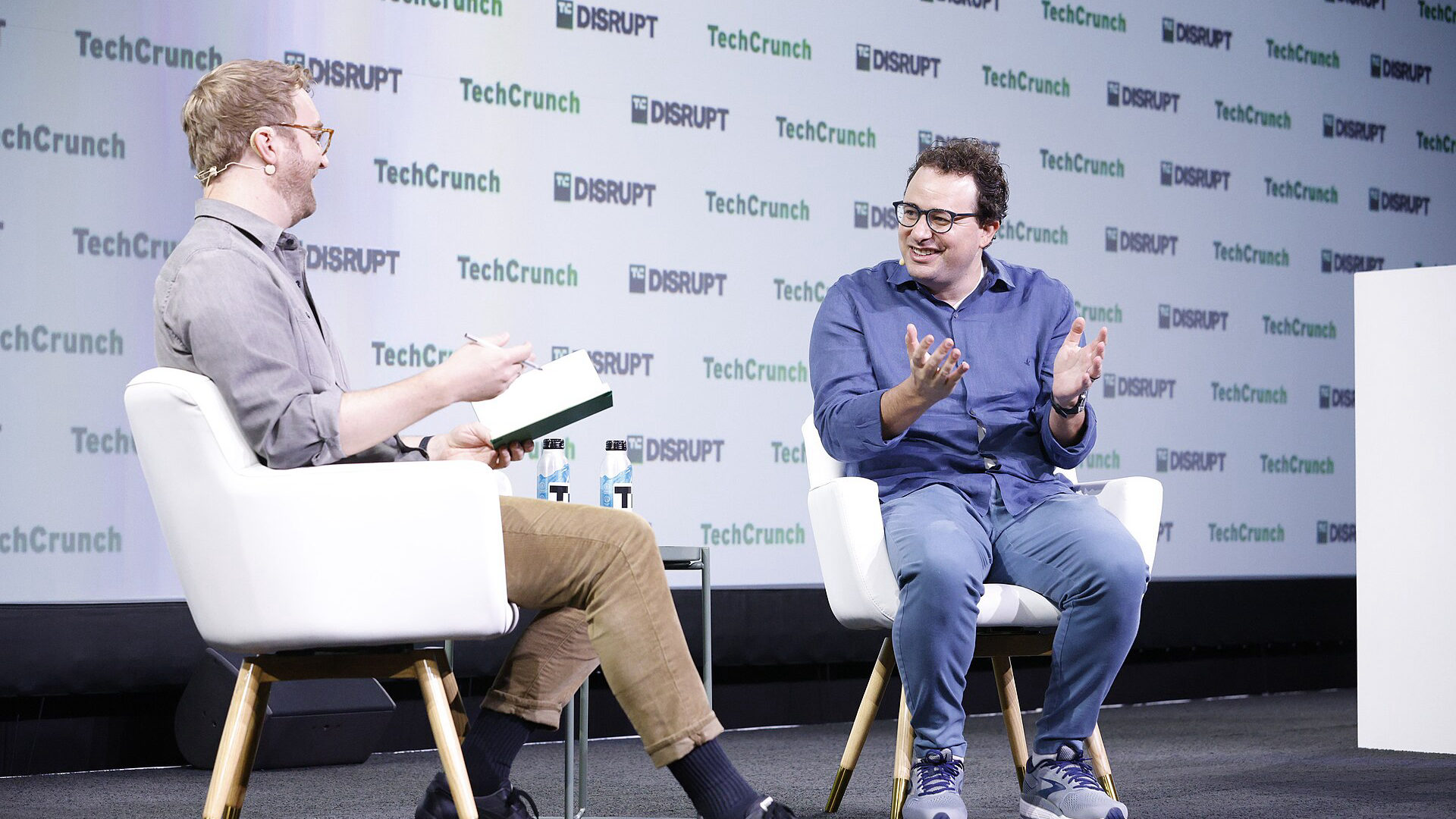
Photo: Dario Amodei, Anthropic's chief executive, at TechCrunch Disrupt 2023. Photo: TechCrunch, CC BY 2.0 (Wikimedia Commons).
In January 2021 a group of researchers left OpenAI to start a company whose stated purpose was to make AI development safer. Five and a half years later that company is valued at $965 billion, reports an annualised revenue of $65 billion, and has just watched one of its own researchers resign in public with the words "gambling with our lives". This is the record in between — assembled the way we assemble everything on this site, with a date and a source on every claim, and with the gaps marked.
1. The founding (2021)
Anthropic was founded on 26 January 2021 by Dario Amodei — previously Vice President of Research at OpenAI — together with Daniela Amodei, Jared Kaplan, Jack Clark, Chris Olah, Ben Mann, Sam McCandlish and Tom Brown. That date and list come from the Wikipedia entry; we did not find a primary Anthropic page that states the founding day, so treat the exact date as secondary-sourced.
What the primary record does show is the structure. Anthropic was set up as a public-benefit corporation, and its Series A documents in 2021 already contained a "Long-Term Benefit Committee" — the precursor of the Long-Term Benefit Trust formally announced on 19 September 2023. The company's own explanation of that trust is worth quoting because it states the founding thesis in one sentence: the trust "can ensure that the organizational leadership is incentivized to carefully evaluate future models for catastrophic risks or ensure they have nation-state level security, rather than prioritizing being the first to market above all other objectives."
Whether that mechanism works is the question the rest of this article keeps returning to.
2. The money (2021–2026)
The funding history is unusually well documented because Anthropic publishes most of its own rounds. Where it does not, we say so.
| Date | Round | Amount | Valuation | Source |
|---|---|---|---|---|
| May 2021 | Seed/early | $124M | — | secondary (Wikipedia) — not confirmed on anthropic.com |
| 29 Apr 2022 | Series B | $580M | — | anthropic.com |
| 25 Sep 2023 | Amazon | up to $4B ($1.25B first) | — | TechCrunch |
| 27 Oct 2023 | $2B ($500M + $1.5B) | — | Bloomberg / Forbes | |
| Nov 2024 | Amazon | further $4B (up to $8B total) | — | NBC News |
| Mar 2025 | Series E | $3.5B | $61.5B | secondary only — not confirmed on anthropic.com |
| Sep 2025 | Series F | $13B | $183B | secondary only — not confirmed on anthropic.com |
| 12 Feb 2026 | Series G | $30B | $380B post-money | anthropic.com (GIC, Coatue lead) |
| 28 May 2026 | Series H | $65B | $965B post-money | anthropic.com (Altimeter, Dragoneer, Greenoaks, Sequoia lead) |
The Series A, C and D amounts are not on the record we could reach in this round of research; we have left them out rather than guess.
Two revenue figures frame the last six months. On about 22 May 2026 the company said its annualised revenue was around $47 billion. On 17 August 2026 Bloomberg and CNBC reported that Anthropic had told investors the July run-rate had reached $65 billion, "ahead of IPO". A CNBC report from 29 April 2026 said the company had discussed a $900 billion valuation before the round closed at $965 billion. The company's chief financial officer, Krishna Rao, put the commercial case this way in the Series H announcement: "Claude is increasingly indispensable to our growing global community of customers."
For readers who follow our Market Observation data: no Anthropic security trades publicly as of this writing, so none of these figures are market prices. They are private-round marks and company-reported run-rates, and should be read as such.
3. The models
The product line is easy to list and hard to source. Every model date below except Claude 4, Claude Opus 5 and the Fable/Mythos 5 announcement comes from aggregator timelines rather than from the individual anthropic.com launch posts, which we did not open one by one. We give them as reported.
Claude 1 arrived in March 2023, Claude 2 in July 2023 and Claude 2.1 (with a 200,000-token context window) in November 2023. The Claude 3 family — Haiku, Sonnet, Opus — followed in March 2024, with Claude 3.5 Sonnet in June 2024 and an updated 3.5 line in October 2024. Claude 3.7 Sonnet, described as a hybrid reasoning model, came in February 2025.
From here the primary sources take over. Claude Opus 4 and Sonnet 4 launched on 22 May 2025 (the Claude 4 system card is on anthropic.com). Point releases followed at a pace the aggregators record as roughly every one to three months: Opus 4.1 (August 2025), Sonnet 4.5 (September), Haiku 4.5 (October), Opus 4.5 (November), Opus 4.6 (February 2026), Sonnet 4.6 (February), Opus 4.7 (April), Opus 4.8 (May).
On 9 June 2026 Anthropic announced two models at once: Claude Fable 5, generally available, and Claude Mythos 5, restricted to partners in what the company calls "Project Glasswing". The announcement states: "Fable 5's capabilities exceed those of any model we've ever made generally available." The published API price was $10 per million input tokens and $50 per million output tokens. Claude Sonnet 5 followed on 30 June and Claude Opus 5 on 24 July 2026 (Axios). Reports of a "Mythos" model had circulated since late March 2026, but those reports are secondary and we have not confirmed them against a primary source.
4. The safety policy — and what it says about itself
Anthropic's Responsible Scaling Policy is the document that is supposed to make the founding thesis operational. Version 2.1 took effect on 31 March 2025; version 3.0, described as a full rewrite, took effect on 24 February 2026. We read the v3.0 PDF. One sentence in it does a lot of work: "The overall level of catastrophic risk from AI depends on the actions of multiple AI developers, not just one."
That sentence is honest, and it is also the crux of the argument Jacob Coxon made when he resigned in September (see our companion article). A policy that conditions safety on what competitors do is a policy that accepts the race as given. Supporters read it as realism; critics read it as an admission.
5. Government, war and the line the company drew
On 26 February 2026 Dario Amodei published a statement about negotiations with the US Department of War (the renamed Department of Defense). It is one of the few places where the company has drawn a public red line, and the wording is precise:
"I believe deeply in the existential importance of using AI to defend the United States and other democracies."
"Mass domestic surveillance is incompatible with democratic values."
"Today, frontier AI systems are simply not reliable enough to power fully autonomous weapons."
"These threats do not change our position: we cannot in good conscience accede to their request."
What the "request" and the "threats" were is described in the statement itself; we will not paraphrase it beyond the quotes. A Wikipedia summary additionally claims that Claude models were used in a 2026 conflict involving Iran and in an intervention in Venezuela. We found no primary or reputable secondary source for that claim in this round of research, so we flag it as unverified and do not repeat it as fact.
In Europe, the enforcement powers of the EU AI Act took effect on 3 August 2026 (CNBC). Within ten days Anthropic began watermarking Claude's output worldwide to satisfy the Act's Article 50 transparency rules (Euronews, The Next Web) — a compliance decision delivered globally rather than only in the EU. Our own compliance position, as an education and market-information company under MiCA Article 3, is set out on the regulatory page.
A month later, on 3 September 2026, Senator Bernie Sanders and Representative Greg Casar announced the "Ban Artificial Superintelligence Act". Casar's line in the press release: "Congress should immediately ban AI systems too powerful to control."
6. The departures
Two resignations in 2026 bracket the year. On 9 February, Mrinank Sharma, head of the Safeguards Research team, resigned; the British Institute for Safety and Innovation summarised his stated reason as "difficulties in letting his values govern his personal and organisational decisions", and press reports quoted him saying "the world is in peril". His original post could not be read directly.
On 8–9 September, Jacob Coxon — a pretraining researcher who had joined from OpenAI in 2026 — resigned and left the industry, writing that both companies are "racing straight to self-improving superintelligence and gambling with our lives". Evan Hubinger, Anthropic's Alignment Science lead, replied publicly that he personally puts the risk of AI killing all humans at "greater than ten percent within the next decade" and that the company does "not yet have a plan to solve alignment for superintelligence". No corporate statement had been issued at the time of writing.
A settlement is also part of the record: secondary sources report a $1.5 billion agreement in September 2025 over copyrighted books used in training. We did not read the court filing, so the figure is reported, not verified.
7. What the record adds up to
Read the five years in one line and the pattern is stark. The company that was founded to slow the race down became one of its two fastest runners. Each of the founding commitments — the benefit trust, the scaling policy, the red line on surveillance and autonomous weapons — is real and documented. So is the $965 billion valuation, the $65 billion run-rate and the model cadence of a new frontier release roughly every quarter.
Nothing in the primary record says the two halves are incompatible. Nothing in it says they are compatible either. What the record does contain, as of September 2026, is a senior alignment lead saying in public that the plan for the hardest case does not yet exist. For a company whose founding document promised to prioritise catastrophic-risk evaluation over "being the first to market", that is the fact a reader should carry away — not as a verdict, but as the open item on the file.
We will keep this timeline updated as primary sources appear. If you would like the method behind it — how one person and four AI systems check each other's work before anything is published — it is described on our Uncle Sunny Academy page and in The Analyst Room.
Sources: anthropic.com (Series B announcement, 29 Apr 2022; Long-Term Benefit Trust, 19 Sep 2023; Series G, 12 Feb 2026; Series H, 28 May 2026; Responsible Scaling Policy v3.0, 24 Feb 2026; Statement on the Department of War, 26 Feb 2026; Claude Fable 5 / Mythos 5, 9 Jun 2026; Claude 4 system card); TechCrunch (25 Sep 2023); Bloomberg (27 Oct 2023; 17 Aug 2026); Forbes (31 Oct 2023); NBC News (Nov 2024); CNBC (29 Apr 2026; 3 Aug 2026; 17 Aug 2026); Axios (24 Jul 2026); Euronews (11 Aug 2026); The Next Web; BISI report on Mrinank Sharma; Newsweek (9 Sep 2026); TechCrunch (9 Sep 2026); sanders.senate.gov (3 Sep 2026); Wikipedia (founding date, seed round, settlement — secondary). Model release dates for Claude 1–3.7 and 2025–26 point releases are from aggregator timelines and are marked as such.
Educational content. Not investment advice.
Continue on DAI
Explore Topics
Written by
DAI Research Desk
Content creator and writer sharing insights and stories.